Celtic Legends Irish & Norse · comparative
The Wolf in Irish and Norse Tradition
Two traditions, not one: the Irish wolf (mac tíre, the Ossory werewolves of Gerald of Wales, c.1188) kept distinct from the Norse (Fenrir, Odin’s Geri and Freki, the úlfheðnar).
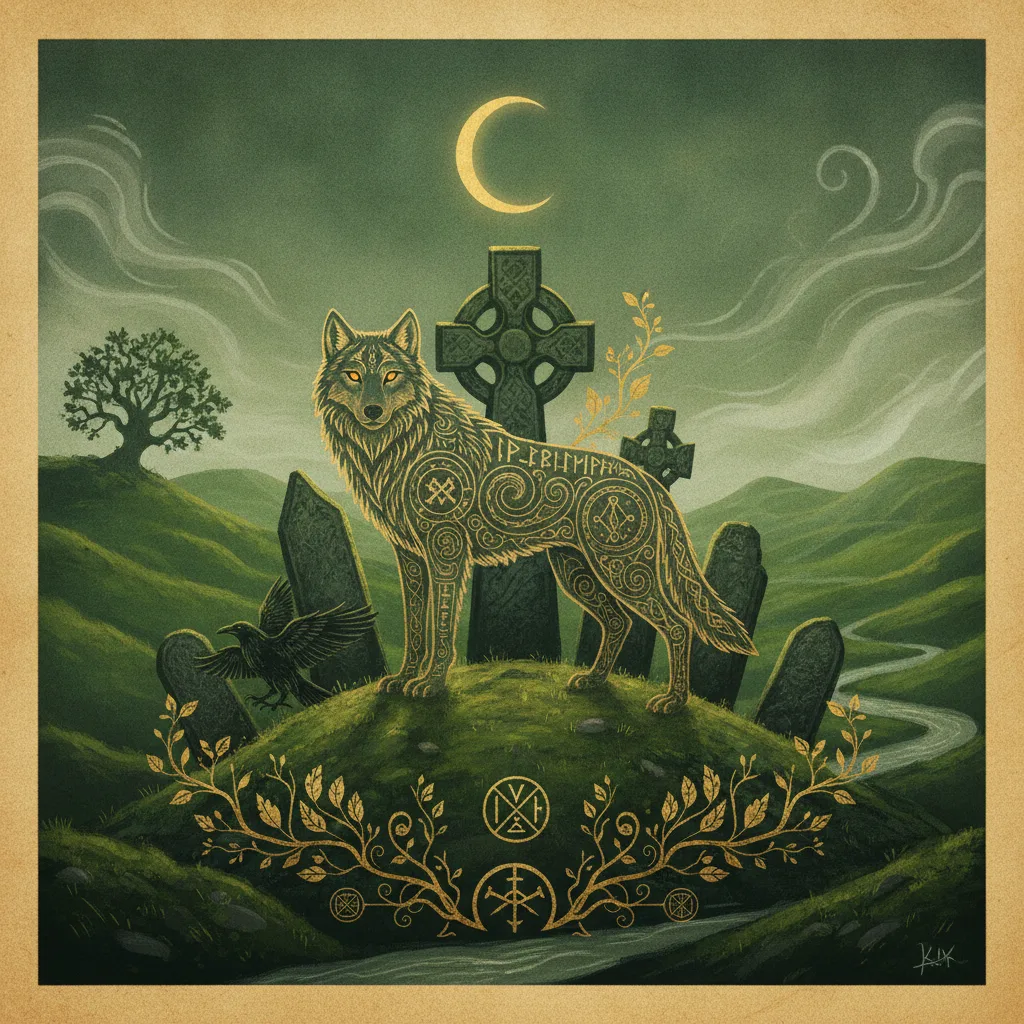
The wolf runs through two separate traditions that 'Celtic' blurs into one. In Irish lore it is mac tíre, 'son of the land,' and the gentle Ossory werewolves recorded by Gerald of Wales around 1188. In Norse myth it is the bound Fenrir and Odin's wolves Geri and Freki, told in the Eddas around 1220. They belong to unrelated literatures.
- Irish and Norse wolf-lore are separate traditions; 'Celtic' is not one single mythology.
- In Irish, the wolf is mac tíre ('son of the land'); the wolf-hound line is deliberately thin.
- The Ossory werewolves - gentle, Christian - come from Gerald of Wales's Topographia Hibernica (c.1188).
- Norse wolves include the bound Fenrir and Odin's Geri and Freki, told in the Eddas (c.1220).
- Ireland's last wild wolf was killed around 1786; wolf 'totem' packages are modern inventions.
| Tradition | Irish and Norse (two separate traditions) |
| Type | creature / theme |
| Earliest attestation | Irish werewolves: Topographia Hibernica, c.1188; Norse Fenrir: Prose Edda, c.1220 and Poetic Edda (Codex Regius, c.1270) |
| Associated places | Ossory (Kilkenny/Laois); Ireland generally; Norse cosmos |
| Associated symbols | wolfskin, fetter (Gleipnir), the hound/wolf boundary |
This site is named for a wolf, and for the world of the sidhe — the otherworld folk of Ireland. So it is worth beginning where the name begins: with the wolf as it actually appears in two distinct bodies of story that modern readers tend to blur into one word, “Celtic.” They are not one tradition. The wolves of medieval Ireland and the wolves of medieval Iceland were written down by different people, in different languages, for different reasons, and they mean different things. Kept properly, they should be kept apart.
The wolf in Irish tradition
Ireland had real wolves long after Britain and much of Europe had lost theirs. They lived in the record not only as animals but as a whole vocabulary. The everyday Irish word is mac tíre, literally “son of the land” — a phrase that treats the wolf less as a monster than as something native, belonging. Older and more poetic terms sit beside it: faol (and faolchú), and cú allaidh, “wild hound.” That last one matters, because in Irish the line between wolf and hound is deliberately thin, and it runs straight through the heroic literature.
The wolf also left its tracks across the map. Placenames still carry it — Feltrim in County Dublin preserves Faeldruim, “wolf ridge”; Knockaunvicteera in Clare is the “little hill of the wolf”; Isknamacteera in Kerry is the “water of the wolves.” These are not literary flourishes. They are what people called the places they lived, because wolves lived there too.
The werewolves of Ossory
The single most famous Irish wolf story was not written by an Irishman. It comes from Gerald of Wales (Giraldus Cambrensis), a Cambro-Norman cleric who travelled to Ireland and compiled the Topographia Hibernica (“Topography of Ireland”) around 1188. In it he reports a marvel from the diocese of Ossory (in what is now Kilkenny and Laois). A priest travelling through a wood meets a wolf that speaks. The wolf explains that he and his companion are humans of Ossory, cursed to take wolf-shape for seven years at a time; the curse is attributed to an abbot-saint, given in the text as Natalis. The wolf begs the priest to give the last rites to his dying she-wolf mate, and — to prove she is human beneath the pelt — peels back her wolfskin with his claw to show the old woman inside.
It is a genuinely strange, genuinely medieval tale: half folklore, half theological argument about whether a soul keeps its nature under an animal’s body. What it is not is a horror story. The Ossory wolves are rational, Christian, pitiable — closer to enchanted people than to predators. Later Irish folklore knows a word, faoladh, for this benign shapeshifter type, and it is worth stressing that this gentle, guardian-like werewolf is quite unlike the ravening loup-garou of continental Europe. When you read the Ossory account, remember its frame: Gerald was a foreign churchman with his own agenda about the Irish, and the tale reaches us through his pen, not through native Irish manuscript tradition.
What happened to the real wolves
The lore outlived the animal. Under English administration in the seventeenth century wolves were hunted to destruction — the Cromwellian government of the 1650s paid bounties for wolf-heads, and Ireland was briefly nicknamed “Wolfland.” The last wild wolf in Ireland is generally said to have been killed in 1786, on Mount Leinster in County Carlow. So the wolf on this masthead is, in the plainest sense, a ghost: an animal Ireland has not had for over two centuries, kept alive only in words.
The wolf in Norse tradition — a separate world
The wolves most readers picture — the bound beast, the twin companions of a one-eyed god, the wolf-skinned warriors — are Norse, not Irish, and they come from a different set of books entirely. Setting them next to the Irish material is not to merge the two; it is to show how differently two neighbouring cultures imagined the same animal.
Fenrir
The great wolf Fenrir (Fenrisúlfr) is a child of the god Loki, bound by the gods with the magical fetter Gleipnir. Only the god Týr is brave enough to put his hand in the wolf’s mouth as a pledge of good faith while it is chained; when the trick is revealed, Fenrir bites the hand off. At Ragnarök, the doom of the gods, Fenrir breaks free and swallows Odin. This is told most fully in the Prose Edda of the Icelander Snorri Sturluson (composed around 1220), in the section called Gylfaginning, and it is foreshadowed in the older poem Völuspá, preserved in the Poetic Edda (the Codex Regius manuscript, written down in the 1270s from earlier oral tradition).
Geri and Freki
Not every Norse wolf is a monster. Odin keeps two wolves, Geri and Freki (“the greedy one” and “the ravenous one”), at his side, feeding them all the meat from his table while he himself takes only wine. They are named in the Poetic Edda poem Grímnismál, and Snorri quotes that same stanza in Gylfaginning. Here the wolf is retinue, not enemy — a companion of the god of war, poetry and the dead.
The úlfheðnar
Finally there are the úlfheðnar (“wolf-coats”), warriors said to fight in a wolf-skinned frenzy, kin to the better-known berserkir (“bear-shirts”). The earliest surviving reference is in Haraldskvæði (also called Hrafnsmál), a skaldic poem attributed to Þórbjörn Hornklofi in the late ninth century, praising King Harald Fairhair; wolf-warriors also appear in the later Icelandic family sagas such as Vatnsdæla saga and Grettis saga. Whether real cult, literary motif, or both is debated — but the wolf here is a way of becoming something other than human in battle, which is the exact opposite of the Ossory wolf who is desperate to be recognised as human still.
What the sources actually say — and what circulates
A great deal of what gets posted online as “ancient Celtic wolf lore” is neither ancient nor securely Celtic. Two cautions in particular:
- “Celtic” is not a single mythology. Irish wolf-lore and Norse wolf-lore belong to unrelated language families and separate literatures. Blending Fenrir with the Ossory werewolves — or filing both under “Celtic” — is a modern habit, not a medieval one.
- The neat “wolf totem” packages that circulate on social media (fixed lists of symbolic meanings, invented “Celtic zodiac” wolf signs, and the like) are twentieth- and twenty-first-century inventions. They can be perfectly good personal symbolism; they are not attested in the medieval texts, and we should not pretend they are.
The wolf in modern art, fiction and games
Both wolves have thrived in the modern imagination. Fenrir is a recurring figure in video games and fantasy — appearing, for instance, as a major character in God of War Ragnarök and across the Final Fantasy and Shin Megami Tensei series — and Geri and Freki turn up wherever Odin does. The Irish wolf has had a quieter but real modern life: in the campaign to rewild and re-imagine Ireland’s lost predator, and in the shapeshifting faoladh that surfaces in contemporary Irish fantasy and horror. This site takes its name from that quieter tradition — the wolf as “son of the land,” and the sidhe-haunted country it once ran through.
How this site handles sources
This entry sets the standard for everything else here. Where we can name the manuscript a story first survives in, we do. Where a date, a translator, or an attribution is contested, we say so rather than smoothing it over. And we keep the medieval attestation strictly separate from the Victorian Celtic-Twilight revival and the modern neopagan reception — two later layers we will always flag, and date, on their own terms. Old stories, kept properly.
| Tradition | Irish and Norse, kept distinct |
| Earliest text | Irish: Topographia Hibernica (Gerald of Wales), c.1188; Norse: Prose Edda (Snorri Sturluson), c.1220 |
| Also appears | Poetic Edda / Codex Regius (c.1270): Völuspá, Grímnismál; skaldic Haraldskvæði (late 9th c.); Vatnsdæla & Grettis sagas |
| Later additions | Modern ‘Celtic wolf totem’ / ‘Celtic zodiac’ material is 20th–21st c. invention, not medieval |
| Translation | O’Meara, The History and Topography of Ireland (Penguin, 1982); Faulkes, Edda (1987); Larrington, The Poetic Edda (Oxford, 1996) |
| Reviewed | 2026-08 |
Frequently asked questions
Are Irish and Norse wolf myths the same tradition?
No. They come from unrelated languages and separate literatures. Irish wolf-lore (mac tíre, the Ossory werewolves) and Norse wolf-lore (Fenrir, Geri and Freki, the úlfheðnar) should be kept apart; blending them under ‘Celtic’ is a modern habit.
Who wrote the werewolves of Ossory story?
Gerald of Wales (Giraldus Cambrensis), a Cambro-Norman cleric, in his Topographia Hibernica of about 1188. It reaches us through a foreign churchman, not native Irish manuscript tradition.
What does mac tíre mean?
Literally ‘son of the land’ — a common Irish word for wolf. Older terms include faol, faolchú and cú allaidh (‘wild hound’).
When did wolves die out in Ireland?
The last wild Irish wolf is generally said to have been killed in 1786 on Mount Leinster, County Carlow, after intensive bounty-hunting from the 1650s onward.
Where does Fenrir come from?
Chiefly Snorri Sturluson’s Prose Edda (c.1220), in the Gylfaginning, with older references in the Poetic Edda (Codex Regius, c.1270). He is bound by the gods and, at Ragnarök, breaks free and swallows Odin.
Is the ‘Celtic wolf totem’ meaning ancient?
No. Fixed symbolic ‘wolf totem’ lists and ‘Celtic zodiac’ signs are modern inventions. They can be meaningful personal symbolism but are not found in the medieval sources.
