Folklore in illustration: from Arthur Rackham to now
A tour of folklore illustration from Arthur Rackham and Kay Nielsen to Alan Lee, Charles Vess and Jackie Morris: real artists, real books, real debts.
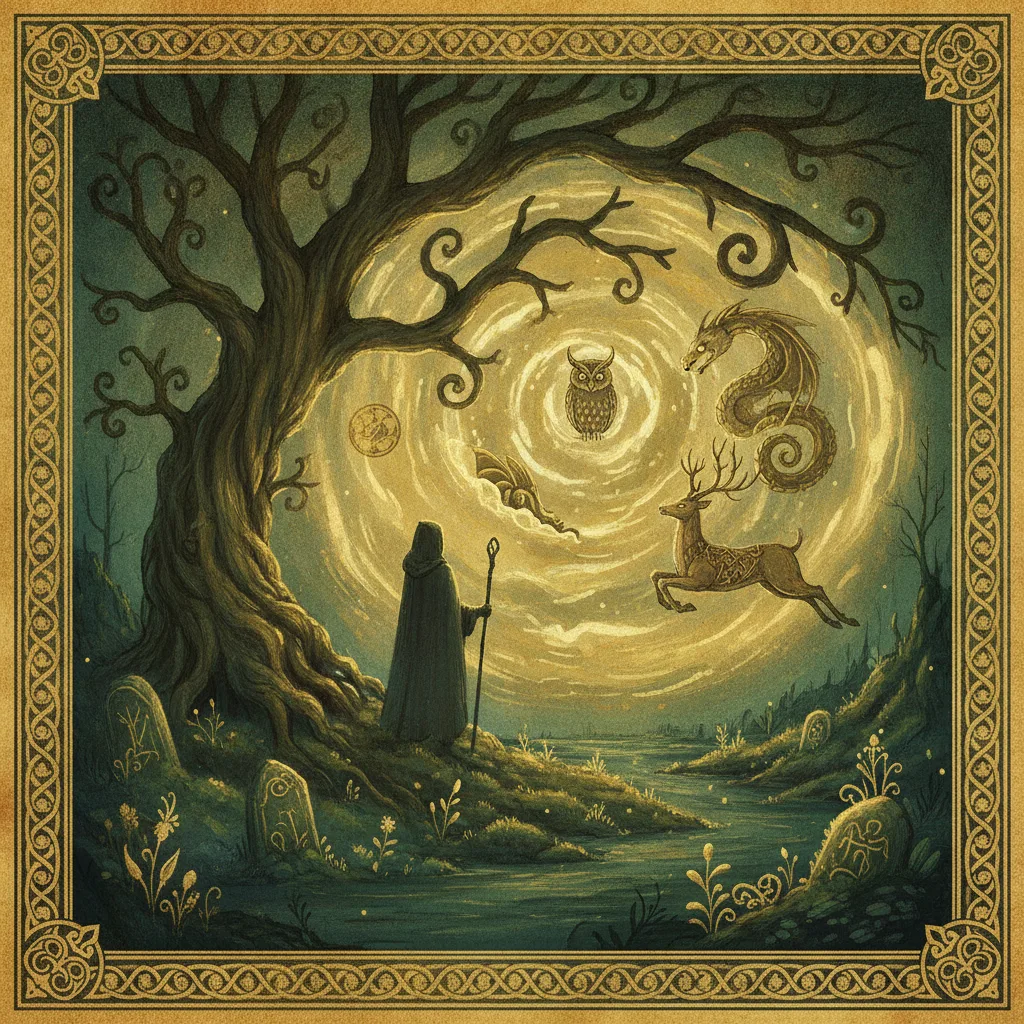
A tour of folklore illustration's lineage, from the Golden Age around 1900, Rackham, Dulac and Nielsen, plus Bauer and Bilibin abroad, through the field-guide turn of Lee and Froud's Faeries (1978), to working artists like Vess, Morris and Lynch. Notice how each drew trees, weather, ornament and whether fairies are pretty, and that the best read their sources.
- The Golden Age (around 1900): Rackham, Dulac and Nielsen.
- Bauer and Bilibin gave Nordic and Russian folklore their look.
- Lee and Froud's Faeries (1978) reset fairies as uncanny.
- Working now: Charles Vess, Jackie Morris and P. J. Lynch.
- The best illustrators read their sources; the interesting resist prettiness.
Long before folklore was a Pinterest aesthetic, it was a working brief for illustrators — a set of stories that had to be given faces, forests and weather. The pictures those artists made have shaped how most of us imagine a fairy, a troll or an enchanted wood far more than any single text has. This is a short, honest tour of that lineage, from the Golden Age of book illustration to the artists carrying it now, with real names, real books and what each one actually contributed.
The Golden Age
The roughly thirty years around 1900, made possible by new colour-printing techniques, are usually called the Golden Age of illustration. Three names anchor it.
Arthur Rackham (1867–1939)
The Englishman who, for many readers, simply is what fairy tales look like. Rackham’s world is all sinuous line, muted washes, and trees with faces and clutching fingers; his people are gnarled or wild-haired, his fairies genuinely uncanny rather than sweet. His editions of Grimm, Rip Van Winkle, Peter Pan in Kensington Gardens and A Midsummer Night’s Dream set a template still visible everywhere. If folklore illustration has a founding grammar, much of it is his.
Edmund Dulac (1882–1953)
A French-born artist who settled in Britain, Dulac brought a different palette — jewel-bright, influenced by Persian miniatures and Japanese prints. Where Rackham is woody and northern, Dulac is often warm and orientalist in the period sense, at his best in The Arabian Nights and Andersen. The two were friendly rivals, and the contrast between them still maps two poles of the tradition: the shadowy and the sumptuous.
Kay Nielsen (1886–1957)
A Dane whose spare, elongated, boldly designed plates for the Norwegian folk-tale collection East of the Sun and West of the Moon are among the most striking images in the whole field. Nielsen later worked, unhappily and mostly uncredited, in Hollywood animation. His folk-tale work is essential viewing for anyone interested in how far stylisation can go while still serving a story.
Beyond the English shelf
The tradition was never only Anglo-French. John Bauer (1882–1918), the Swedish painter of Bland tomtar och troll (“Among Gnomes and Trolls”), gave the Nordic forest its definitive look: mossy, misty, populated by lumpen, sorrowful trolls and small brave princesses. Ivan Bilibin (1876–1942) did the equivalent for Russian folklore, with strong black outlines, folk-ornament borders and flattened, decorative colour drawn from traditional Russian design. Both are reminders that “folklore illustration” has many national dialects, each rooted in its own material culture.
The bridge: mythic art and the field-guide impulse
The single most influential modern book in this vein is Faeries (1978), created jointly by Alan Lee and Brian Froud. Framed as a naturalist’s field guide to the faerie world, it treated folklore as if it were zoology — habitats, behaviours, taxonomy — and its earthy, un-cute vision of fairies as strange, sometimes menacing creatures reset the visual vocabulary for a generation. Froud went on to design the creatures for Jim Henson’s films The Dark Crystal and Labyrinth, carrying folk-monster design onto the screen.
Alan Lee, meanwhile, illustrated a landmark edition of The Mabinogion in 1982 — watercolours that let the Welsh tales breathe in mist and stone — before becoming, with John Howe, the defining visual interpreter of Tolkien and a conceptual artist on Peter Jackson’s films. His folklore work and his Middle-earth work share the same rain-soaked, deeply British sense of landscape as a living presence.
Working now
Charles Vess
The American artist whose lush, botanical line owes an open debt to Rackham. Vess collaborated with Neil Gaiman on the illustrated Stardust (first published as a graphic novel in 1997) and later produced more than fifty illustrations for the complete Books of Earthsea (2018), realising Ursula K. Le Guin’s world with her close involvement. He is proof that the Golden-Age tradition is a living craft, not a museum piece.
Jackie Morris
A painter of luminous watercolours, often of animals and the numinous edges of the natural world. Morris illustrated The Lost Words (2017), her collaboration with the writer Robert Macfarlane conceived as a “spell book” to reclaim disappearing nature words, and won the CILIP Kate Greenaway Medal for it in 2019. Her work sits at the meeting point of folklore, natural history and quiet activism.
P. J. Lynch
The Irish illustrator whose rich, painterly realism has twice won the Kate Greenaway Medal (in 1995 and 1997), and who has served as Laureate na nÓg, Ireland’s children’s laureate. Lynch shows how the classic illustrated-storybook tradition — full-bleed painted scenes, real emotional weight — continues at the highest level.
A word on the illustrators who framed the canon
Two more names belong in any honest account. Warwick Goble (1862–1943) brought a watercolour delicacy to folk and fairy tales from around the world, including Japanese and Indian collections, widening the tradition beyond Europe. And H. J. Ford (1860–1941) illustrated Andrew Lang’s hugely popular “coloured” Fairy Books — the Blue, Red, Green and the rest — which for millions of Victorian and Edwardian children were the first place these stories were ever seen. Ford’s images are less celebrated than Rackham’s today, but their reach in shaping the popular idea of “a fairy tale” was enormous.
How to look at folklore illustration
A few things reward attention as you browse these artists:
- How they draw trees and weather. In this tradition landscape is rarely just background; Rackham’s grasping branches and Bauer’s smothering moss are doing narrative work.
- Whether the fairies are pretty. The more interesting artists — Froud, Lee, Rackham at full strength — resist prettiness. Uncanniness is closer to what the folklore itself believed.
- The border and the ornament. Bilibin and the Arts-and-Crafts illustrators treat the frame as part of the meaning, drawing on real folk decoration rather than generic scrollwork.
- Where the source came from. The best of these artists read their material. Nielsen’s Norway, Bauer’s Sweden and Lee’s Wales look specific because they are.
If you want to go deeper, seek out the writer and editor Terri Windling, whose “mythic arts” advocacy has done a great deal to connect these older masters with the contemporary artists working in their wake — and whose reading lists are a reliable next step.
Frequently asked questions
Who was the most famous fairy-tale illustrator?
Arthur Rackham (1867-1939) is the best known, celebrated for his sinuous line and uncanny fairies in editions of Grimm, Peter Pan and A Midsummer Night's Dream. He effectively set the visual template for the genre.
Who illustrated the book Faeries?
Faeries (1978) was created jointly by Alan Lee and Brian Froud. Framed as a field guide to the faerie world, it reset the modern visual vocabulary for fairies as strange rather than sweet.
Which illustrator worked on the Mabinogion and Tolkien?
Alan Lee. He illustrated a landmark edition of the Mabinogion in 1982 and later became a defining visual interpreter of Tolkien, working as a conceptual artist on Peter Jackson's films.
Are there modern folklore illustrators worth following?
Yes. Charles Vess (Stardust, The Books of Earthsea), Jackie Morris (The Lost Words, Kate Greenaway Medal 2019) and Ireland's P. J. Lynch, a two-time Greenaway winner, all continue the tradition at a high level.
