Myth & Folklore Irish
The Banshee (bean sídhe): the death-messenger and her regional forms
The banshee is the Irish "woman of the fairy mound" whose keen foretells a family death — a messenger, never a killer — with regional forms like the badhbh and a distinct Scottish cousin, the bean nighe.
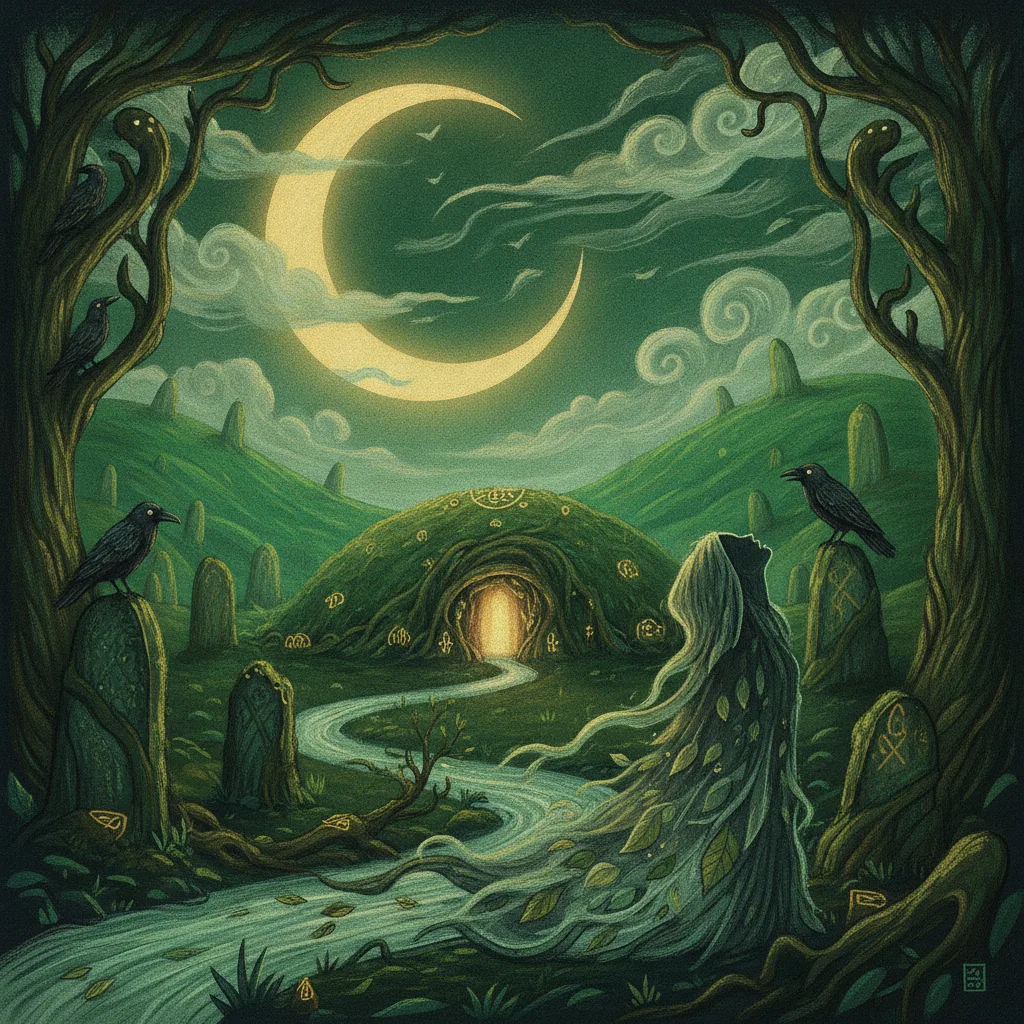
The banshee (Irish bean sídhe, "woman of the fairy mound") is the death-messenger of Irish tradition: a fairy woman whose keening wail foretells a death in certain old Gaelic families. She neither causes nor brings death but announces it, and she is heard far more often than she is ever seen.
- Irish woman of the fairy mound whose keen foretells a death in old Ó and Mac families.
- The supernatural double of the bean chaointe, the human keening-woman at Irish wakes.
- Primarily an auditory belief; her varied looks (maiden, matron, hag) were added later.
- Regional names include the badhbh in the south-east; Scotland's bean nighe is a distinct washer-figure.
- Definitive study is Patricia Lysaght's 1986 work; the pop-culture deadly scream inverts her.
| Tradition | Irish (Scottish Gaelic cousin: bean nighe) |
| Type | Supernatural death-messenger / keening woman |
| Earliest attestation | Medieval Irish concept of the bean sídhe; in print from Croker (1825) |
| Associated places | Outside the family home at night; fords and streams (bean nighe) |
| Associated symbols | Keening/lament, a comb, long hair, the crow (badhbh) |
The sound comes at night, from outside the house — a keening, a wailing, a woman’s voice raised in grief for someone not yet dead. In Irish tradition this is the cry of the bean sídhe, the “woman of the fairy mound,” anglicised as banshee. She is not the bringer of death and not its cause. She is its messenger: her lament announces that a death has been decided, and that a particular family will soon have a wake to hold.
The woman who cries for a family
The classic banshee belief is intimate and specific. She does not wail for everyone. She is attached to certain old Irish families — traditionally those with names beginning in Ó or Mac, the families “of the blood” — and she keens for their dead alone, wherever in the world they may be. Emigrants told of hearing her in America or Australia on the night a relative died back in Ireland. She is heard far more often than she is seen, but where she is described she takes one of a few recurring forms: a young and beautiful woman, a stately matron, or a hideous hag, often with long streaming hair which she combs — a detail that gave rise to a superstition against picking up a stray comb, lest it be hers.
She belongs to the tradition of the bean chaointe, the keening-woman who led the lament at Irish wakes. The banshee is that figure lifted into the Otherworld.
Keening and the human original
To understand the banshee you have to understand keening (Irish caoineadh), the formal, improvised vocal lament performed — almost always by women — over the body at an Irish wake. Professional or semi-professional keening-women were a real institution in Ireland into the nineteenth century, and the Church spent centuries trying, largely in vain, to suppress the practice as unseemly. The banshee is, in effect, the supernatural double of the keening-woman: where the living mná caointe mourned after death, the fairy woman mourns before it. Her cry is a keen out of time.
How she was heard
Testimony collected across Ireland is strikingly consistent about the experience rather than the appearance. The cry is described as unlike any human or animal voice — a high, mournful keening that seems to move around the house, now at one gable, now at another, never quite locatable. It is heard most often at night, and frequently by several people at once, which was taken as proof it was no ordinary grief. Sometimes it is preceded by a clap at the window or the beating of wings. Dogs were said to fall silent or to cower. In the morning, or within a day or two, word would come of a death in the family, and the household would understand what they had heard.
Because she was heard so much more often than seen, the banshee’s “appearance” is really a patchwork of the rarer sightings: the beautiful woman, the grey-cloaked matron, the red-eyed hag worn out with weeping. What unites them is the hair and the act of lament — she is forever combing, forever crying. The variety in her looks is itself a clue that the banshee was primarily an auditory belief onto which visual details were later hung.
Regional forms and related figures
The name and the shape of the death-messenger vary by region and by tradition, and it is worth being precise about them rather than lumping them together:
- Bean sídhe — the standard Irish form, “woman of the fairy mound,” heard across most of Ireland.
- Badhbh (also badhb, bibe) — in parts of the south-east, especially the Leinster and east-Munster area, the messenger is called the badhbh or badhbh chaointe (“keening badhbh”). This name is significant: Badb is also the name of an ancient Irish war-goddess of the Mythological Cycle, associated with the crow or hooded crow and with prophesying slaughter. The overlap suggests a very old link between the death-messenger and a battlefield deity, though the two should not be simply equated.
- Bean chaointe — “keening woman,” used in some areas for the fairy mourner as well as the human one.
The Scottish cousin — and why she is not the same
In Scottish Gaelic tradition the nearest figure is the bean nighe, the “washer-woman” (also nigheag, “little washer”), and the related caoineag (“weeper”). The bean nighe is seen at a ford or stream at night, washing the bloodstained grave-clothes of those about to die. She is genuinely a different creature — a portent encountered by sight at the water’s edge, sometimes able to grant wishes to one who approaches her correctly — and she should not be flattened into “the Scottish banshee.” Both belong to a wider Gaelic pattern of the woman who foreknows death, but the Irish keener and the Scottish washer are distinct.
What the sources say, and when they say it
The banshee belief is old, but the printed record that shaped the modern image is not. The idea of a fairy woman attached to a family and crying before a death is bound up with the medieval concept of the bean sídhe, and early modern references appear from the seventeenth century onward. The figure entered the popular English-language canon with Thomas Crofton Croker’s Fairy Legends and Traditions of the South of Ireland (1825), which devoted one of its five sections to “The Banshee.” Lady Wilde’s Ancient Legends (1887) and Yeats’s Fairy and Folk Tales (1888) carried the belief further into print.
The definitive modern study is Patricia Lysaght’s The Banshee: The Irish Supernatural Death-Messenger (first published 1986), based on a large questionnaire survey conducted through the Irish Folklore Commission’s archives. Lysaght’s work is the reason we can speak with any confidence about the regional distribution of the names and forms — where the badhbh is said instead of the bean sídhe, how the appearance varies from district to district. If a source makes sweeping claims about “the” banshee, Lysaght is the corrective: the belief is regionally patterned, not uniform.
What is contested
Several popular claims deserve a warning label. The neat equation “banshee = the war-goddess Badb” is an inference from the shared name, not a documented identity; treat it as a suggestive link. The frequently repeated notion that only families of “pure” Milesian or Gaelic descent have a banshee is a tradition, not a fact, and its details vary by teller. And the visual cliché of the banshee as a shrieking, white-shrouded ghost owes as much to later gothic and cinematic imagery as to Irish belief, in which she is above all a voice.
From wake to screen
The banshee has had a busy afterlife. She recurs across twentieth- and twenty-first-century film, television, comics, games, and fantasy fiction, almost always reduced to a single trait — the deadly scream, weaponised as a “banshee wail.” This pop-culture banshee is an offensive supernatural monster; the folkloric one is nothing of the kind. She kills no one. She grieves. Stripping the mourning out of the banshee and keeping only the shriek inverts the original: a figure of sorrow and family loyalty turned into a hazard.
Something of the older meaning survives in the way Irish people still use the phrase — “the banshee was heard” — as a way of saying a death was foretold, and in the enduring association between her cry and the lost art of the keen. She is, in the end, the sound a family makes for its own dead, imagined as older than any living mouth. That is a more human thing than a monster, and a good deal sadder.
| Tradition | Irish |
| Earliest text | Medieval Irish tradition of the bean sídhe; early-modern references from the 17th c. |
| Also appears | As the badhbh / badhbh chaointe in the south-east; Scottish Gaelic bean nighe and caoineag are related but distinct |
| Later additions | Croker (1825), Lady Wilde (1887), Yeats (1888); the definitive modern study is Patricia Lysaght, 'The Banshee' (1986) |
| Translation | bean sídhe = 'woman of the fairy mound' |
| Reviewed | 2026-08 |
Frequently asked questions
Does the banshee cause death?
No. In Irish tradition she is a messenger, not a killer. Her keen announces that a death has already been decided for a particular family. Blaming the banshee for the death reverses the belief.
Who does the banshee cry for?
Traditionally for members of certain old Irish families, especially names beginning in Ó or Mac. She was said to follow the family line, so emigrants told of hearing her abroad on the night a relative died in Ireland.
What is the badhbh?
In parts of the south-east of Ireland the death-messenger is called the badhbh or badhbh chaointe rather than the bean sídhe. The name also belongs to an ancient Irish war-goddess linked to the crow, hinting at a very old connection — though the two are not simply the same figure.
Is the Scottish bean nighe the same as the banshee?
No. The Scottish Gaelic bean nighe ('washer-woman') is seen washing the grave-clothes of the doomed at a ford. Both foretell death, but the Irish banshee is heard keening near the home while the bean nighe is met by sight at the water.
Why the comb superstition?
The banshee is often pictured combing her long hair, so folk custom warned against picking up a stray comb, especially at night, in case it was hers and picking it up drew her attention.
Where does the 'screaming banshee' idea come from?
Mostly from gothic and screen fiction, which keeps the frightening wail and drops the grief. In folklore she is above all a voice of mourning — the supernatural double of the human keening-woman (bean chaointe).
