Celtic Legends Irish · Fenian Cycle
Oisín and Tír na nÓg: the Land of Youth
Niamh, the white horse over the sea, and the three hundred years: the great Irish Otherworld tale. The version everyone knows is Micheál Coimín's poem of c. 1750, dated here.
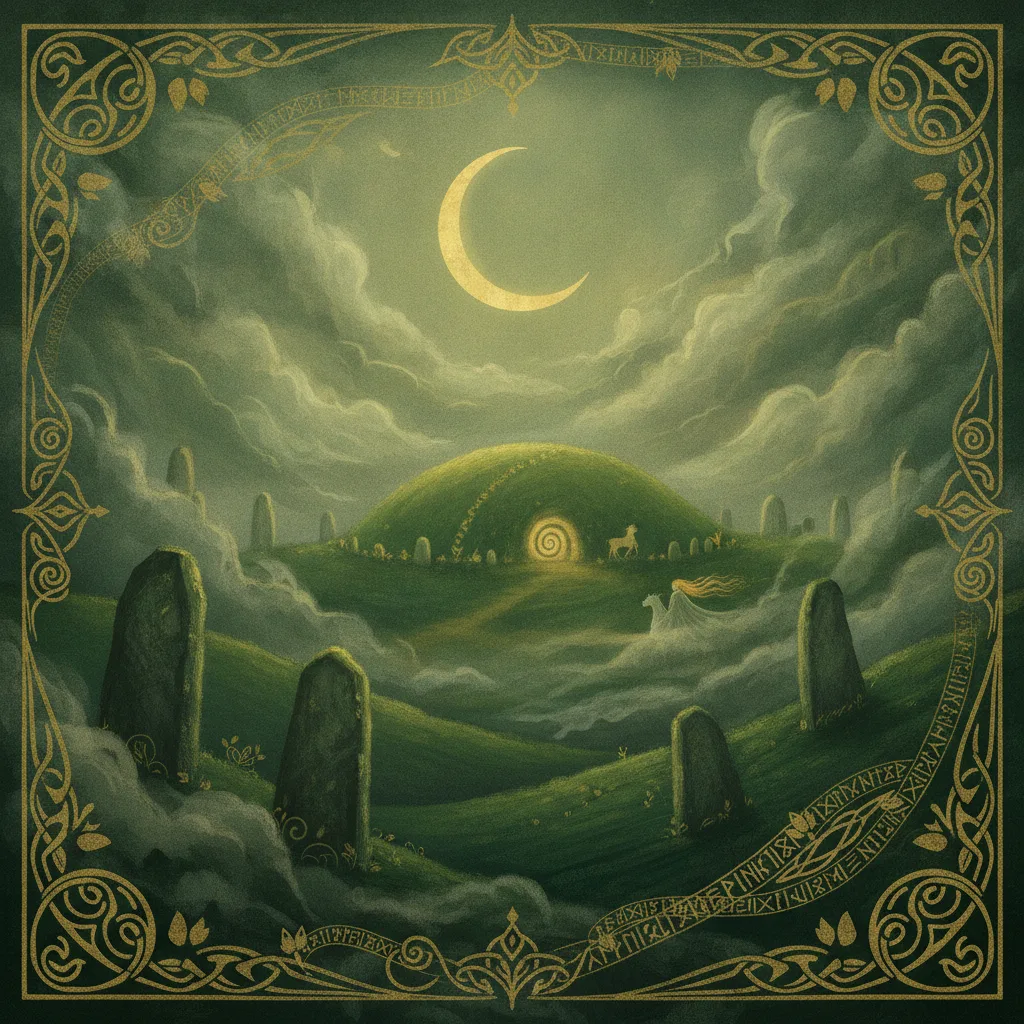
Oisín and Tír na nÓg is the Irish Otherworld story in which Niamh carries the poet Oisín to the ageless Land of Youth; on returning he finds three hundred years gone and instantly withers. The medieval Oisín is ancient, but the famous Niamh journey comes from Micheál Coimín's poem of about 1750, popularised by Yeats in 1889.
- Oisín and Tír na nÓg is the Irish Otherworld tale of Niamh, a horse over the sea, and lost centuries.
- Oisín, Fionn's poet-son, and his argument with St Patrick are genuinely medieval (Acallam na Senórach, c.1200).
- The famous Niamh/Tír na nÓg plot comes from Micheál Coimín's poem of about 1750.
- The Otherworld-time motif is older still, seen in Immram Brain (late 7th-early 8th century).
- Yeats's The Wanderings of Oisin (1889) carried the story to wider fame.
| Tradition | Irish (Fenian Cycle) |
| Type | Otherworld journey / hero-tale |
| Earliest attestation | Oisín is medieval (Acallam na Senórach, c. 1200); the Niamh / Tír na nÓg tale is from Coimín's Laoi Oisín ar Thír na nÓg (c. 1750) |
| Associated places | Tír na nÓg; Mag Mell; the western sea; Ireland after the Fianna |
| Associated symbols | Niamh of the Golden Hair, the white horse, the forbidden touch of the ground, sudden ageing |
A woman with golden hair rides out of the western sea on a white horse and calls a poet by name. She is Niamh, daughter of the king of the Land of the Young, and she has come for Oisín, son of Fionn. He mounts behind her, the horse runs over the waves, and they come to Tír na nÓg — the Land of Youth, where no one ages and no one grieves. He lives there in happiness for what feels like three years. When homesickness takes him and he rides back to see Ireland, three hundred years have passed; and when his foot touches Irish soil the years fall on him at once, and the young warrior becomes a withered old man. It is the great Irish story of the Otherworld and the terrible arithmetic of its time.
Who Oisín is, and what Tír na nÓg is
Oisín (“little deer,” “fawn”) is the son of Fionn mac Cumhaill and the finest poet of the Fianna, the central warrior-band of the Irish Fenian Cycle. Tír na nÓg — “the Land of the Young” — is one of the names for the Irish Otherworld, an ageless country over or under the sea, akin to Mag Mell (the Plain of Delights) and Emain Ablach. The tale belongs to the Irish tradition specifically, and it turns on a motif found across that tradition: mortal time and Otherworld time do not run at the same speed, and the crossing back is deadly.
The story the sources tell
Niamh Chinn Óir — “Niamh of the Golden Hair” — carries Oisín west across the sea, past marvels, to her father’s kingdom. There they marry and have children, and there is neither sickness nor age. But Oisín begins to long for his father and the Fianna, and Niamh, grieving, lends him the white horse for a visit home — on one condition: he must not let his feet touch the ground of Ireland. He returns to find the Fianna long dead, their forts in ruin, the old world gone and Christianity come. Stooping (in the usual telling) to help some men move a great stone, he slips from the saddle; the moment he touches the earth the horse bolts back to sea, and three centuries land on him in an instant. In many versions he lives on just long enough to meet St Patrick, to whom he tells, half in wonder and half in anger, the glory of the vanished Fianna.
The quarrel with St Patrick
The return is not only sad; in the older ballad tradition it is combative. The withered Oisín, last of the Fianna, falls into a long argument with St Patrick about the two worlds. Patrick presses the glory of Heaven and the torments of Hell; Oisín answers that he would rather be with Fionn and the hunt than in any Christian paradise, and refuses to believe a God who would leave the generous Fianna to damnation. These Oisín-and-Patrick dialogues — sometimes tender, often barbed and funny — are among the most human passages in Gaelic literature, and they frame the whole tale as a meeting between the old pagan Ireland and the new Christian one, each unwilling to yield to the other.
What the sources say vs. what circulates — the dating that matters
This is an entry where honest dating is the whole point, because the version everyone knows is much later than people assume.
- Oisín himself is medieval. As Fionn’s poet-son he is old in the tradition, and the framing device of an aged Oisín surviving to argue and reminisce with St Patrick is genuinely medieval — it is the structure of Acallam na Senórach (“The Colloquy of the Ancients,” c. 1200) and of a large body of Ossianic ballads (the laoithe Fiannaíochta) sung in Ireland and Gaelic Scotland for centuries.
- The famous Niamh / Tír na nÓg journey, as a single connected story, is eighteenth-century. The narrative most retellings follow — the golden-haired horsewoman, the white horse over the sea, the three hundred years, the fall and sudden ageing — comes from Laoi Oisín ar Thír na nÓg (“The Lay of Oisín in the Land of Youth”), composed around 1750 by the Clare poet Micheál Coimín (Michael Comyn, died 1760). It is a masterpiece of late Fenian verse — but it is a work of the Enlightenment era, not a relic of the Iron Age.
- Comyn built on older bones. His poem was almost certainly worked up from earlier oral and written Fenian material, and the Otherworld-time motif is unmistakably ancient: in the far older Immram Brain (late 7th–early 8th c.), Bran’s companion likewise crumbles to ash the instant he touches Irish soil after long years away. So the idea is deep; the beloved plot with Niamh’s name on it is Comyn’s shaping of it.
- Name the tradition. This is Irish, though it lives too in Gaelic Scotland’s Fenian balladry. It is not a generic “Celtic” tale.
Where it is written down
For the medieval Oisín, the key texts are Acallam na Senórach (c. 1200; translated by Ann Dooley and Harry Roe as Tales of the Elders of Ireland, 1999) and the corpus of Fenian ballads. For the Tír na nÓg tale specifically, the source is Micheál Coimín’s Laoi Oisín ar Thír na nÓg (c. 1750), which survives in manuscript and circulated widely; it was edited and translated into English by Thomas Flannery in 1896 (an earlier scholarly text and translation had appeared through the Ossianic Society in the nineteenth century). It is Comyn’s poem, in Victorian translation, that carried the story to the wider world.
The revival layer, dated
The story’s modern fame owes an enormous amount to one poem: W. B. Yeats‘s The Wanderings of Oisin (1889), his first major work, which retold Oisín’s Otherworld journey (drawing on the nineteenth-century translations of Comyn) and helped launch the Celtic Revival. Lady Gregory and others folded Oisín into their retellings of the Fianna in the same decades. This reception is glorious and genuinely important — and it is late Victorian, layered on top of Comyn’s eighteenth-century poem, which is itself layered on medieval Fenian tradition. Three datable strata, worth keeping distinct.
Oisín and Tír na nÓg in modern art, fiction and games
“Tír na nÓg” has become shorthand in Irish culture for an ageless paradise, invoked in poetry, song, pub names and album titles. The tale is a staple of children’s retellings and school anthologies across Ireland; it lends its name to the 2007 Irish rugby-themed film Tir na nOg and echoes through animated Irish folklore cinema such as Cartoon Saloon’s work. Niamh, the white horse and the fatal touch of the ground recur across fantasy fiction and games that draw on Irish myth, and Yeats’s poem keeps Oisín on university syllabuses to this day.
Keeping it properly
Oisín and Tír na nÓg is the great Irish Otherworld story: Niamh of the Golden Hair, the horse over the sea, the three hundred years, and the fall that turns a young poet old. The medieval Oisín — Fionn’s son, arguing with St Patrick — is genuinely ancient; the Otherworld-time motif is older still. But the version everyone tells comes from Micheál Coimín’s poem of about 1750, carried to fame by Yeats in 1889. Love all three layers; do not mistake the eighteenth-century poem for Iron-Age myth. Old stories, kept properly.
| Tradition | Irish (Fenian Cycle); also in Gaelic Scottish balladry |
| Earliest text | Oisín as Fionn's poet-son and the Oisín–St Patrick frame are medieval (Acallam na Senórach, c. 1200, and the Ossianic ballads) |
| Also appears | The named Niamh / Tír na nÓg journey is from Micheál Coimín (Michael Comyn), Laoi Oisín ar Thír na nÓg, c. 1750; the Otherworld-time motif is far older (cf. Immram Brain, late 7th–early 8th c.) |
| Later additions | Coimín's c. 1750 poem is the source of the familiar plot (Niamh, white horse, 300 years, the fall); W. B. Yeats's The Wanderings of Oisin (1889) drove its modern fame; Celtic Revival retellings (Lady Gregory, 1904) |
| Translation | Thomas Flannery, ed. & trans. of Coimín's lay (1896); earlier Ossianic Society text/translation, 19th c. |
| Reviewed | 2026-08 |
Frequently asked questions
What is Tír na nÓg?
‘The Land of the Young’, one of the names for the Irish Otherworld — an ageless country over or under the sea where there is no sickness, grief or old age, akin to Mag Mell and Emain Ablach.
How long was Oisín in Tír na nÓg?
It felt to him like three years, but three hundred had passed in Ireland. When he returned and his foot touched Irish soil, all those years fell on him at once and he became an old man.
How old is the story of Oisín and Niamh?
Oisín himself is medieval, and the Oisín–St Patrick frame appears in Acallam na Senórach (c. 1200). But the familiar tale of Niamh and Tír na nÓg comes from Micheál Coimín's poem Laoi Oisín ar Thír na nÓg, composed around 1750 — it is not Iron-Age myth.
Who wrote the famous version?
The Clare poet Micheál Coimín (Michael Comyn, died 1760), around 1750. It was edited and translated into English by Thomas Flannery in 1896, and this is the version that reached the wider world.
Did the story influence W. B. Yeats?
Yes. Yeats's first major poem, The Wanderings of Oisin (1889), retold the tale (drawing on 19th-century translations of Coimín) and helped launch the Celtic Revival — a late-Victorian layer on top of Coimín's 18th-century poem.
Is the Otherworld time-motif original to Coimín?
No. The idea that Otherworld time runs differently, and that returning travellers age or crumble on touching home soil, is far older — it appears in Immram Brain (late 7th–early 8th c.), where Bran's companion turns to ash on landing.
