Colour and symbol in folklore illustration
How palette and motif carry meaning in folklore illustration — grounded in what the sources actually name, with a caution against inventing a universal colour code.
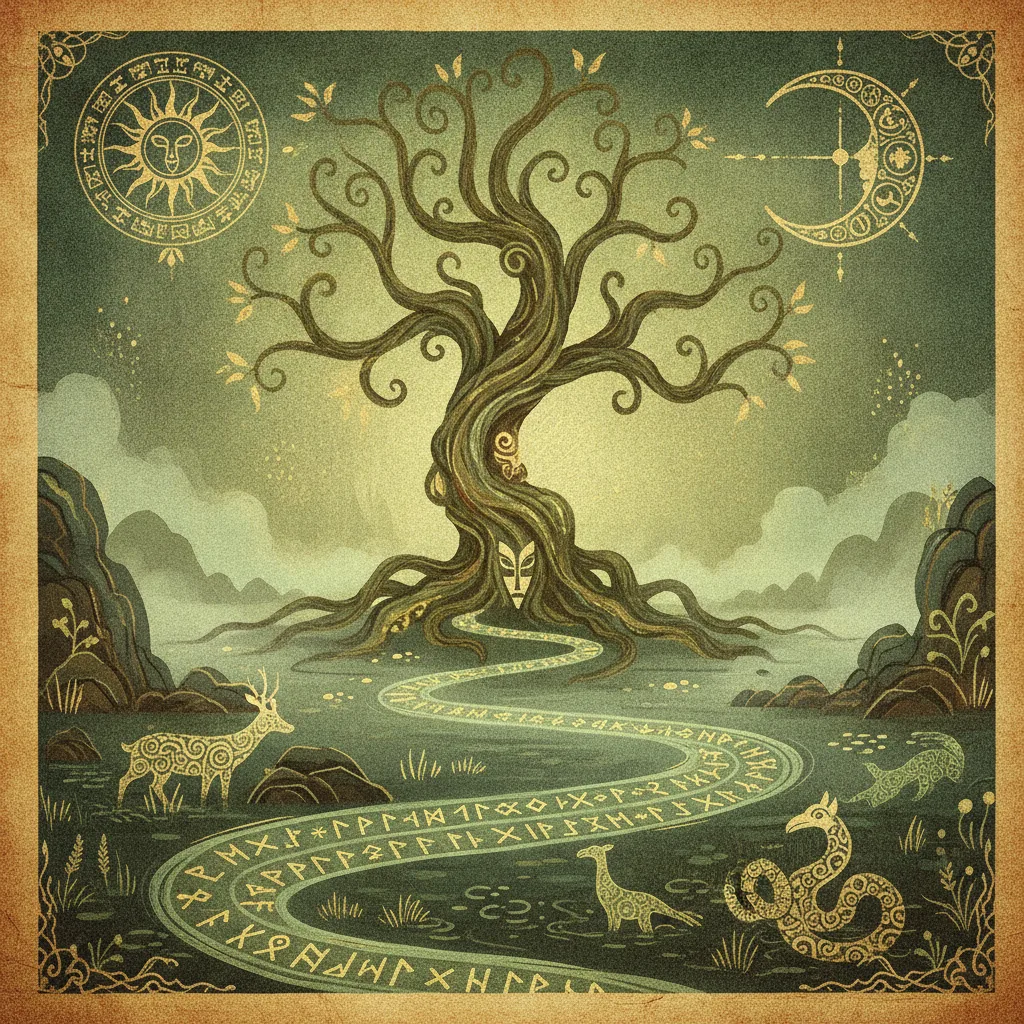
In folklore illustration, colour and motif carry meaning, but it is local and contested, not a universal code. The most reliable colour is the one the source names, like the Morrigan's red. Red, green, white and black recur across Irish lore with contradictory senses. Let palette and motif follow the text and tradition, and know which choices are your era's.
- Colour symbolism is real but local and contested, not universal.
- The strongest colour is the one the source text names.
- Red, green, white and black recur with contradictory meanings.
- Knotwork is manuscript grammar; do not caption invented meanings.
- Modern horror and fantasy palettes creep in uninvited; name them.
A folklore illustration carries meaning in two channels at once: what it shows, and how it is coloured and marked. A washer at the ford means one thing rendered in cold greys and quite another drenched in red. This piece is about the second channel — palette and motif as bearers of meaning — with a working caution up front: none of this is a rulebook. Colour symbolism is real, but it is local, contested and easy to over-claim. The aim is to use it knowingly, not to impose a universal code that does not exist.
Start from the source, not from a colour chart
The most reliable colour symbolism in a folklore image is the colour the source actually names. Medieval and traditional texts are often surprisingly specific, and those specifics beat any generic “red means danger” scheme.
Take the Morrígan. In Táin Bó Regamna she appears as a red-haired woman in a red cloak with red eyebrows, driving a chariot drawn by a one-legged horse. That is a documented, textual red — so an artist who paints her red is grounded in the material, while one who defaults to the modern black-and-crimson gothic scheme is inventing. The lesson generalises: before choosing a palette, find out whether the tradition already assigned one. Our reference guide to drawing the Morrígan works through exactly this kind of source-checking.
The strongest symbolic colour in a picture is usually the one the text put there first. Everything else is your addition, and worth labelling as such in your own mind.
Colours that recur — with their caveats
Some associations do turn up widely across European folklore. Treat these as common tendencies, not laws, and always check against the specific tradition you are drawing from.
- Red. Across Irish material red is repeatedly the colour of otherworld danger and of the supernatural: red-eared white cattle of the otherworld, red-clad war-figures, the “red” hostels and riders of ill omen. It reads as vitality and as threat at once.
- Green. Associated with the fairy folk and the otherworld in much Irish and Scottish lore — to the point that green clothing was, in some places, considered unlucky for humans because it belonged to them. Growth and the uncanny, not simply “nature.”
- White. Otherworldly animals are often white with red ears; white can mark the numinous and the fatal as readily as the pure.
- Black. Frequently mourning and ill omen, but not the all-purpose “evil” of modern shorthand; in many tales the genuinely dangerous thing wears red.
Notice how quickly these blur. Green is lucky in one context and forbidden in another; white is holy and deadly. That instability is the honest state of the material, and pretending otherwise is where folklore illustration goes wrong.
Motif: shapes that mean before they decorate
The same double channel runs through ornament. A motif can be pure pattern, or it can carry weight — and the difference usually lies in whether the artist knows what it once meant.
- Interlace and knotwork. The endless-line ornament of Insular manuscripts reads today as “Celtic spirituality,” but in its original context it was the visual grammar of Gospel books, not a coded pagan symbol. Use it for texture and lineage by all means; just do not caption it with meanings the scribes never intended.
- The triskele and triple forms. Triads recur genuinely in the material — the Morrígna as a trio, groups of three in tale after tale — so a triple motif can echo real structure. But the specific “maiden-mother-crone” gloss often attached to it is a twentieth-century overlay, not ancient doctrine.
- Water and the ford. Not a colour or a shape but a recurring symbolic place: boundaries, crossings and washers-at-the-ford cluster at water. Composing a supernatural encounter at a river-edge is drawing on a real structural motif of the tradition.
- Birds and animal forms. The scald-crow, the salmon, the hound, the seal of the selkie tales — specific creatures carry specific freight in specific stories. A crow at a warrior’s shoulder is not a mood; it is a citation.
How to let palette and motif do the work
Some practical ways to make the two channels carry meaning without shouting.
- Limit the palette to make a colour speak. A single documented red — the Morrígan’s cloak, an otherworld ear — lands far harder in a restrained, earthy field than in an image already saturated everywhere. Symbolic colour needs contrast to register.
- Let motif follow narrative, not fashion. Put the ford, the crow or the triple grouping in because the story has them, not because they look “Celtic.” The viewer feels the difference even when they cannot name it.
- Separate the ornamental from the significant. Decide, for each element, whether it is pattern or statement. Knotwork borders can be frank decoration; the one red object in the frame should be a decision.
- Avoid the pan-symbolic trap. Resist the urge to give every colour a fixed universal meaning. The most convincing folklore images are specific to one tradition and one tale, not assembled from a general dictionary of symbols.
A word about modern colour habits
One more caution, because it trips up a lot of contemporary folklore art. The colour associations we carry as modern viewers — the horror-film palette of black and blood-red, the “mystical” purples and teals of fantasy branding, the muted sage-and-terracotta of current interiors — are strong, recent and culturally specific. They will walk into your image uninvited if you are not watching for them. A Morrígan painted in horror-poster crimson-on-black is not drawing on the Táin; she is drawing on a century of cinema. There is nothing wrong with using a modern palette deliberately, but it should be a choice you can name, kept separate in your mind from the colours the tradition actually records. The test is simple: if you cannot say where a colour came from, assume it came from your own era, not from the source.
The honest position
Colour and symbol genuinely carry meaning in folklore art — but that meaning lives in particular texts, regions and tales, and it contradicts itself as soon as you try to systematise it. The strongest thing an artist can do is know where each choice comes from: this red is from the Táin; this green is the fairy green of Scottish lore; this triskele is decoration I have added, and I know it is not an ancient creed.
Held that way, palette and motif stop being a costume and become a language — one you are speaking deliberately, with an awareness of which words are quotations and which are your own. That awareness is the whole difference between an image that illustrates a tradition and one that merely dresses up in it.
Frequently asked questions
Does red always mean danger in folklore?
No — colour symbolism is local and contested. But in Irish material red repeatedly marks the otherworldly and threatening, and the Morrígan's red hair and cloak in Táin Bó Regamna are a documented, textual red.
Is Celtic knotwork an ancient pagan symbol?
Not as usually claimed. Interlace comes from Christian Insular manuscripts like the Book of Kells. Use it for texture and lineage, but don't attach meanings the original scribes never intended.
What colour is the Morrígan in the sources?
Red. In Táin Bó Regamna she is a red-haired woman in a red cloak with red brows, driving a chariot drawn by a one-legged horse — not the modern black-and-crimson gothic scheme.
Is maiden-mother-crone an ancient meaning of the triskele?
No. Triads are genuinely common in the material, but the maiden-mother-crone gloss is a 20th-century overlay, not ancient doctrine.
How do I use colour symbolism honestly?
Prefer the colour the source actually names, limit your palette so that colour can register, and keep clear in your own mind which choices are sourced and which are your invention.
