Folk-horror and folklore fiction worth your shelf
Six novels that use British and Irish folklore with real care, from a Mabinogi retelling to selkie fiction, with an honest note on how each treats its source.
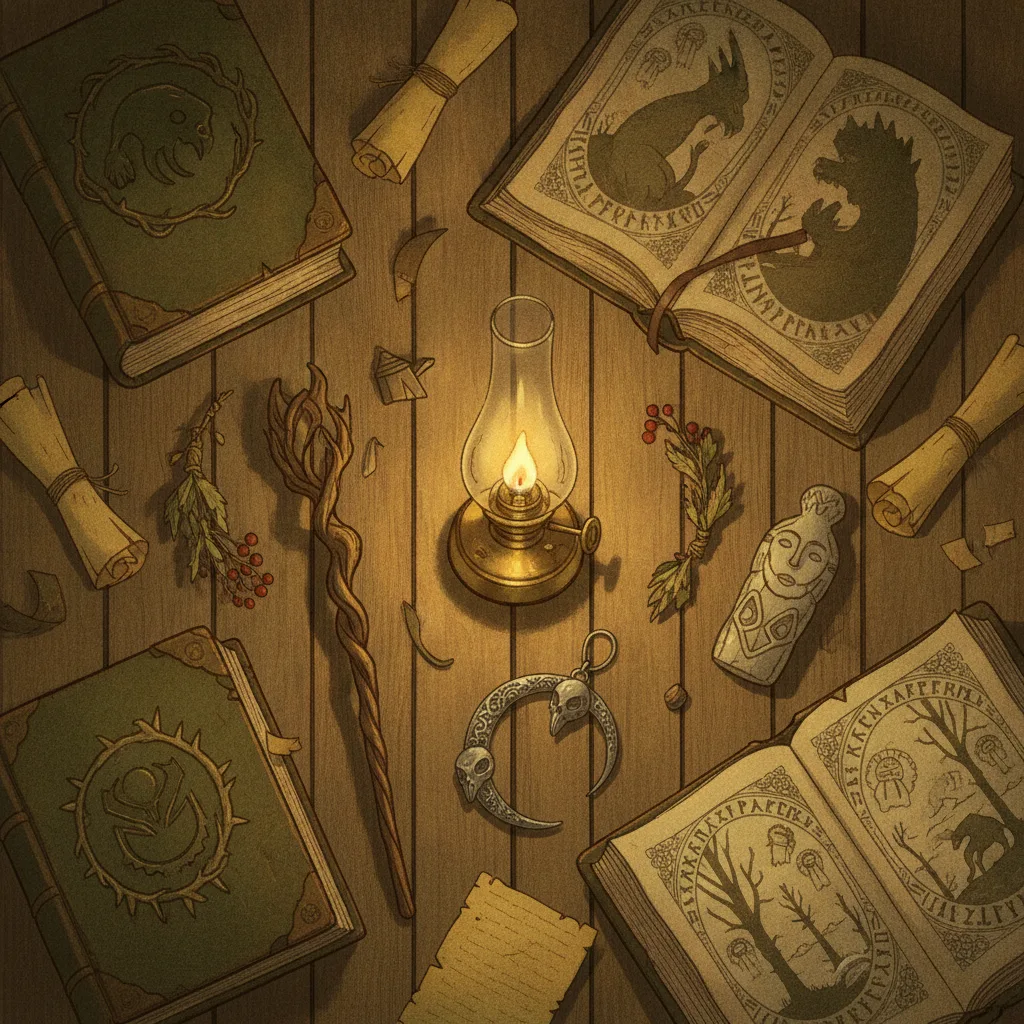
Alan Garner's The Owl Service faithfully replays the Mabinogi's Blodeuwedd; Holdstock's Mythago Wood dramatises how myths form. Susan Cooper and Kirsty Logan reinterpret, Zoe Gilbert synthesises real lore, and Hurley's Starve Acre invents in the folk-horror mode. Know which approach you are holding.
- The Owl Service carries a specific Mabinogi tale into the present.
- Mythago Wood is a novel about how legends form and mutate.
- Logan reinterprets the selkie; Gilbert synthesises genuine British lore.
- Starve Acre invents ‘folklore’ in the folk-horror mode, not the record.
- Folk-horror atmosphere is not the same as documented folklore.
Folk horror has had a long moment, and with it a flood of novels that wrap themselves in standing stones, hares and harvest rites. A lot of it wears folklore as costume — atmosphere borrowed without much thought for the tradition underneath. But some novelists genuinely engage with British and Irish folklore, and the results earn a place on the shelf. Here are six worth owning, with an honest note on how each one treats its source. Knowing the difference between a retelling, a reinterpretation and a clever invention will make you a sharper reader of the whole genre.
Alan Garner, The Owl Service (1967)
The high-water mark of the form. Garner takes the Fourth Branch of the Welsh Mabinogi — the tale of Blodeuwedd, the woman conjured from flowers for Lleu, who betrays him and is turned into an owl — and lets it replay itself through three teenagers in a modern Welsh valley. On accuracy: this is direct, faithful engagement with a specific medieval tale, not a vague “Celtic” mood. It rewards reading the source alongside it; if you want to, our guide to which edition of the Mabinogi to buy will point you to a good translation.
Robert Holdstock, Mythago Wood (1984)
Not a retelling but something rarer: a novel about how myths are made. In the ancient Ryhope Wood, human archetypes take flesh — “mythagos,” from Robin Hood to figures older than writing — generated out of the collective unconscious of everyone who enters. Holdstock, a student of Jungian archetype theory, is engaging with folklore at the level of mechanism. On accuracy: it invents freely, but knowingly, and its subject is precisely the process by which legends form and mutate. It won the World Fantasy Award for good reason. If you have ever wondered why the same hero-figures recur across cultures, or how a local legend hardens into a fixed tale, Holdstock dramatises the question better than any essay.
Susan Cooper, The Dark Is Rising sequence (1965–1977)
Five novels that draw deeply on the well of British myth — Arthurian legend, the Welsh Mabinogion, Anglo-Saxon lore, and the landscapes of Wales, Cornwall and Buckinghamshire. On accuracy: Cooper blends her traditions and simplifies them into an original cosmology of the Light against the Dark. That framework is her invention, not folklore, so read the sequence as a superb gateway that will send you toward the real material — not as a source for it. As an introduction to the feel of British myth for younger and older readers alike, it is hard to beat.
Kirsty Logan, The Gloaming (2018)
Set on an unnamed Scottish island, Logan’s novel is an extended, dreamlike riff on the selkie legend — which she reimagines as, in her own words, a “queer mermaid love story.” On accuracy: this is deliberate reinterpretation rather than preservation. Logan takes the traditional selkie figure — the seal-woman bound to land — and reworks its gender roles and longing into something new. Read it not to learn the legend but to see a living tradition being answered back to by a contemporary writer, which is itself part of how folklore stays alive.
Zoe Gilbert, Folk (2018)
A cycle of interlinked tales set on Neverness, a fictional island modelled closely on the Isle of Man. Gilbert built the book from real collections of custom and lore gathered across the British Isles, then wove them into invented lives — a girl seeking her fiddler’s spirit, a boy born with a wing for an arm. On accuracy: this is synthesis. The island is imagined, but the folkloric texture — its rituals, superstitions and seasonal fears — is drawn from genuine sources. It is a fine model of how to honour real lore while making something wholly your own.
Andrew Michael Hurley, Starve Acre (2019)
The closing novel of Hurley’s loose folk-horror trilogy, set on the bleak edge of the Yorkshire moors, where a grieving couple’s ground begins to yield things that should stay buried. On accuracy: be clear-eyed here. The “folklore” is largely Hurley’s own dark invention in the folk-horror mode — rural dread, the uncanny field, the thing beneath the soil — rather than a documented tradition you could look up. That is no criticism; it is how the genre often works. Enjoy it as a masterclass in atmosphere and grief, not as a record of belief.
Why “folk horror” and folklore are not the same thing
It is worth separating two things the marketing tends to blur. Folk horror is a mood and a set of images — isolated rural communities, old rites persisting into the present, the land itself turning hostile. Folklore is the actual body of traditional belief, story and custom that a culture has carried down. A novel can be drenched in folk-horror atmosphere while inventing nearly all of its “lore,” and another can quietly transmit genuine tradition with no horror at all. Neither is better; they are simply different projects. The trouble comes when a reader treats an atmospheric invention as though it were an ethnographic record, and repeats a novelist’s spooky detail as if it were something real people once believed. Hold the two ideas apart and you can enjoy the shiver without being misled about the source.
How to read these well
Line them up and a useful spectrum appears. Garner gives you retelling: a specific myth carried faithfully into the present. Logan offers reinterpretation: a legend deliberately reworked. Gilbert works by synthesis: real lore recombined into invented places. And Hurley and Holdstock give you invention in the mode: new stories built with the tools and moods of folklore rather than its documented content. All four approaches are legitimate. The only mistake is not knowing which one you are holding — mistaking a novelist’s invention for the tradition itself. Read with that distinction in mind, and folk fiction becomes not a substitute for the old stories but a conversation with them.
If this list leaves you wanting the real thing underneath the fiction, that is the best outcome of all. Garner should send you to a good translation of the Mabinogi; Logan and the selkie novelists should send you back to the seal-folk traditions of Orkney, Shetland and the Scottish and Irish coasts; Gilbert should send you to the collectors of British-Isles custom she quietly drew upon. The finest folklore fiction works like a doorway: it is satisfying to stand in, but its real gift is the room it opens onto. Buy these for the shelf, then let them point you toward the older books that gave them their bones.
Frequently asked questions
Which of these novels is closest to an actual myth?
Alan Garner's The Owl Service (1967). It carries the Fourth Branch of the Welsh Mabinogi — the tale of Blodeuwedd, Lleu and Gronw — directly into a modern setting, making it a faithful retelling rather than a vague 'Celtic' mood piece.
Is Starve Acre based on real folklore?
Largely no. Andrew Michael Hurley's dread is mostly his own invention in the folk-horror mode — the uncanny field, the thing beneath the soil — rather than a documented tradition. Read it for atmosphere and grief, not as a record of belief.
Which title is best for younger readers?
Susan Cooper's The Dark Is Rising sequence. It draws on Arthurian, Welsh and Anglo-Saxon lore, though its Light-versus-Dark cosmology is Cooper's own invention. It works best as a gateway that sends readers toward the real material.
Does The Gloaming preserve the traditional selkie legend?
No — it deliberately reinterprets it. Kirsty Logan reworks the seal-folk story into what she calls a 'queer mermaid love story,' answering back to the tradition rather than preserving it. That reworking is itself part of how folklore stays alive.
