Folklore-motif jewellery: triskeles, knotwork and what they actually mean
Which folklore-motif jewellery is genuinely old and which invented: the pre-Celtic triskele, medieval-manuscript knotwork and the Victorian Celtic-Revival layer.
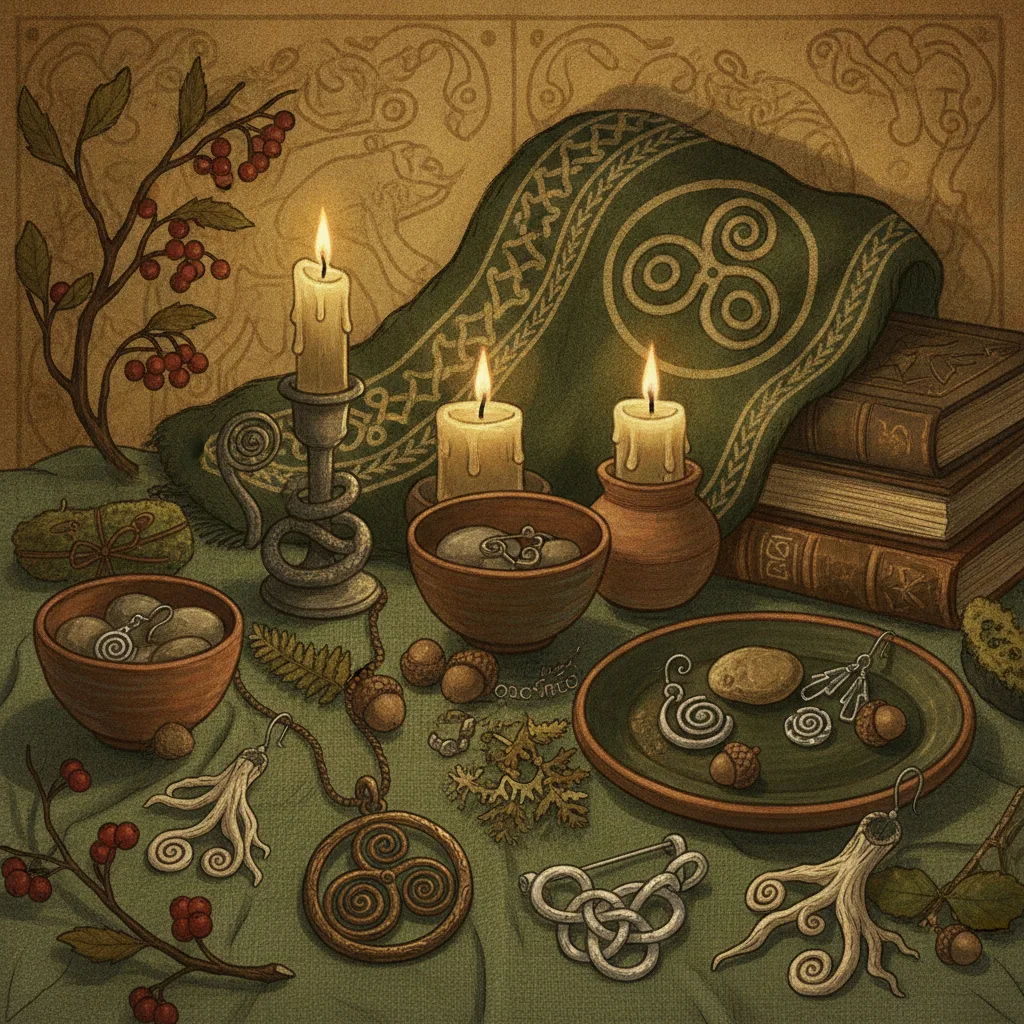
The triple spiral or triskele is genuinely ancient but pre-Celtic (carved at Newgrange c.3200 BC), its meaning unrecorded. Interlaced knotwork is early-medieval Christian manuscript art of roughly the 7th-9th centuries, not Iron Age druid magic. Much Celtic jewellery styling is 19th-century Revival, sparked by the 1850 Tara Brooch; the Claddagh ring is specifically 17th-century.
- Triskele is genuinely ancient but pre-Celtic (Newgrange, c.3200 BC).
- Knotwork is early-medieval manuscript art, roughly 7th-9th century.
- The Celtic cross jewellery version is largely a Revival popularisation.
- The Claddagh ring is a specific 17th-century Galway design.
- Much Celtic jewellery styling dates to the 19th-century Revival.
Walk into any shop selling “Celtic jewellery” and you will be handed a story along with the silver: this knot is ancient, this spiral is druidic, this design is thousands of years old. Some of that is true. A surprising amount of it is Victorian, or medieval, or plain invented, sold with a mythic backstory because the real history is less convenient for a price tag. That is a shame, because the real history is far more interesting than the sales pitch. Here is what these motifs actually are, and which layer of the past each one belongs to.
The triskele and spiral: genuinely ancient
Start with the one that lives up to the billing. The triple spiral, or triskele, is three spirals joined at a common centre, and it is one of the oldest deliberate symbols in these islands. The most famous example is carved into the passage tomb at Newgrange in the Boyne Valley, both on the great entrance kerbstone and deep in the inner chamber. Newgrange was built around 3,200 BC, older than Stonehenge and older than the pyramids at Giza.
We should be careful about what that means. The people who carved it were not “Celts” in any meaningful sense; they were Neolithic farmers, millennia before Celtic language or culture reached Ireland. So the triskele is genuinely ancient, but it is pre-Celtic, and its original meaning is unrecorded. Modern readings, cycles of life, death and rebirth, or a link to the winter-solstice sunrise that the tomb is aligned to, are informed guesses, not decoded fact. Worn today it is a real thread back to deep prehistory. Just do not let anyone tell you exactly what a Stone Age carver meant by it.
Interlace and knotwork: medieval, not prehistoric
Here is the big one, the motif most heavily marketed as “ancient Celtic” that simply is not. Interlaced knotwork, the endless woven bands with no beginning or end, is early-medieval manuscript art.
True knotted interlace appears in the Insular art of Ireland and Britain from around the 7th century AD, in illuminated gospel books, the Book of Kells, the Lindisfarne Gospels and their relatives, and on high crosses and metalwork of the same Christian era. One of the earliest true knots survives in a 7th-century gospel fragment at Durham. And the style was not even purely home-grown: the ribbon-interlace that Insular artists developed drew heavily on Mediterranean and Coptic models, the interlace of 5th- and 6th-century Christian Egypt bearing a striking resemblance to the earliest Insular knotwork.
So knotwork is beautiful, it is genuinely old, and it is authentically part of Irish and British heritage, but it is Christian-era manuscript art of roughly the 7th to 9th centuries, not Iron Age druid magic. If a piece is sold to you as “an ancient pagan Celtic knot,” the seller is either mistaken or hoping you are. Knowing the real story does not diminish the design; it just places it correctly, in the scriptorium rather than the stone circle.
The Victorian invention layer
There is a third layer that most jewellery marketing quietly skips: a huge amount of what we now think of as “Celtic jewellery” was actually created or popularised in the 19th-century Celtic Revival.
The turning point was the discovery of the Tara Brooch around 1850, a spectacular piece of 8th-century Irish metalwork. It caused a sensation, and Dublin firms began producing replicas and Revival-style pieces for a Victorian market hungry for national and romantic heritage; Queen Victoria’s own enthusiasm helped drive the fashion. Much of the visual language of the modern “Celtic jewellery” counter, the way the motifs are combined, scaled and set into rings and brooches for everyday wear, dates from this Victorian revival, not from antiquity. The Claddagh ring, with its heart, hands and crown, is real and traditional but specifically 17th-century, from the fishing village of Claddagh outside Galway, and it too was popularised more widely in this later period.
This is not a debunking for its own sake. Revival craft is a legitimate and often gorgeous tradition in its own right. The point is simply to know which century you are wearing.
The same caution applies to the trinity knot or triquetra, another shape you will see everywhere with a confident “ancient Celtic” label. As a three-cornered interlace it belongs to the same medieval manuscript tradition as the rest of the knotwork, and its popular reading as a “triple goddess” or a neat symbol of a threefold anything is a modern gloss laid over an old form. The interlace is real and medieval; the tidy meaning printed on the gift-box insert is usually twentieth-century. None of that stops it being a fine thing to wear. It just means the honest sentence is “medieval interlace, modern meaning,” not “ancient druid symbol.”
A quick, honest field guide
- Triple spiral / triskele: genuinely ancient (Newgrange, c. 3,200 BC), but pre-Celtic and of unrecorded meaning.
- Interlaced knotwork: early-medieval Christian manuscript and metalwork art, roughly 7th to 9th century, influenced by Mediterranean and Coptic models.
- “Celtic cross” (ringed cross): an early-medieval Christian form; the mass-market jewellery version is largely a Revival-era popularisation.
- Claddagh ring: a specific 17th-century Galway design; meaning (love, loyalty, friendship) is real and consistent.
- Much “Celtic jewellery” styling: 19th-century Celtic Revival, sparked by the 1850 Tara Brooch discovery.
How to buy it well
None of this should put you off wearing folkloric jewellery; it should make you a better buyer of it. Favour makers who can tell you the real provenance of a design, and who reach for accuracy over mystique. A silversmith who says “this is a Revival-style interlace, the knotwork tradition comes from the manuscripts” is more trustworthy than one selling “ancient druid power symbols.” Choose solid metals over plated costume pieces, because a good silver or gold piece patinates and lasts for generations, which is itself the most folkloric quality an object can have.
And let the wider mythology inform your choices. If you are drawn to a symbol, read the actual stories behind the culture it comes from; our pieces on the Tuatha Dé Danann and figures like the Morrígan are a better guide to what these motifs orbit than any product description. Wear the spiral, wear the knot, wear the Claddagh. Just wear them knowing which past they actually belong to. That knowledge is the difference between a costume and an heirloom.
Frequently asked questions
Is Celtic knotwork ancient?
Not as ancient as it is sold. True interlaced knotwork is early-medieval Christian manuscript and metalwork art, appearing in Insular art from around the 7th century in books like the Book of Kells, and it drew on Mediterranean and Coptic ribbon-interlace. It is genuinely old and authentically Irish and British, but it is scriptorium art, not Iron Age druid magic.
How old is the triskele or triple spiral?
Genuinely ancient. The triple spiral is carved into the passage tomb at Newgrange, built around 3,200 BC, older than Stonehenge and the pyramids. But its makers were Neolithic farmers, not Celts, so it is pre-Celtic, and its original meaning is unrecorded; modern readings are informed guesses.
What is the Victorian Celtic Revival layer in jewellery?
Much of what we now call Celtic jewellery was created or popularised in the 19th-century Celtic Revival, sparked by the discovery of the 8th-century Tara Brooch around 1850. Dublin firms produced replicas and Revival-style pieces for a Victorian market, and much of the modern styling of these motifs dates from then, not from antiquity.
Is the Claddagh ring traditional?
Yes, but specifically 17th-century. The Claddagh ring, with its heart (love), clasped hands (friendship) and crown (loyalty), originated in the fishing village of Claddagh outside Galway and took its modern form in the 1600s. It was popularised more widely in the later Revival period.
How do I buy folklore-motif jewellery well?
Favour makers who give real provenance and reach for accuracy over mystique, choose solid metals over plated costume pieces because they patinate and last for generations, and read the actual stories behind a symbol culture. Wear the spiral, knot and Claddagh, but know which past each belongs to.
