Myth & Folklore Scottish Gaelic (Highlands & Islands)
Kelpies and the each-uisge: the Scottish Gaelic water-horse
The Scottish Gaelic water-horse comes in two forms: the river-haunting kelpie and the deadlier loch-dwelling each-uisge — a beautiful horse whose sticky hide drags riders under to drown.
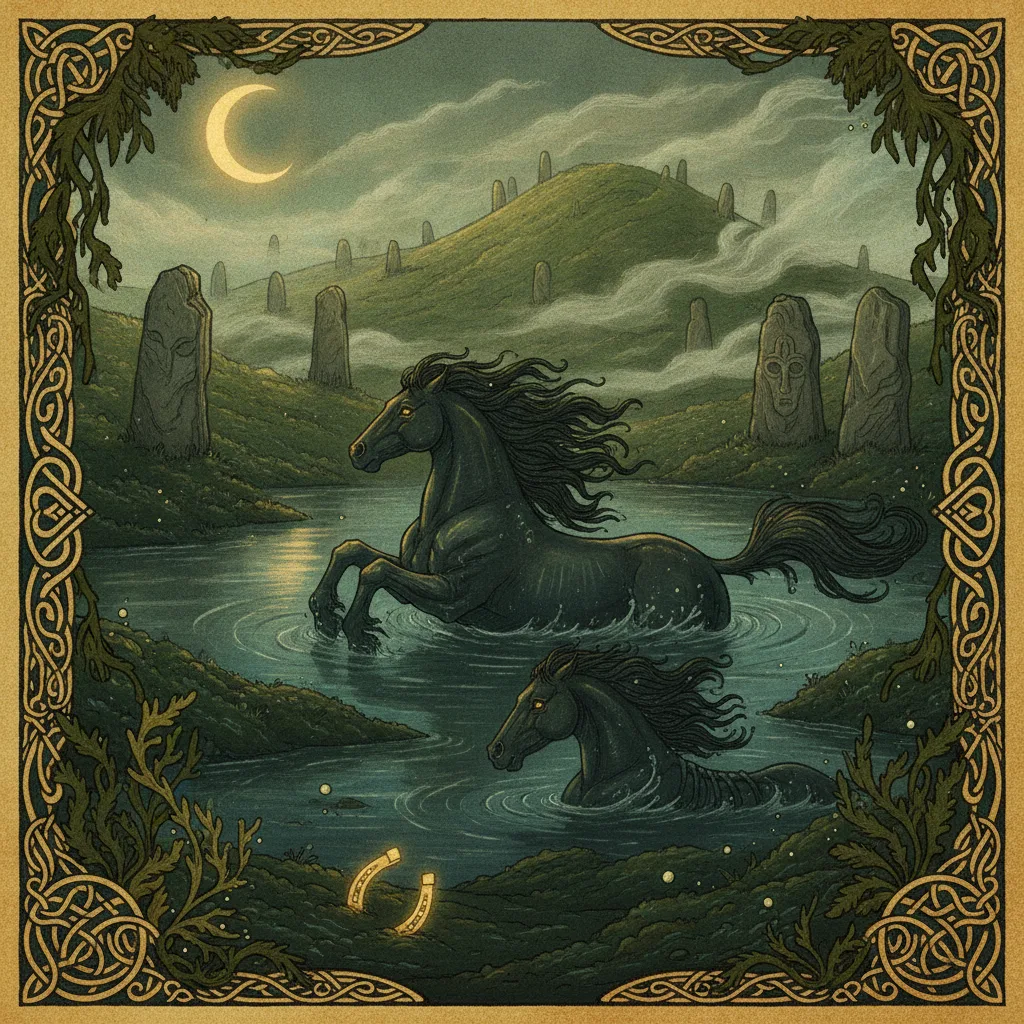
The water-horse is a Scottish Gaelic spirit of the Highlands and Islands that appears as a fine horse to lure riders into the water and drown them. Tradition distinguishes the kelpie of rivers and fords from the deadlier each-uisge of lochs and sea-lochs, whose adhesive hide traps its victims; it then devours them, leaving only the liver.
- Scottish Gaelic water-horse that lures riders onto its back, then drowns them.
- The kelpie belongs to rivers and fords; the fiercer each-uisge to lochs and sea-lochs.
- Its hide is adhesive; it eats the victim, leaving only the liver washed ashore.
- Can also appear as a handsome man, betrayed by water-weed or sand in his hair.
- Really a safety warning about deep water; the kelpie/each-uisge line was not rigidly kept.
| Tradition | Scottish Gaelic (Highlands & Islands) |
| Type | Malevolent shapeshifting water-horse |
| Earliest attestation | Scots word 'kelpie' by the 1780s (Burns, 1786); oral lore collected by J. G. Campbell (1900) |
| Associated places | Kelpie: rivers, streams, fords. Each-uisge: lochs and sea-lochs |
| Associated symbols | The luring horse, adhesive hide, the victim's liver washed ashore |
A fine horse stands at the water’s edge, saddled or bare-backed, patient and inviting. Perhaps children clamber onto its long back, and there is always room for one more — the back seems to stretch. Then it turns and plunges into the loch, and the riders find their hands stuck fast to its hide, and they are gone. This is the water-horse of Scottish Gaelic tradition, and it is one of the darkest figures in the folklore of the Highlands and Islands: a beautiful lure with a drowning at the end of it.
Two water-horses, not one
English speakers tend to call every Scottish water-horse a “kelpie,” but the tradition itself draws a distinction that is worth keeping, because it maps onto the landscape:
- The kelpie (Scots; Scottish Gaelic each-uisge is often used loosely for both, but the kelpie proper is the each bàn / river-horse) is the spirit of running water — rivers, streams, and fords. It haunts the crossing places and is associated with sudden floods and the roar of a river in spate.
- The each-uisge (literally “water horse”) is the creature of still and deep water — lochs and sea-lochs — and it is by far the more dangerous of the two. The folklorist Katharine Briggs called it “perhaps the fiercest and most dangerous of all the water-horses.”
Both are Scottish Gaelic traditions of the Highlands and Islands, and it is more accurate to name them that way than to file them under a vague “Celtic.” This is not the Irish púca (which torments but rarely kills) nor the seal-folk (who grieve and leave). The water-horse drowns and eats.
The way it kills
The method is consistent across the tradition and genuinely grim. In horse form, the each-uisge’s hide is adhesive: once a victim touches it, they cannot let go, and the creature carries them into the deep to drown. It then devours the body — and here comes the single most-repeated detail of the lore — leaving only the liver, which floats to the surface and washes ashore. That gruesome, oddly specific marker is how a community knew what had taken a missing person. The each-uisge could also appear as a handsome man to lure women, betrayed only by water-weed, sand, or shells tangled in his hair; and sometimes as a gigantic bird.
The one escape, in many tales, is water itself: the each-uisge will not readily cross or pursue over the sea, and a victim who can reach dry land or leave the water may break free — if they can first tear loose from the clinging hide.
The children and the one who noticed
The most widely told each-uisge tale is a schoolyard horror with a survivor. A group of children — the number varies, often given as seven — are playing by a loch when a fine horse appears and offers them a ride. One by one they climb onto its back, and the back lengthens to take each new rider, until all but one are seated. The last child, a boy, hangs back; in many versions he notices something wrong — the beast’s strange eyes, or sand and water-weed in its mane — and refuses. As the horse turns for the water he tries to help his friends and finds his own finger stuck to the hide; he saves himself only by cutting it off with a knife. The others are carried under and drowned, and the next day their livers wash up on the shore. It is a story built to be remembered by exactly the audience it warns: children by the water.
The each-uisge’s other shapes deepen the dread. As a beautiful young man it courts girls by the lochside, and the tradition supplies a tell: laid in the girl’s lap, its hair is found to be threaded with liobhagach an locha — the water-weed of the loch — or with sand and shell, the residue of the deep. A woman who recognises the sign and slips away lives; one who does not is pulled down. Even the horse-form has a giveaway in some tellings: hooves reversed, or a constant dripping, or a coat that never quite dries.
What the sources say, and when
The word kelpie is attested in Scots by the late eighteenth century — Robert Burns names the “water-kelpies” that “haunt the foord” in his Address to the Deil (1786) — which gives the tradition a firm early date in print, though the belief is older. The richest early collection of the water-horse lore comes from John Gregorson Campbell (1836–1891), a Free Church minister of Tiree and Coll, whose Superstitions of the Highlands and Islands of Scotland was published posthumously in 1900. Campbell gathered his material “entirely from oral sources” in Gaelic-speaking Argyll and the islands, and his chapters on the water-horse and the kelpie are among the primary records of how the belief actually lived in the communities that held it.
Later folklorists refined the picture. Katharine Briggs, in her mid-twentieth-century Dictionary of Fairies and related works, systematised the distinction between the river-dwelling kelpie and the loch-and-sea each-uisge and gave the each-uisge its reputation as the fiercest of the water-horses. Comparable water-horses appear across the northern world — the Manx cabyll-ushtey and glashtin, the Welsh ceffyl dŵr, the Scandinavian bäckahäst and nøkk — a sign that the drowning water-horse is a shared northern European belief, not a purely Scottish one.
What is contested
The kelpie / each-uisge distinction, while real in the folkloristic literature, was not rigidly observed by every teller; in ordinary speech the two words often blur, and some districts used one name for both. So the clean “kelpie = river, each-uisge = loch” rule is a useful scholarly summary, not an ironclad law of the tradition. The claim that the kelpie can be tamed or controlled by seizing its bridle appears in some tales but is far from universal. And the popular image of the kelpie as a benign, majestic emblem of Scotland — encouraged by modern tourism — quietly reverses what the folklore is actually about, which is the very real danger of deep, cold water to children and travellers.
A warning wearing a horse’s skin
That last point is the key to the water-horse. Beneath the supernatural machinery, these are stories that did a job: they kept children away from the treacherous edges of lochs and rivers, from the fords that flooded without warning, from the deep water that killed silently and often in a country laced with it. The stretching back that always has room for one more child, the hand that cannot let go, the liver on the shore — these are the images a community reaches for when it needs to make a lesson unforgettable. The each-uisge is folklore doing safety education in the only language that stuck.
Today the water-horse’s most visible face is triumphant and tourist-friendly: The Kelpies, Andy Scott’s colossal thirty-metre steel horse-heads completed at Falkirk in 2013, celebrate the working heavy horses of Scotland’s canals as much as the myth. They are magnificent, and they are the opposite of the folklore — the drowning lure turned into a monument you are invited to walk right up to. Loch Ness’s tourist “monster” carries a faint echo of the same old belief in the thing that lives in the deep water and takes the unwary. The each-uisge itself, though, was never meant to be admired. It was meant to be feared, and to keep you alive.
| Tradition | Scottish Gaelic |
| Earliest text | 'kelpie' in Scots by the late 18th c. (Robert Burns, 'Address to the Deil', 1786); fullest early oral record in John Gregorson Campbell, 'Superstitions of the Highlands and Islands of Scotland' (posthumous, 1900) |
| Also appears | Manx cabyll-ushtey/glashtin; Welsh ceffyl dŵr; Scandinavian bäckahäst and nøkk |
| Later additions | Katharine Briggs systematised the kelpie/each-uisge distinction (20th c.); The Kelpies sculptures, Falkirk (Andy Scott, 2013) |
| Translation | each-uisge = 'water horse' |
| Reviewed | 2026-08 |
Frequently asked questions
What is the difference between a kelpie and an each-uisge?
In the folkloristic tradition the kelpie haunts running water — rivers, streams and fords — while the each-uisge ('water horse') belongs to lochs and the sea and is far more dangerous. Katharine Briggs called the each-uisge perhaps the fiercest of all the water-horses. In everyday speech the two names often blur.
How does the water-horse kill?
It appears as a fine horse and lets riders mount; its hide is adhesive, so once touched they cannot let go. It plunges into the water and drowns them, then devours the body — leaving only the liver, which floats ashore. That grim marker told a community what had happened to a missing person.
Is the kelpie Scottish or Irish?
The kelpie and each-uisge are Scottish Gaelic traditions of the Highlands and Islands. They differ from the Irish púca (which torments but rarely kills) and the seal-folk. Similar water-horses exist in Manx, Welsh and Scandinavian lore, so the belief is broadly northern European.
How old is the word 'kelpie'?
It appears in Scots by the late eighteenth century — Robert Burns mentions water-kelpies haunting the ford in his 'Address to the Deil' (1786). The fullest early record of the oral belief is John Gregorson Campbell's 'Superstitions of the Highlands and Islands of Scotland' (1900).
Can a kelpie be tamed?
Some tales say it can be controlled by seizing its bridle, but this is far from universal and should be treated as one regional motif rather than a rule of the tradition.
Why did people tell water-horse stories?
Beneath the horror they did practical work: they kept children and travellers away from deep lochs, flooding fords and treacherous water in a country full of it. The each-uisge is, in effect, unforgettable safety education.
