Celtic Legends Irish · Mythological Cycle (Early Modern romance)
The Children of Lir (Oidheadh Chloinne Lir)
Fionnuala and her brothers, swans for 900 years: Ireland's tenderest sorrow-tale. It stars the Tuatha Dé, but the text is Early Modern Irish (c. 1500), not Iron Age.
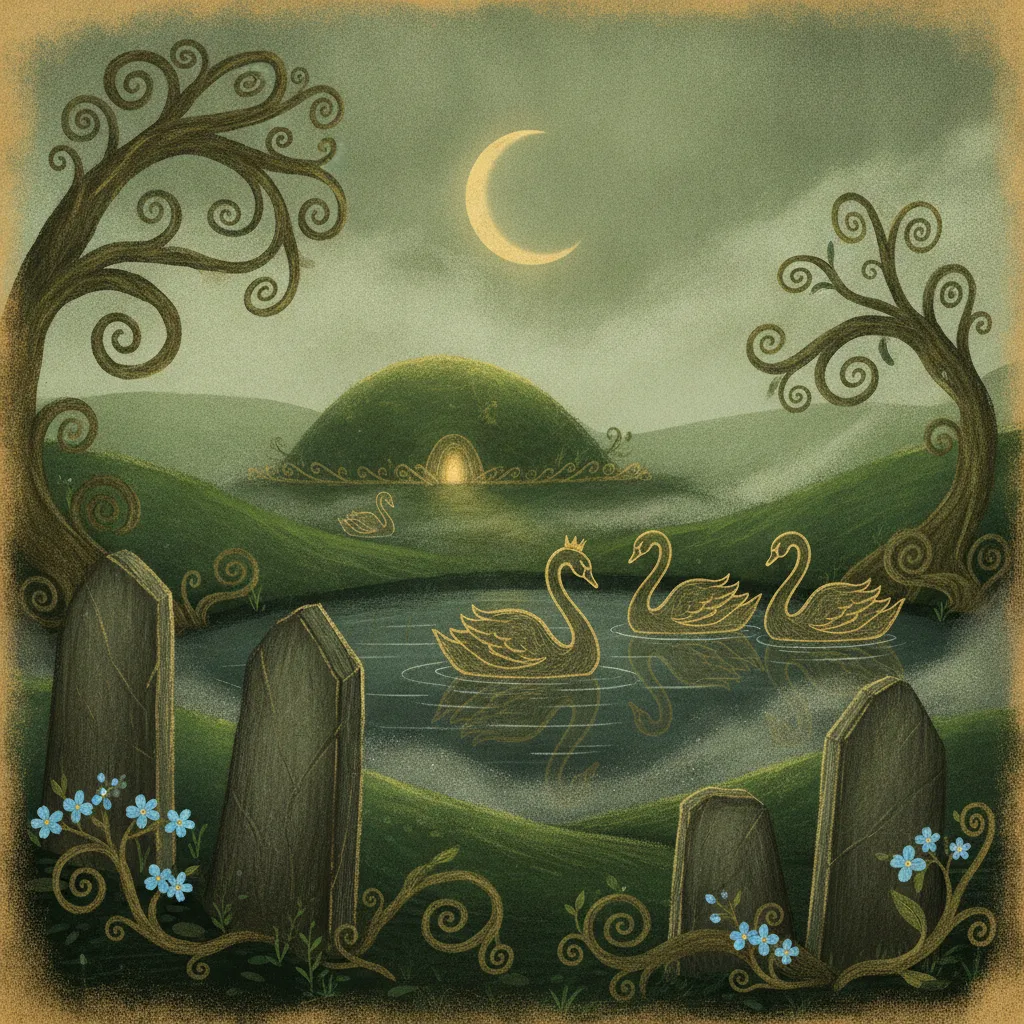
The Children of Lir (Oidheadh Chloinne Lir) is the Irish tragedy of four children turned to swans for nine hundred years by their jealous stepmother Aoife, freed at last by a Christian bell. Though set among the Tuatha Dé Danann, the text is Early Modern Irish - roughly fifteenth- to sixteenth-century, not ancient - and one of the 'Three Sorrows of Storytelling.'
- The Children of Lir is the Irish tale of four siblings enchanted into swans for 900 years.
- Their stepmother Aoife casts the spell; a Christian bell finally frees them.
- Set among the Tuatha Dé Danann, but the text is Early Modern Irish (c.15th-16th century), not ancient.
- Its Christian resolution is built in, reflecting its late Christian-era composition.
- It is one of the 'Three Sorrows of Storytelling'; O'Curry printed it in 1863, Joyce retold it in 1879.
| Tradition | Irish (Mythological Cycle; Early Modern romance) |
| Type | tragic tale / transformation legend |
| Earliest attestation | Early Modern Irish; MSS no earlier than c. 1500 (principal copies 16th–17th c.) |
| Associated places | Lough Derravaragh; the Sea of Moyle; Irrus Domnann / Inishglora |
| Associated symbols | four white swans, the druid's wand, the Christian bell, Fionnuala sheltering her brothers |
Four children go down to bathe in a lake, and their stepmother touches them with a druid’s wand, and they rise as swans. She cannot take their voices, so for nine hundred years they keep the sweetest singing in Ireland — three hundred years on a quiet lake, three hundred on the bitter Sea of Moyle, three hundred on the cold western ocean — until a Christian bell rings across the water and the spell ends at last. This is Oidheadh Chloinne Lir, “The Tragic Fate of the Children of Lir”: the most tender and the most quoted of Irish sorrow-tales, and a story whose true age is very often got wrong.
The story the sources tell
Lir is a lord of the Tuatha Dé Danann. When the Tuatha Dé choose Bodb Dearg as their king and pass Lir over, Bodb heals the slight by giving Lir his foster-daughter Aoibh in marriage. Aoibh bears four children — the girl Fionnuala, the boy Aodh, and the twin boys Fiachra and Conn — and then dies. Lir marries her sister Aoife, who at first loves the children but grows sick with jealousy of their father’s devotion to them.
Aoife takes the children on a journey and, at Lough Derravaragh, strikes them with a wand of enchantment, turning them into four white swans. She cannot unmake their human minds or their voices, and she is forced to name a term: nine hundred years as swans — three hundred on Lough Derravaragh, three hundred on the Sea of Moyle (the strait between Ireland and Scotland), and three hundred on the wild sea by Irrus Domnann and Inishglora in the west — until a prince of the north weds a princess of the south and a new faith comes to Ireland with the ringing of a bell. When Lir and Bodb discover what she has done, Bodb turns Aoife herself into a demon of the air forever. The swan-children endure cold, storm and centuries of exile, comforting one another with song. At the appointed end they hear the bell of a Christian holy man, are returned to human form as impossibly aged, withered creatures, are baptised, and die at once — buried together, Fionnuala with her three brothers gathered under her wings.
The long exile and the bell
The three ages of the swans are drawn very differently. On Lough Derravaragh the children are still visited: word of the singing swans spreads, and the people of Ireland — and the grieving Lir and Bodb — come to the shore to listen, so that the first three hundred years pass in a kind of mournful company. The middle age, on the Sea of Moyle, is the cruellest: there they are scattered by storms, half-frozen on the rocks, and Fionnuala, the eldest, becomes the keeper of the others, sheltering Aodh under the feathers of her breast and a brother beneath each wing through the worst nights. By the third age, on the western sea, the old world they knew has entirely vanished; when they finally return to Lir’s hill they find only green mounds and nettles where the halls once stood. The release comes not with rescue but with a sound: the small, strange ringing of a Christian bell, tolled by a holy man of the new faith, which reaches them across the water and marks the end of their term. That bell — an ordinary thing, terrifying and consoling at once — is one of the great images in Irish literature of an age ending and another beginning.
What the sources say vs. what circulates — the dating
This is the crucial point for keeping the story properly, because it is constantly mis-aged.
- The tale is set in the mythological past, but the text is late medieval. Its characters are the Tuatha Dé Danann, so people assume the story is ancient — Iron Age, even. It is not. Oidheadh Chloinne Lir is an Early Modern Irish composition; its surviving manuscripts are no earlier than about 1500, with the principal copies from the sixteenth and seventeenth centuries, and the narrative as we have it is generally dated to roughly the fifteenth century or later. It is a polished literary romance, not a transcript of pagan myth.
- The Christian frame is built in. The spell’s release depends on the coming of Christianity — the swans are freed by a bell and die baptised. This is not a pagan tale with a Christian veneer added; the Christian resolution is the point of the story as its author shaped it, which fits its late, Christian-era composition.
- It is one of the “Three Sorrows.” Post-medieval tradition groups it with two other tragedies as the Trí Truaighe na Scéalaíochta — “the Three Sorrows of Storytelling”: the Children of Lir, the Oidheadh Chloinne Uisnigh (the fate of the sons of Uisneach, the Deirdre tale), and the Oidheadh Chloinne Tuireann (the fate of the children of Tuireann). This grouping is itself a later organising idea, not an ancient trilogy.
- Which Lir? The Lir of this tale is a Tuatha Dé lord and is generally kept distinct in the tradition from Ler, the sea-word who fathers the sea-god Manannán mac Lir, even though the similar names are endlessly confused in retellings.
- Name the tradition. This is Irish, specifically — not a generic “Celtic” fairy tale.
Where it is written down
Oidheadh Chloinne Lir survives in Early Modern Irish manuscripts (among them Gaelic LVI in the National Library of Scotland). It was edited with an English translation by Eugene O’Curry in the journal Atlantis (vol. 4, 1863); given a widely read English retelling by P. W. Joyce in Old Celtic Romances (1879); and edited again, text and translation, by Richard J. O’Duffy as Oidhe Chloinne Lir: The Fate of the Children of Lir (1883). It is Joyce’s Victorian version, above all, that carried the swan-children into schoolrooms and nurseries.
The revival and modern layers, dated
The Children of Lir became a touchstone of Irish national feeling in the late nineteenth and twentieth centuries — the innocent, exiled, faithful family enduring centuries of cold read powerfully as an image of Ireland itself. The most famous embodiment is Oisín Kelly‘s bronze Children of Lir (1971) at the Garden of Remembrance in Dublin, where the swan-transformation stands as a national memorial to those who died for Irish freedom. That symbolism is real and moving — and it is a twentieth-century reading laid over a fifteenth-/sixteenth-century text, worth holding a little apart from it.
The Children of Lir in modern art, fiction and games
Few Irish tales have been retold more. It is a fixture of illustrated children’s books and school anthologies across Ireland; it has been adapted for stage, opera and animation; it lends its imagery to music (from choral settings to popular song) and its motifs — the swan-siblings, the cruel stepmother, the bell that ends the spell — recur across fantasy fiction and games that draw on Irish myth. The swan remains one of the most loaded images in Irish culture largely because of this one story.
Keeping it properly
The Children of Lir is the great Irish swan-tragedy: Fionnuala and her brothers enchanted for nine hundred years by their aunt Aoife, kept singing through storm and exile, freed at last by a Christian bell only to age and die. It stars the Tuatha Dé Danann, but the text itself is Early Modern Irish — roughly fifteenth- to sixteenth-century, not Iron Age — one of the “Three Sorrows of Storytelling,” carried to modern fame by Victorian translators and a 1971 bronze. Love the story; date it honestly. Old stories, kept properly.
| Tradition | Irish (Mythological Cycle; Early Modern Irish romance) |
| Earliest text | Oidheadh Chloinne Lir, Early Modern Irish; surviving MSS no earlier than c. 1500 (e.g. NLS Gaelic LVI), principal copies 16th–17th c.; narrative generally dated 15th c. or later |
| Also appears | Grouped post-medievally with Oidheadh Chloinne Uisnigh and Oidheadh Chloinne Tuireann as the Trí Truaighe na Scéalaíochta, the ‘Three Sorrows of Storytelling’ |
| Later additions | The Christian bell/baptism resolution is integral to the late composition, not a pagan core; the ‘Three Sorrows’ grouping is a later organising idea; 19th–20th c. nationalist symbolism (e.g. Oisín Kelly's 1971 bronze at Dublin's Garden of Remembrance) |
| Translation | Eugene O'Curry, Atlantis vol. 4 (1863); P. W. Joyce, Old Celtic Romances (1879); R. J. O'Duffy (1883) |
| Reviewed | 2026-08 |
Frequently asked questions
What is the story of the Children of Lir?
Lir's four children — Fionnuala, Aodh, and the twins Fiachra and Conn — are turned into swans by their jealous stepmother-aunt Aoife for 900 years. They keep their human voices and sing through centuries of exile until a Christian bell frees them, whereupon they age, are baptised, and die.
How old is the tale?
The characters are the Tuatha Dé Danann, so it feels ancient, but the text is Early Modern Irish. Its surviving manuscripts are no earlier than about 1500, and the narrative is generally dated to the 15th century or later — not the Iron Age.
What are the ‘Three Sorrows of Storytelling’?
A later grouping (Trí Truaighe na Scéalaíochta) of three Irish tragedies: the Children of Lir, the fate of the sons of Uisneach (the Deirdre story), and the fate of the children of Tuireann. The trio is a post-medieval organising idea, not an ancient trilogy.
How long were they swans, and where?
Nine hundred years: three hundred on Lough Derravaragh, three hundred on the Sea of Moyle between Ireland and Scotland, and three hundred on the western sea by Irrus Domnann and Inishglora.
Is this Lir the same as Manannán's father?
The tradition generally keeps them distinct: the Lir of this tale is a Tuatha Dé lord, while Ler, the sea-word, fathers the sea-god Manannán mac Lir. The similar names are often confused in retellings.
What are the main editions?
Eugene O'Curry edited and translated it in Atlantis (1863); P. W. Joyce gave the famous English retelling in Old Celtic Romances (1879); and R. J. O'Duffy published a text and translation in 1883.
