Myth & Folklore Irish · folklore (19th-c. collection)
The Dullahan: the headless rider of Irish folklore
The headless death-herald of Irish folklore, with his glowing head and silent death-coach. A great monster, honestly young: 19th-c. collection, not medieval myth.
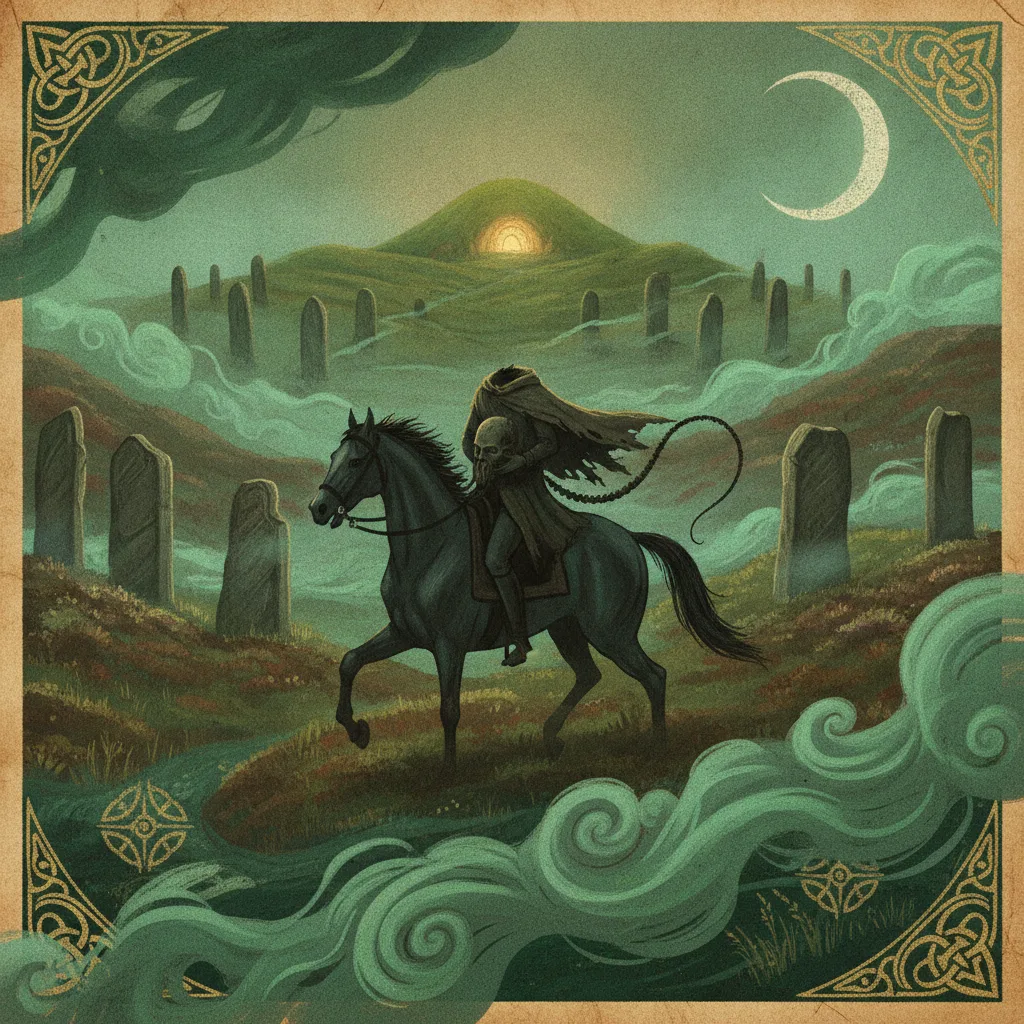
The Dullahan (Irish dúlachán) is a headless death-herald of Irish folk belief: a rider, or the driver of a silent black death-coach, who halts and calls a name to claim a soul, and is turned back only by gold. He belongs to nineteenth-century folklore collection, not the medieval sagas, and even his oral roots are uncertain.
- Irish death-herald: a headless rider or driver of the silent cóiste bodhar (death-coach).
- Carries his own glowing severed head; wields a whip made from a human spine.
- Where he stops and names someone, that person dies; no barrier stops him.
- His one weakness is gold — even a small coin or pin turns him back.
- Documented only from the early 1800s (Croker, Wilde, Yeats), not medieval myth; the Sleepy Hollow link is unproven.
| Tradition | Irish (folklore, 19th-c. collection) |
| Type | headless death-herald / omen spirit |
| Earliest attestation | Thomas Crofton Croker, Fairy Legends and Traditions of the South of Ireland (1825–1828); not in medieval literature |
| Associated places | Irish country roads at night; the death-house (via the cóiste bodhar) |
| Associated symbols | the carried glowing head, the human-spine whip, the silent death-coach, gold as the one deterrent |
He rides a black horse at night down the country roads, and he has no head on his shoulders — he carries it in his hand, a grinning thing the colour of mouldy cheese, its eyes darting, its mouth fixed in a hideous grin. When he reins in and stops, someone is about to die; and if he speaks, he speaks only one word — a name — and the person named is taken. No gate or lock can bar him, but a scattering of gold will turn him back. He is the Dullahan, the headless horseman of Irish folklore — and he is a superb example of a figure everyone “knows” whose real history is much shorter, and much more nineteenth-century, than the myth-marketing suggests.
Who he is
The Dullahan (Irish dúlachán) is a headless death-herald of Irish folk belief: a rider, or sometimes the driver of a black death-coach — the cóiste bodhar, the “silent” or “deaf coach” — drawn by headless horses. He belongs to the same imaginative family as the banshee: not a god or a hero, but an omen of death, one of the frightening messengers of the otherworld in the folk imagination. This is Irish tradition specifically — and, importantly, it is folk tradition, not the matter of the medieval sagas.
The story the tradition tells
The Dullahan is less a story than a set of vivid, consistent details that recur wherever he is described.
- The head. He carries his own severed head, which glows or is used as a lantern to light the road, and which can see for miles. Its skin is dark and clammy, often likened to stale dough or mouldy cheese.
- The whip. His whip is made from a human corpse’s spine, and with it he can lash out the eyes of anyone who watches him too closely.
- The coach. In many tellings he drives the cóiste bodhar, whose wheels and hooves make no natural sound; when it halts at a door, a death follows in that house.
- The naming. He does not stop to chat: where he draws rein and calls a name, that soul is claimed. He cannot be stopped by any barrier — gates swing open before him — but he has one weakness: an object of gold, even a small coin or pin, will frighten him off.
The death-coach and the death-family
The Dullahan rarely rides alone in the folk imagination. He is bound up with the wider Irish machinery of death-omen: the cóiste bodhar (death-coach) is heard rumbling to a house before a passing, and in many districts the banshee’s keening and the Dullahan’s coach were spoken of together, two signs of the same coming grief. Where the banshee wails for the old families, the Dullahan simply arrives and names — and once he has called at your door, the folk belief allows no bargaining and no reprieve. Some accounts attach him to particular roads, gateways and stretches of country where a fatal accident had happened, so that he functions, as so much Irish supernatural belief does, as a way of marking and remembering dangerous or death-touched places in the landscape.
Regional shapes
Like most living folklore, the details shift from place to place. In some counties he is strictly a horseman; in others chiefly the coachman of the black coach; in a few he is spoken of almost interchangeably with other headless or death-heralding beings. This variability is itself a mark of oral tradition — there is no single “correct” Dullahan, only a family of local tellings that share the head, the coach, the naming and the gold.
What the sources say vs. what circulates — being honest about the age
This is the part to keep properly, because the Dullahan is routinely sold as “ancient Celtic myth,” and the record does not support that.
- He is a creature of nineteenth-century folklore collection. The Dullahan is not found in the great Old, Middle or Early Modern Irish literature. His proper documentation begins in the early nineteenth century, above all in the work of the collector Thomas Crofton Croker. He is a figure of the oral and folk record as it was written down in the 1800s, not of the medieval manuscripts.
- Even his roots in oral tradition are debated. Because he is thinly attested in native sources and leans heavily on one collector, scholars have questioned how deep his roots in genuine Irish oral tradition really run, and how much shape he owes to nineteenth-century literary telling. An early passing reference is sometimes dated to around 1802, but the substantial material is Croker’s and later. Treat “ancient” claims with real caution — uncertain is the honest word.
- The name is not securely explained. Dúlachán is often glossed as “dark man” (as if from dubh, “black”), but the etymology is not settled; that gloss is a reasonable guess, not a fact.
- Name the tradition. He is Irish folklore — not a pan-“Celtic” deity, and not to be blurred with Welsh or Scottish material.
Where he is written down
The foundational source is Thomas Crofton Croker‘s Fairy Legends and Traditions of the South of Ireland, published in parts between 1825 and 1828 — the collection that also, translated by the Brothers Grimm (Irische Elfenmärchen, 1826), introduced Irish fairy-lore to a European readership; its death-coach tale is a key text. The Dullahan then passes into the later Victorian anthologies: Lady Wilde‘s Ancient Legends of Ireland (1887) and W. B. Yeats‘s Fairy and Folk Tales of the Irish Peasantry (1888), both of which drew on Croker and kept the headless rider in circulation. It is worth noting that Croker was known to shape and embellish his material, so even the “primary” source is a literary one.
The pop-culture layer, and one persistent myth
A word on the claim you will meet everywhere: that the Dullahan inspired Washington Irving’s headless horseman in The Legend of Sleepy Hollow (1820). This is unproven and probably overstated. Irving’s tale predates Croker’s collection, and Irving drew chiefly on Continental (notably German/Hessian) headless-horseman traditions; the neat “Sleepy Hollow came from the Dullahan” line is a modern tidy-up, not a documented lineage. Enjoy the resemblance; don’t state a descent.
The Dullahan in modern art, fiction and games
For a figure with such a short paper trail, he has thrived in modern media. Disney’s Darby O’Gill and the Little People (1959) put the cóiste bodhar and its headless driver on screen for a mass audience. He is a recurring monster in video games — a “Dullahan” enemy appears across the Final Fantasy and Castlevania franchises and many others — and he has been reinvented most famously as Celty Sturluson, the sympathetic Irish dullahan of the Japanese light-novel and anime series Durarara!!. Between Halloween marketing and gaming bestiaries, the headless rider is now one of the most globally recognised “Celtic” monsters — which makes honest dating all the more useful.
Keeping him properly
The Dullahan is the headless death-herald of Irish folklore: the rider with his glowing head in his hand, the spine-whip, the silent death-coach, the single fatal naming, and the gold that turns him back. But he is a creature of the nineteenth-century folklore record — Croker, Wilde, Yeats — not of the medieval sagas; even his oral depth is uncertain; and the popular “he inspired Sleepy Hollow” line is unproven. A great monster, honestly young. Old stories, kept properly.
| Tradition | Irish folklore (19th-c. collection); not medieval myth |
| Earliest text | Thomas Crofton Croker, Fairy Legends and Traditions of the South of Ireland (published in parts 1825–1828); an early passing reference is sometimes dated c. 1802 |
| Also appears | Croker's collection translated by the Brothers Grimm as Irische Elfenmärchen (1826); Lady Wilde, Ancient Legends of Ireland (1887); W. B. Yeats, Fairy and Folk Tales of the Irish Peasantry (1888) |
| Later additions | His oral depth is uncertain and leans on one (embellishing) collector; the claim that he inspired Irving's Sleepy Hollow (1820) is unproven and likely overstated; heavy modern pop-culture reinvention (Darby O'Gill, video-game bestiaries, Durarara!!) |
| Translation | Croker's own English text (1825–1828); Grimm German translation (1826) |
| Reviewed | 2026-08 |
Frequently asked questions
What is the Dullahan?
A headless death-herald of Irish folklore: a rider on a black horse — or the driver of the silent death-coach, the cóiste bodhar — who carries his own glowing head. Where he stops and calls a name, that person dies.
Is the Dullahan an ancient Celtic myth?
No. He is not found in medieval Irish literature. His documentation begins in the early 19th century, chiefly with the collector Thomas Crofton Croker, and even his depth in genuine oral tradition is debated. ‘Ancient’ claims are not supported by the record.
How do you protect yourself from him?
In the folklore, gold is his one weakness — even a small gold coin or pin will frighten him off. No gate, lock or barrier otherwise stops him.
Did the Dullahan inspire the Headless Horseman of Sleepy Hollow?
Probably not, or at least it is unproven. Washington Irving's tale (1820) predates Croker's collection and drew mainly on Continental German/Hessian headless-horseman traditions. The ‘Sleepy Hollow came from the Dullahan’ line is a modern tidy-up.
What is the earliest written source?
Thomas Crofton Croker's Fairy Legends and Traditions of the South of Ireland, published in parts between 1825 and 1828 — later Victorian anthologies by Lady Wilde (1887) and W. B. Yeats (1888) kept him in circulation.
What does the name mean?
The Irish dúlachán is often glossed ‘dark man’, as if from dubh (‘black’), but the etymology is not settled, so treat that meaning as a reasonable guess rather than a fact.
