The Minor Arcana as symbolism: the four suits and the pips
The 56 Minor Arcana cards as iconography: the four suits, their elements, and how Pamela Colman Smith's 1909 scenic pips remade tarot. Not fortune-telling.
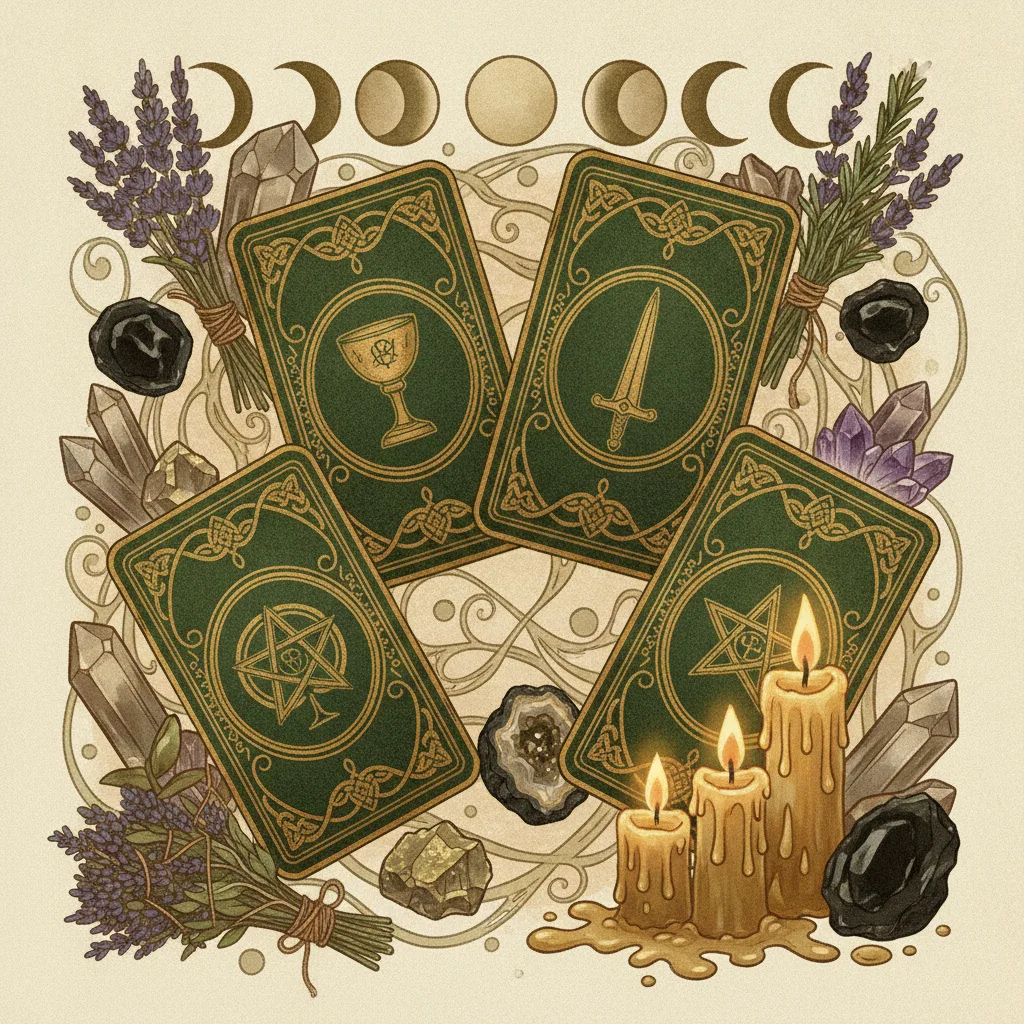
The Minor Arcana is 56 of tarot's 78 cards — four suits of Wands, Cups, Swords and Pentacles inherited from Latin playing cards. Occultists later assigned each an element and domain. The great change came in 1909, when Pamela Colman Smith illustrated every pip card as a narrative scene.
- The Minor Arcana's four suits come from Latin playing cards.
- Occultists later tied the suits to the four classical elements.
- Before 1909 pip cards were countable suit-signs, not scenes.
- Pamela Colman Smith illustrated all 78 cards as narrative pictures.
- Her scenic pips echo the 1490s Sola Busca deck.
Most people who know anything about tarot know the Major Arcana — the Fool, the Tower, Death, the World. But 56 of a deck’s 78 cards belong to the Minor Arcana: four suits of fourteen cards each, and it is here that a card game’s ordinary playing deck meets the illustrated imagery that later generations read as symbolism. This is a guide to that iconography and its history — what the suits and the pip cards depict and how they came to look the way they do — not a manual for telling the future, which the pictures were never designed to do.
The shape of the Minor Arcana
The Minor Arcana is structured almost exactly like a modern playing-card deck, because it shares an ancestry with one. Four suits, each running Ace (One) through Ten, plus four court cards. In the older Continental pattern the courts are Page (or Knave), Knight, Queen and King — one more rank than the Jack-Queen-King of ordinary cards, the extra Knight being what a standard deck later dropped.
The four suits, in the widely used Rider-Waite-Smith naming, are:
- Wands (also Batons, Rods or Staves)
- Cups (Chalices)
- Swords
- Pentacles (Coins or Discs in older and other decks)
These map directly onto the Latin-suited playing cards still used in Italy and Spain: bastoni (batons), coppe (cups), spade (swords) and denari (coins). The tarot did not invent the suits; it inherited them.
The four suits as symbolic categories
By the time occultists of the late nineteenth and early twentieth centuries were rethinking the deck, each suit had been assigned a classical element and a domain of human life. These associations are an interpretive tradition layered onto the cards, not something inherent in a batons-and-coins game, but they are the framework most modern imagery assumes:
- Wands — Fire. Traditionally read as the sphere of drive, creativity, enterprise and action. In the imagery, staves that sprout leaves, journeys, contests and building.
- Cups — Water. The sphere of emotion, relationship and the inner life. Overflowing chalices, toasts, reunions and reverie.
- Swords — Air. The sphere of thought, conflict, language and difficulty. Blades, storms, bindings and hard decisions — the suit with the starkest images.
- Pentacles — Earth. The sphere of work, craft, material life and the body’s world. Coins, gardens, workshops and stewardship of resources.
Read as symbolism, the suits are simply four lenses on ordinary experience — doing, feeling, thinking, making. That is a useful way to understand why the imagery clusters as it does, without any claim that a card can report on events.
Pips versus pictures: the great change of 1909
Here is the pivot of the whole story. For most of tarot’s history the numbered “pip” cards were not scenic. In the fifteenth-century Italian decks and in the later Tarot de Marseille pattern, the Three of Cups showed three cups arranged in a decorative pattern — much as the three of hearts shows three hearts. The pips were countable suit-signs, not little stories. Only the court cards and the trumps carried figures.
What changed that, and defined the look of tarot for the twentieth century onward, was the deck published in London in 1909 by William Rider and Son, designed by the artist Pamela Colman Smith to the specifications of the occultist A. E. Waite. Smith illustrated every pip card with a full narrative scene: the Ten of Wands as a figure bowed under a heavy bundle of staves; the Three of Swords as a heart pierced by three blades under rain; the Ten of Cups as a family beneath a rainbow of chalices. For the first time in a widely printed deck, all 78 cards told a picture-story.
Pamela Colman Smith, properly credited
For decades the deck was called simply “Rider-Waite,” crediting the publisher and the commissioner while omitting the artist who actually drew all 78 images. That is now widely corrected: it is increasingly called the Rider-Waite-Smith deck, or the Waite-Smith deck, restoring Pamela Colman Smith — an artist and illustrator active in the London art world and a member of the Hermetic Order of the Golden Dawn — to her rightful place. Her scenic pips are the reason a modern reader can look at a numbered card and “read” it at all; the interpretive richness people prize is largely her visual invention.
Smith did not work from nothing. She created her deck within a couple of years of the British Museum acquiring photographs of the Sola Busca tarot, an Italian deck of the 1490s that was one of the earliest with fully illustrated pip cards, and she very likely saw those images. Several of her compositions — the Three of Swords among them — echo Sola Busca cards closely enough that the debt is clear. So the “revolutionary” illustrated pips have a fifteenth-century precedent; Smith’s achievement was to make the idea coherent, beautiful and mass-produced.
How to look at a pip card
Approached as iconography, a Smith pip rewards plain visual reading. Note the suit (which domain — doing, feeling, thinking, making). Note the number (aces as beginnings and pure potential; tens as fullness or the end of a cycle). Then read the scene as a small composed picture: who is in it, what they are doing, what the weather and setting suggest. The Five of Pentacles shows two figures passing a lit church window in the snow — an image of hardship and of help nearby, composed to be understood at a glance. That is design, and studying it is closer to reading a stained-glass panel than to any claim about what will happen.
The court cards
The sixteen court cards — Page, Knight, Queen and King in each suit — were traditionally taken to represent people or the qualities of the suit expressed as character. Smith gave each a distinct posture and setting keyed to its element: the watery, contemplative King of Cups on a throne at sea; the earthy, prosperous Queen of Pentacles in a flowering garden. Again this is portraiture-as-symbolism: the elemental temperament made visible, useful for reflection and story, and not a mechanism for identifying real individuals.
Why the iconographic reading matters
Understanding the Minor Arcana as a designed image-system — Latin playing-card suits, elemental associations added by later occultists, and Pamela Colman Smith’s 1909 scenic pictures drawing on a 1490s precedent — lets you appreciate the cards honestly. It credits the right people, dates the imagery correctly, and treats the 56 cards as what they demonstrably are: a remarkable piece of narrative illustration built on an old game, worth studying as art and cultural history in their own right.
Frequently asked questions
How many cards are in the Minor Arcana?
Fifty-six of the deck's 78 cards, divided into four suits of fourteen: Ace through Ten plus four court cards (Page, Knight, Queen and King).
What are the four suits and their associations?
Wands (Fire, drive and action), Cups (Water, emotion and relationship), Swords (Air, thought and conflict) and Pentacles (Earth, work and the material world). The elemental associations were added by later occultists, not inherent in the original card game.
Who illustrated the scenic pip cards?
Pamela Colman Smith, for the deck published in London in 1909 by William Rider and Son to A. E. Waite's specifications. She gave every numbered card a full narrative scene, which is why the deck is now credited as Rider-Waite-Smith.
Were pip cards always illustrated with scenes?
No. In the fifteenth-century Italian decks and the Tarot de Marseille, the pips were plain countable suit-signs. The Sola Busca deck of the 1490s was a rare early exception with fully illustrated pips, and likely influenced Smith.
Do the Minor Arcana cards tell the future?
This guide treats them as designed imagery and cultural history — narrative illustration built on an old card game — not as a means of predicting events.
