Celtic Legends Pan-European (Germanic, Norse, Welsh, English, French)
The Wild Hunt
The spectral riders are a pan-European motif — Germanic, Norse, Welsh, English and French — not one Celtic myth. Who leads the hunt, and where each version comes from.
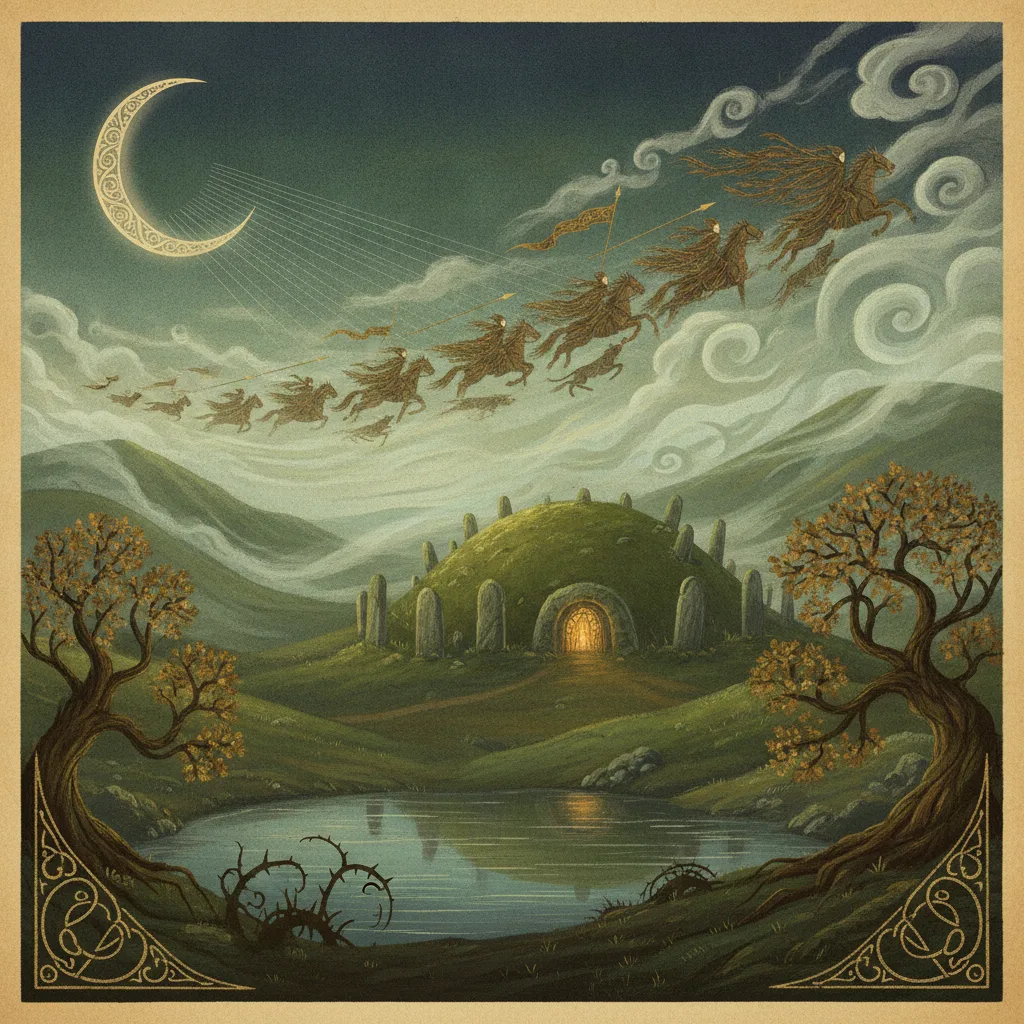
The Wild Hunt is not a single Celtic myth but a pan-European motif - a spectral cavalcade of huntsmen, hounds and the restless dead across the winter sky - attested separately in Germanic, Norse, Welsh, English and French sources. The umbrella term and its Odin-led synthesis come from Jacob Grimm's Deutsche Mythologie (1835), framed long after the varied medieval accounts.
- The Wild Hunt is a pan-European motif, not a single unified Celtic myth.
- The term and Odin-as-leader synthesis come from Jacob Grimm's Deutsche Mythologie (1835).
- Datable medieval accounts include Orderic Vitalis (c.1130s) and the Peterborough Chronicle (1127).
- Welsh tradition has the Cŵn Annwn and Gwyn ap Nudd; France, the Mesnie Hellequin.
- England's Herne the Hunter first appears in Shakespeare (1597), not ancient sources.
| Tradition | Pan-European: Germanic, Norse, Welsh (Brythonic), English, French |
| Type | Spectral procession / motif of huntsmen, hounds and the restless dead |
| Earliest attestation | Orderic Vitalis, c. 1130s (of an event in 1091); Peterborough Chronicle s.a. 1127 |
| Associated places | Windsor Forest (Herne); Annwn (Welsh Otherworld); Normandy; Norway; German lands |
| Associated symbols | Spectral hounds and horses, horns, storm and midwinter/Yule, white red-eared dogs (Wales) |
The Wild Hunt is often filed under “Celtic myth.” It is nothing so tidy. It is a pan-European motif — a spectral cavalcade of huntsmen, hounds and the restless dead that storms across the winter sky — attested in Germanic, Norse, English, Welsh and French sources, each with its own leader, its own name and its own date of first appearance. Even the phrase “the Wild Hunt” is not ancient. Untangling the strands matters, because the popular idea of one unified myth is largely a 19th-century invention.
The name is younger than the legends
The umbrella term comes from the German folklorist Jacob Grimm, who popularised die wilde Jagd (“the Wild Hunt”) in his Deutsche Mythologie (1835). Grimm did something bold and, in hindsight, questionable: he gathered scattered regional legends and recent peasant folklore together, treated them as fragments of one lost system, and argued that its leader was a survival of the god Wodan (Norse Óðinn / Odin). That Odin-as-huntsman synthesis is genuinely influential, but it is Grimm’s interpretation, framed centuries after the medieval accounts. The individual legends he drew on are older and more varied than the single story he built from them.
The Germanic and Norse strand
In Germanic Europe the hunt appears under names like the Wütendes Heer (“Furious Host”) and, in Scandinavia, the Norwegian Oskoreia or Åsgårdsreia — a boisterous, dangerous ride associated with the dark of midwinter and Yule. Odin’s own attributes — a night-rider, a god of the dead and of ecstatic frenzy, accompanied in the myths by wolves and ravens — make him a natural candidate for a leader figure, which is why Grimm reached for him. It is fair to say the Norse imaginative world supplied strong raw material; it is not quite fair to say a single “Odin’s Hunt” is attested as such in the earliest Norse texts.
The medieval Latin accounts
The best datable descriptions come from Anglo-Norman clerics writing in Latin. Around the 1130s, Orderic Vitalis, in his Historia Ecclesiastica, tells of a young Norman priest named Walchelin who in 1091 met a terrifying nocturnal procession of the damned — soldiers, clergy, women and knights, tormented and known to him as the dead of the district. Orderic calls this company the familia Herlechini, the household of Herlequin (Hellequin) — the earliest clear form of the French Mesnie Hellequin. A generation later, the Peterborough Chronicle, under the year 1127, records black huntsmen on black horses and goats with hideous hounds, seen and heard by many for weeks after an unpopular abbot’s installation.
To these we can add Walter Map, whose De Nugis Curialium (c. 1180s) preserves the tale of King Herla, an ancient British king who visited the Otherworld, returned to find centuries had passed, and was doomed to ride endlessly with his troop — the Herlethingus. Map explicitly links Herla’s ride to the Hellequin material, and later readers connected the name in turn to Woden. So the “Wild Hunt” of the high Middle Ages travelled under several polysyllabic names — Herlechin, Herlething, Hellequin — across England, Normandy and Wales.
The Welsh strand: Cŵn Annwn and Gwyn ap Nudd
Wales contributes one of the most distinctive versions, and it is important not to fold it carelessly into the Germanic one. The Cŵn Annwn — the “hounds of Annwn,” the Welsh Otherworld — are spectral dogs, in folklore white with red ears, whose cry grows fainter as they draw nearer. In the First Branch of the Mabinogi (Pwyll Pendefig Dyfed), Pwyll blunders into a hunt in the forest and drives off a pack feeding on a stag, only to learn the hounds belong to Arawn, king of Annwn — the encounter that sets the whole tale in motion. In later medieval and folk tradition the hunt of these hounds is presided over by Gwyn ap Nudd, a lord of the Otherworld and of the fair folk. This is a genuinely Brythonic (Welsh) contribution, with its own Otherworld cosmology, not a mere translation of Odin’s ride.
The English strand: Herne the Hunter
England’s most famous huntsman, Herne the Hunter, is a useful lesson in dating. Herne — a horned, chain-rattling phantom haunting an oak in Windsor Forest — first appears in a securely datable source only in Shakespeare’s The Merry Wives of Windsor (1597). Later writers, especially in the Victorian period and after, speculated that Herne was a fossil of an ancient horned god or a local form of the Wild Hunt leader. That may be so, but it is speculation built on a single Elizabethan reference; the “ancient god Herne” is largely a modern romantic elaboration. Alongside him, English tradition also knew Wild Edric, a real 11th-century Anglo-Saxon lord who resisted the Normans and was later said to ride the borderlands as a spectral hunter.
The continental strand: the Mesnie Hellequin and beyond
In medieval and later France the procession is the Mesnie Hellequin (Hellequin’s retinue) — the same Hellequin whose name Orderic recorded, and who would, by a winding theatrical route, lend his name to the harlequin of later comedy. In parts of German-speaking Europe the leadership sometimes shifts to female figures — Frau Holle or Perchta — heading a procession of spirits or the unbaptised dead around the Twelve Days of Christmas. The consistent thread across all these regions is a season (deep winter, Yule, the Twelve Days) and a mood (the dead abroad, the sky in uproar), not a single named god.
What ties it together — and what does not
What the versions share is structural: a spectral company, often the dead or the damned; a leader; hounds and horses; a midwinter or storm setting; and an encounter that brings warning, doom or abduction. What they do not share is a single origin, a single leader or a single culture. The Welsh Cŵn Annwn come from Annwn; the Norse ride belongs to a Germanic Yule; Hellequin is Norman-French; Herne is Elizabethan English. Grimm’s achievement was to notice the family resemblance. His overreach — copied ever since — was to treat that resemblance as proof of one buried myth with Odin at its head. The honest description is a widespread European motif with deep but plural roots, best appreciated one named tradition at a time.
What the hunt was for
In the societies that told these stories, the hunt was rarely just a thrill. It carried a moral and social charge. To see it was frequently an omen — of death, war, plague or the death of a king. The medieval clerical accounts, in particular, put the motif to work as Christian moral instruction: Orderic Vitalis’s procession is explicitly a parade of sinners doing penance, a warning to the living to mend their ways, and his priest Walchelin survives to report it precisely so the lesson can be told. The company was also said to sweep up the unwary — those out of doors at the wrong hour, or in some tellings the unbaptised and the unshriven — which gave the legend a practical function as a curfew and a caution to children.
These uses help explain why the motif proved so durable and so portable. A story that can be a seasonal ghost tale, a moral sermon, a political omen and a bedtime warning all at once will travel well and take local colour wherever it lands. That is exactly what the surviving record shows: the same broad shape recurring from Norway to Normandy to Windsor, each community naming its own leader and pinning the ride to its own troubled nights.
Into the modern imagination
After Grimm, the Wild Hunt became a fixture of Romantic and then popular culture — in poetry, painting, opera and, more recently, fantasy fiction and games. That afterlife is genuinely part of the story, but it is a modern chapter and should be dated as one. When a novel or a game presents “the Wild Hunt” as a single coherent mythology led by one dark rider, it is drawing on Grimm’s 19th-century synthesis and its descendants, not on the plural medieval record. Knowing which layer you are looking at is the whole point.
| Tradition | Pan-European motif with plural roots (Germanic/Norse, Welsh, English, French) |
| Earliest text | Orderic Vitalis, Historia Ecclesiastica (c. 1130s), the familia Herlechini; Peterborough Chronicle, year 1127 |
| Also appears | Walter Map, De Nugis Curialium (c. 1180s), King Herla / Herlethingus; Pwyll Pendefig Dyfed (First Branch of the Mabinogi), Arawn and the hounds of Annwn |
| Later additions | Herne the Hunter (Shakespeare, Merry Wives of Windsor, 1597); Gwyn ap Nudd as huntsman in later Welsh lore; Jacob Grimm's Wodan/Odin synthesis (Deutsche Mythologie, 1835) |
| Translation | German die wilde Jagd = "the Wild Hunt"; Welsh Cŵn Annwn = "hounds of Annwn"; French Mesnie Hellequin = "Hellequin's household" |
| Reviewed | 2026-08 |
Frequently asked questions
Is the Wild Hunt a Celtic myth?
Not exactly. It is a pan-European motif. There is a genuinely Celtic (Welsh/Brythonic) version — the Cŵn Annwn led by Arawn or Gwyn ap Nudd — but the motif as a whole is equally Germanic, Norse, English and French, and its most datable early accounts are Anglo-Norman Latin texts.
Who leads the Wild Hunt?
It depends entirely on the tradition. Jacob Grimm argued for Odin/Wodan in 1835, but that is a 19th-century synthesis. Medieval sources name Herlequin/Hellequin and King Herla; Welsh lore names Arawn and Gwyn ap Nudd; England has Herne the Hunter and Wild Edric; German regions sometimes have Frau Holle or Perchta.
Where does the name "Wild Hunt" come from?
From the German die wilde Jagd, popularised by the folklorist Jacob Grimm in his Deutsche Mythologie (1835). The legends are far older than the umbrella term, which is why lumping them under one name can be misleading.
What is the earliest written account?
Two Anglo-Norman sources stand out: Orderic Vitalis (writing around the 1130s) describing the priest Walchelin's vision of the familia Herlechini in 1091, and the Peterborough Chronicle's entry for the year 1127 describing black huntsmen and hounds. Walter Map's King Herla follows around the 1180s.
Are the Cŵn Annwn part of the Wild Hunt?
They are the Welsh form of the motif. The "hounds of Annwn" — spectral dogs, white with red ears — belong to Arawn, king of the Otherworld, in the First Branch of the Mabinogi, and in later lore are hunted by Gwyn ap Nudd. It is a distinct Brythonic tradition, not a copy of the Norse ride.
Is Herne the Hunter an ancient god?
There is no early evidence for that. Herne first appears in Shakespeare's Merry Wives of Windsor (1597). The idea that he is a survival of a pre-Christian horned god is a later, largely Victorian, speculation built on that single reference.
