The best Irish mythology non-fiction: where to actually start
New to Irish myth and drowning in lookalike 'Celtic' titles? A frank, in-print starting shelf, from Marie Heaney's retellings to Mark Williams's history.
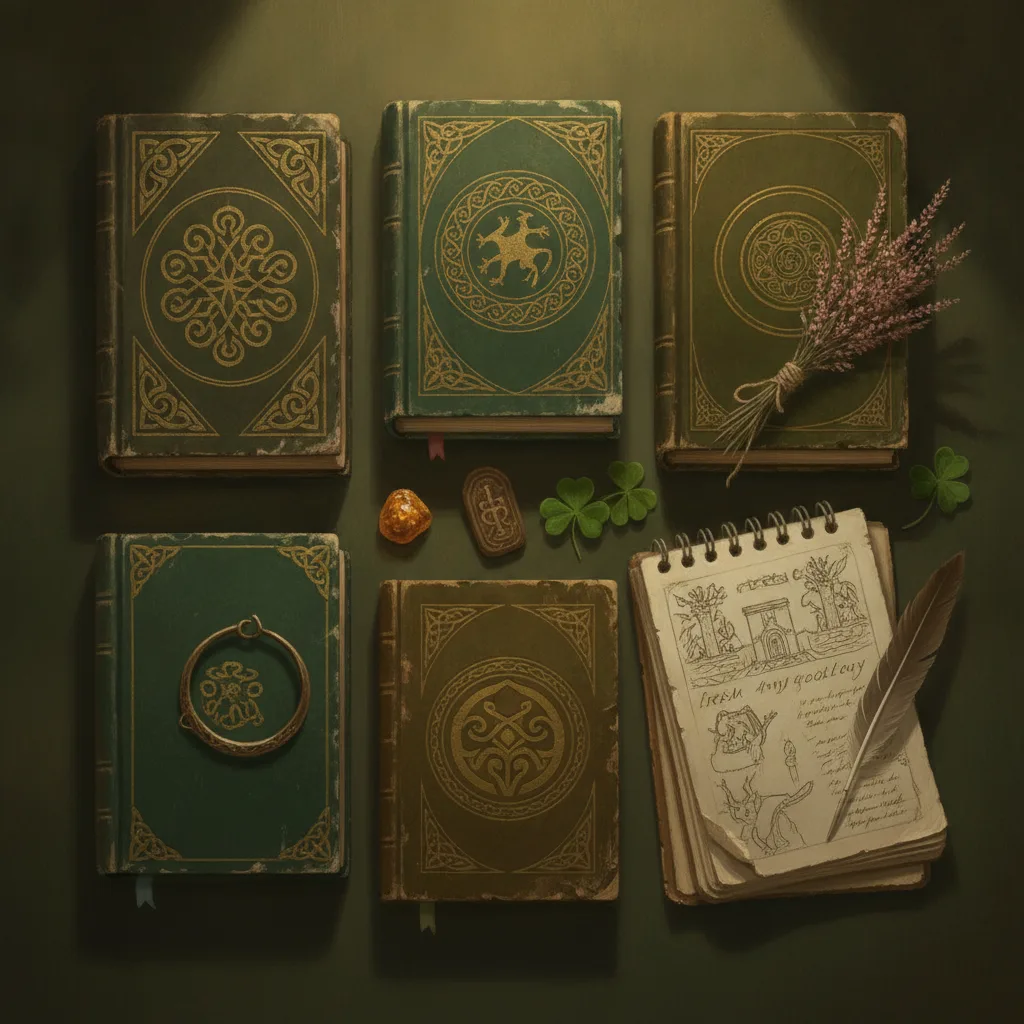
Start with Marie Heaney's Over Nine Waves for the shape of the stories, then Mark Williams's Ireland's Immortals to understand how they came down to us. Keep Daragh Smyth or Miranda Aldhouse-Green as a reference, and read Lady Gregory as Revival literature, not a reliable source.
- Over Nine Waves is the most complete single-volume retelling in print.
- Ireland's Immortals explains how the gods were rewritten over centuries.
- Smyth or Aldhouse-Green serve as desk references.
- Read Lady Gregory as Celtic Revival literature, not fact.
- Avoid the pan-Celtic grab-bag that blends distinct traditions.
Walk into any bookshop’s mythology shelf and you will find a dozen books with a knotwork spiral on the cover and the word “Celtic” in the title. Some are excellent. Many are century-old public-domain compendia reprinted with a fresh jacket, and a few are simply invented. If you want to read the actual mythology of Ireland — the gods of the Tuatha Dé Danann, the heroes of the Táin, the Fianna — the hard part is not finding books but knowing which ones to trust. Here is a short, honest starting shelf: what each title is genuinely good for, and where to be careful.
Start with a good retelling: Marie Heaney, Over Nine Waves
If you read one book first, make it Marie Heaney’s Over Nine Waves: A Book of Irish Legends (Faber). It gathers the most important tales from the three great pre-Christian sequences — the Mythological, Ulster and Fenian cycles — followed by the lives of Patrick, Brigid and Colmcille, all in clear, unhurried prose. It is a retelling, not a translation, so you are reading Heaney’s version rather than a medieval text. That is exactly what you want at the start: a map of the whole landscape before you go looking at the primary sources. It remains, in practice, the most complete single-volume retelling in print.
The one modern history to own: Mark Williams, Ireland’s Immortals
Mark Williams’s Ireland’s Immortals: A History of the Gods of Irish Myth (Princeton University Press; paperback ISBN 978-0-691-18304-6) is the book that turns a reader into someone who understands the material. Williams, who teaches medieval Irish and Welsh at Oxford, traces how Ireland’s pagan divinities were rewritten by Christian scribes in the Middle Ages and then reinvented again during the Celtic Revival of the late nineteenth and early twentieth centuries. It introduces the Morrígan, Brigid and the rest not as a fixed pantheon but as figures that shift shape across a thousand years of writing.
Crucially, Williams is honest about uncertainty. He will tell you, for instance, that the goddess “Danu” is largely a modern reconstruction from a genitive form, rather than a securely attested deity. If you have ever wondered why the sources contradict one another, this is the book that explains it — and it does so without draining the wonder out of the stories.
A reference for the desk: Daragh Smyth, A Guide to Irish Mythology
Daragh Smyth’s A Guide to Irish Mythology (Irish Academic Press; the second edition dates to the 1990s) is an A-to-Z with a genuinely useful cross-reference system, covering all four cycles. It is the book you reach for when a name surfaces mid-read and you want a quick, sober entry rather than a random blog. One caveat worth stating plainly: it is an older title and is often out of stock new or priced steeply, so a good used copy is usually the sensible buy.
A concise illustrated overview: Miranda Aldhouse-Green, The Celtic Myths
For a slim, well-illustrated single volume, Miranda Aldhouse-Green’s The Celtic Myths: A Guide to the Ancient Gods and Legends (Thames & Hudson, 2015) is a strong pick. Aldhouse-Green is a professor of archaeology, so she brings material evidence — the Gundestrup Cauldron, the bog bodies — to bear alongside the Irish and Welsh tales, and she is good on how the myths were transmitted and by whom. Two honest notes: it is pan-Celtic rather than Ireland-only, and its angle is archaeology and belief as much as narrative. That breadth is a feature if you want context, a limitation if you only want Irish story.
Read as history, not as fact: Lady Gregory
Lady Augusta Gregory’s Cuchulain of Muirthemne (1902) and Gods and Fighting Men (1904) are beautiful, and Yeats adored them. They are also more than a century old, written in a deliberately archaic “Kiltartan” English, and quietly arranged and softened for an Edwardian readership. Enjoy them as literature and as a landmark of the Celtic Revival — but treat them as historical artefacts of how the Revival presented myth, not as a reliable modern source. If you spot a detail there that appears nowhere else, be cautious before repeating it as fact.
What to be wary of
Two things trip up newcomers. The first is the endlessly reprinted public-domain compendium — T. W. Rolleston’s Myths and Legends of the Celtic Race (1911), the works of Charles Squire, and their kin. They are cheap and everywhere, but they carry the assumptions, and sometimes the racial framing, of their era, and their scholarship is long superseded. The second is the “Celtic” grab-bag that blends Irish, Welsh, Scottish and Gaulish material into a single soup, as though it were one tradition. It was not.
This is really a question of folklore accuracy, and it comes down to a simple test you can apply in the shop. A trustworthy book tells you where a claim comes from — which manuscript, which century, which editor — and flags where something is reconstructed or contested. An untrustworthy one narrates myth as a seamless, timeless fact, with no seams and no sources. Williams and Aldhouse-Green pass that test comfortably; the Victorian compendia mostly do not.
A word on “Celtic” versus “Irish”
One distinction saves a great deal of confusion. “Celtic” is a language family and a broad cultural label spanning Ireland, Scotland, Wales, Cornwall, Brittany and the ancient Continental Celts. “Irish” myth is a specific literary tradition preserved in medieval Irish manuscripts. Much of what is marketed as “Celtic mythology” quietly folds Welsh material — the Mabinogi, Arthurian romance — in with the Irish, and readers come away thinking figures from different traditions all belong to one seamless pantheon. The better books keep the strands separate and tell you when they are reaching across. If a title promises “the Celtic myths” but only ever cites Irish tales, that is worth noticing; and if it blends Irish and Welsh gods without comment, be sceptical. Knowing which nation, language and century a story comes from is not pedantry — it is the difference between reading the mythology and reading a marketing category.
What about children’s and gift editions?
Illustrated retellings for younger readers can be lovely, and a beautifully produced gift edition is a fine way to fall in love with the material. Just hold them to the same test: does the book say whose version this is, and where the stories come from? A retelling is honest when it presents itself as one. The problem is only the volume that dresses a loose, invented paraphrase in the authority of “ancient Celtic wisdom.” For a reader building real knowledge, use the retelling as a doorway and let a modern history like Williams’s do the load-bearing work behind it.
A simple path
Put together, the route is short. Read a retelling to learn the shape of the stories (Heaney). Read a modern history to understand how they came down to us (Williams). Keep a reference within reach for the names (Smyth, or Aldhouse-Green for wider context). Add Lady Gregory later, for pleasure and for perspective on the Revival. Do that, and you will know more than most casual readers — and, just as usefully, you will know what you do not yet know.
Frequently asked questions
Where should a complete beginner start?
With a retelling that maps the whole terrain: Marie Heaney's Over Nine Waves: A Book of Irish Legends (Faber). It covers the Mythological, Ulster and Fenian cycles in clear prose, so you learn the shape of the stories before tackling primary sources.
What is the best modern book for understanding the gods?
Mark Williams's Ireland's Immortals: A History of the Gods of Irish Myth (Princeton). It traces how the deities were rewritten by medieval scribes and reinvented in the Celtic Revival, and it is honest about what is attested versus reconstructed.
Are the old public-domain 'Celtic myth' books worth reading?
Treat them with caution. Titles like T. W. Rolleston's Myths and Legends of the Celtic Race (1911) are cheap and endlessly reprinted, but their scholarship is superseded and they carry the assumptions of their era. Use modern books for guidance.
Is Lady Gregory a reliable source?
Read her as history, not fact. Cuchulain of Muirthemne (1902) and Gods and Fighting Men (1904) are beautiful Celtic Revival landmarks, but they are arranged, softened and written in archaic 'Kiltartan' English. Enjoy them as literature, not as a modern source.
How can I tell a trustworthy myth book from a bad one?
A good one tells you where each claim comes from — which manuscript, century and editor — and flags what is reconstructed or contested. A weak one narrates myth as seamless, timeless fact with no sources. Apply that test in the shop.
