Celtic Legends Irish · Mythological Cycle
Brigid
Brigid the goddess — daughter of the Dagda, patron of poetry, healing and the forge (Sanas Cormaic, c.900) — and Saint Brigid of Kildare: deeply entangled, but the continuity is genuinely unresolved.
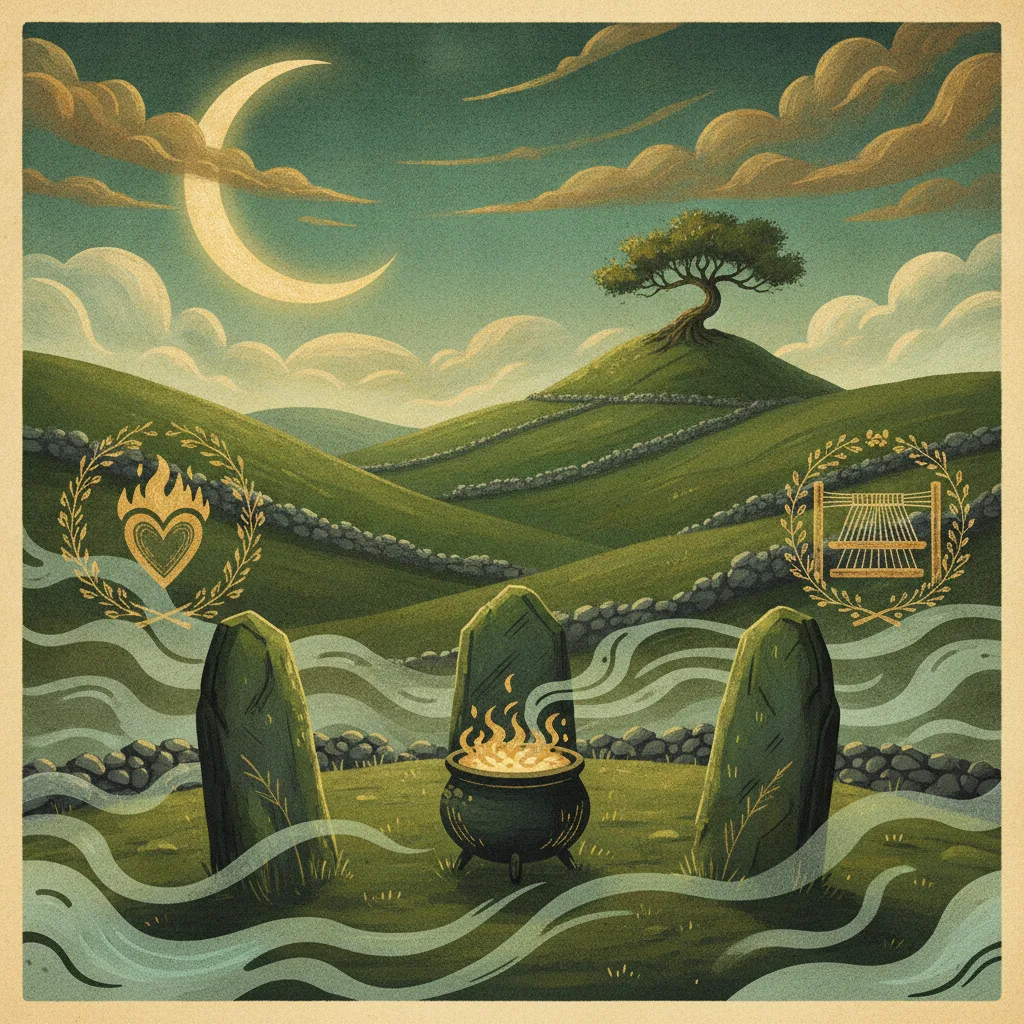
Brigid is two entangled figures: the Irish goddess of poetry, healing and the forge, attested around 900 in Cormac's Glossary and Cath Maige Tuired, and Saint Brigid of Kildare (c.451-525), whose earliest Life dates to about 650. Popular claims that the Church simply turned the goddess into the saint outrun the evidence; the exact relationship is genuinely contested.
- Brigid is two entangled figures: an Irish goddess and Saint Brigid of Kildare.
- The goddess of poetry, healing and smithcraft is attested c.900 in Cormac's Glossary.
- In Cath Maige Tuired she is the Dagda's daughter and the origin of Irish keening.
- Saint Brigid (c.451-525) has an early Life by Cogitosus (c.650); her feast is 1 February (Imbolc).
- The 'goddess became saint' claim is a modern oversimplification; the real link is intimate but unproven.
| Tradition | Irish (Mythological Cycle) |
| Type | goddess (later overlaid with a saint) |
| Earliest attestation | Sanas Cormaic (Cormac’s Glossary), c.900; also Cath Maige Tuired |
| Associated places | Kildare; Ireland; (cognate Brigantia in northern Britain) |
| Associated symbols | fire, the forge, poetry, healing wells, the rush cross, Imbolc (1 Feb) |
Brigid is two figures wearing almost the same name, and the honest work of folklore is to keep them in view together without pretending we know exactly how they are related. There is Brigid the goddess of the Tuatha Dé Danann — patron of poetry, healing and the forge — and there is Saint Brigid of Kildare, one of Ireland’s three national patron saints. Popular retellings collapse the two into a single “goddess who became a saint.” The medieval sources are more interesting, and more uncertain, than that.
Brigid the goddess
Our clearest early witness is Sanas Cormaic (“Cormac’s Glossary”), an Irish glossary of word-origins traditionally attributed to Cormac mac Cuilennáin, king-bishop of Cashel, who died in 908 — so the core of the text dates to around 900. Its famous entry describes Brigit as “a goddess whom poets worshipped,” a woman of wisdom and poetry. Crucially, it says she had two sisters of the same name: Brigit the woman of healing (leechcraft) and Brigit the woman of smithwork. In other words the earliest description we have already presents her as a threefold figure spanning poetry, medicine and metalwork — the three high crafts of early Irish society.
She is placed in the divine genealogy as a daughter of the Dagda, and in the war-story Cath Maige Tuired she is married to Bres, the half-Fomorian king, and bears a son, Ruadán. When Ruadán is killed in the battle, Brigid comes to mourn him — and the text says that she “shrieked and wept” and that this was the first time keening (caoineadh) was heard in Ireland. That single line makes her, in the tradition, the origin of the Irish funeral lament. It is one of the most quietly powerful moments in the whole cycle, and it is genuinely medieval, not a modern embroidery.
Was she once a wider Celtic goddess?
Beyond Ireland there is a British goddess, Brigantia, worshipped among the Brigantes of northern Britain and attested in Romano-British inscriptions, whose name appears to be linguistically cognate. Scholars have long connected the two as reflexes of a common word meaning “the exalted one” or “the high one.” This is a reasonable and widely held inference from language — but it is an inference, drawn from etymology and scattered inscriptions, not a single continuous myth, and it should be stated as such rather than as a documented fact.
Brigid the saint — and the honest problem of continuity
Saint Brigid of Kildare is traditionally dated to roughly 451–525 and is remembered as the founder of the monastery of Kildare. Her earliest surviving Life, the Vita Sanctae Brigitae by the monk Cogitosus, was written around 650 — remarkably early for an Irish saint’s Life. Her feast day is 1 February, which is also Imbolc, the old festival marking the start of spring and the lactation of ewes.
Here is where care is essential. The popular story — endlessly repeated online — is that the Church simply took the pagan goddess, renamed her a saint, and moved on. The truth is more contested. It is true that the saint carries attributes strikingly similar to the goddess (fire, fertility, protection of livestock, association with poetry and healing) and that her feast lands squarely on a pre-Christian festival. But recent scholarship is cautious about assuming a straightforward “goddess-into-saint” transformation:
- Some scholars argue Brigid of Kildare was a real or semi-historical figure around whom local devotion grew, and that her cult later absorbed older attributes rather than being invented from the goddess wholesale.
- Others hold that the overlap is too deep to be coincidence and that the goddess’s cult did substantially feed the saint’s.
- The neat “she is literally the goddess” claim, popular since the nineteenth century, outruns what the evidence can actually prove.
The intellectually honest position — and the one this site takes — is that goddess and saint are intimately entangled, that the entanglement is real and ancient, and that the exact mechanism is genuinely uncertain. Anyone who tells you it is settled, in either direction, is overselling.
The fire of Kildare
One detail binds goddess, saint and folklore together more tightly than any other: the perpetual fire at Kildare. By the twelfth century Gerald of Wales, in his Topographia Hibernica (c.1188), reported that at Kildare a sacred flame associated with Brigid was kept endlessly burning, tended in turn by her nuns — nineteen of them, with Brigid herself keeping the twentieth night — and enclosed by a hedge that, he says, no man was permitted to cross. A tended, undying fire watched over only by women is exactly the kind of institution that invites speculation about pre-Christian roots, and many have read it that way. But note what we actually have: a twelfth-century observer describing a Christian monastic custom. Whether that fire descends from an older cult of the fire-goddess is plausible and much argued, and, like the wider continuity question, unproven. It is a perfect miniature of the whole Brigid problem — a real, vivid, datable practice, wrapped around an origin we cannot see to the bottom of. The Kildare flame was famously extinguished at the Reformation and has been symbolically relit in modern times.
The living customs
Around the saint’s day cluster folk customs of real antiquity in their recorded form, whatever their ultimate origin: the woven St Brigid’s cross of rushes, hung for protection; the brat Bhríde, a cloth left out overnight to catch her blessing; and processions with the Brídeóg, a figure of Brigid carried house to house. These are documented folk practices, mostly recorded from the early modern period onward, and they keep both Brigids alive in daily life.
Where she is written down
For the goddess: Sanas Cormaic (c.900), edited and translated by John O’Donovan and Whitley Stokes as Cormac’s Glossary (1868); Cath Maige Tuired, in Elizabeth A. Gray’s edition for the Irish Texts Society (1982); and the genealogical material of Lebor Gabála Érenn, in R. A. S. Macalister’s edition (1938–1956). For the saint: the Vita of Cogitosus (c.650) and the later Bethu Brigte. The British goddess Brigantia is known only from Romano-British inscriptions and iconography.
What the sources say vs. what circulates
- “Goddess = saint, full stop” is a nineteenth- and twentieth-century oversimplification. Keep the relationship as intimate but unproven.
- The “triple goddess maiden-mother-crone” reading of Brigid is modern Neopaganism. The medieval triple Brigit is three sisters of poetry, healing and smithcraft — a very different scheme.
- Elaborate “correspondence” tables (crystals, tarot, specific herbs) are contemporary devotional practice, valuable as living tradition but not medieval attestation.
Brigid in modern art, fiction and games
Brigid has an unusually vivid modern life. In 2023 Ireland established a new public holiday around St Brigid’s Day (early February) — the first Irish public holiday named for a woman — a striking case of a medieval figure re-entering the civic calendar. She is a major figure in contemporary Irish Neopaganism and in the wider Imbolc revival, and she recurs in fantasy fiction, poetry and visual art drawing on the Irish gods. The goddess of poets, fittingly, keeps inspiring poems.
Keeping her properly
Brigid the goddess is securely attested from around 900 in Sanas Cormaic and Cath Maige Tuired: daughter of the Dagda, patron of poetry, healing and the forge, and the mythical origin of keening. Saint Brigid of Kildare is a distinct figure with her own early Life (c.650). The two are deeply and anciently entangled — but exactly how is unresolved, and this site will always say so rather than flatten a real historical puzzle into a tidy story.
| Tradition | Irish (Mythological Cycle); saint-cult overlay |
| Earliest text | Sanas Cormaic (Cormac’s Glossary), c.900 — ‘a goddess whom poets worshipped’ |
| Also appears | Cath Maige Tuired (mother of Ruadán; origin of keening); Lebor Gabála Érenn genealogy; cognate British goddess Brigantia (Romano-British inscriptions) |
| Later additions | Saint Brigid of Kildare (c.451–525; earliest Life by Cogitosus, c.650); goddess-to-saint ‘continuity’ is contested and unresolved; ‘maiden-mother-crone’ triad and correspondence tables are modern Neopaganism; St Brigid’s Day public holiday from 2023 |
| Translation | O’Donovan & Stokes, Cormac’s Glossary (1868); Gray, Cath Maige Tuired (1982); Macalister, Lebor Gabála Érenn (1938–1956) |
| Reviewed | 2026-08 |
Frequently asked questions
Are the goddess Brigid and Saint Brigid the same person?
They are deeply and anciently entangled — the saint shares fire, fertility, poetry and healing associations with the goddess, and her feast falls on Imbolc — but the ‘the saint is simply the goddess renamed’ claim is contested. Recent scholarship is cautious; the exact relationship is genuinely unresolved.
What is the earliest source for the goddess?
Sanas Cormaic (Cormac’s Glossary), from around 900, which calls Brigit ‘a goddess whom poets worshipped’ and describes her and her two same-named sisters as patrons of poetry, healing and smithcraft.
Is Brigid a triple goddess?
In the medieval sources, yes — but as three sisters of poetry, healing and smithcraft, not the modern ‘maiden-mother-crone’ triad, which is a 20th-century Neopagan framework.
Did Brigid invent keening?
In Cath Maige Tuired, when her son Ruadán is killed she shrieks and weeps, and the text says this was the first keening (caoineadh) heard in Ireland — making her, in the tradition, the origin of the funeral lament.
What is the connection to Brigantia?
Brigantia was a goddess of the Brigantes in Romano-British northern Britain whose name appears cognate with Brigid’s. Scholars link them as reflexes of a common word for ‘the high one’ — but this is a linguistic inference, not a single shared myth.
Why is there now an Irish public holiday for Brigid?
In 2023 Ireland created a new early-February public holiday around St Brigid’s Day — the first Irish public holiday named for a woman — a modern civic revival of a very old figure.
