Celtic Legends Irish · Mythological Cycle
Balor: the Fomorian king with the destroying eye
The Fomorian king whose single destroying eye could unmake an army — and who dies exactly as prophesied, at the hand of his grandson Lugh, in Cath Maige Tuired.
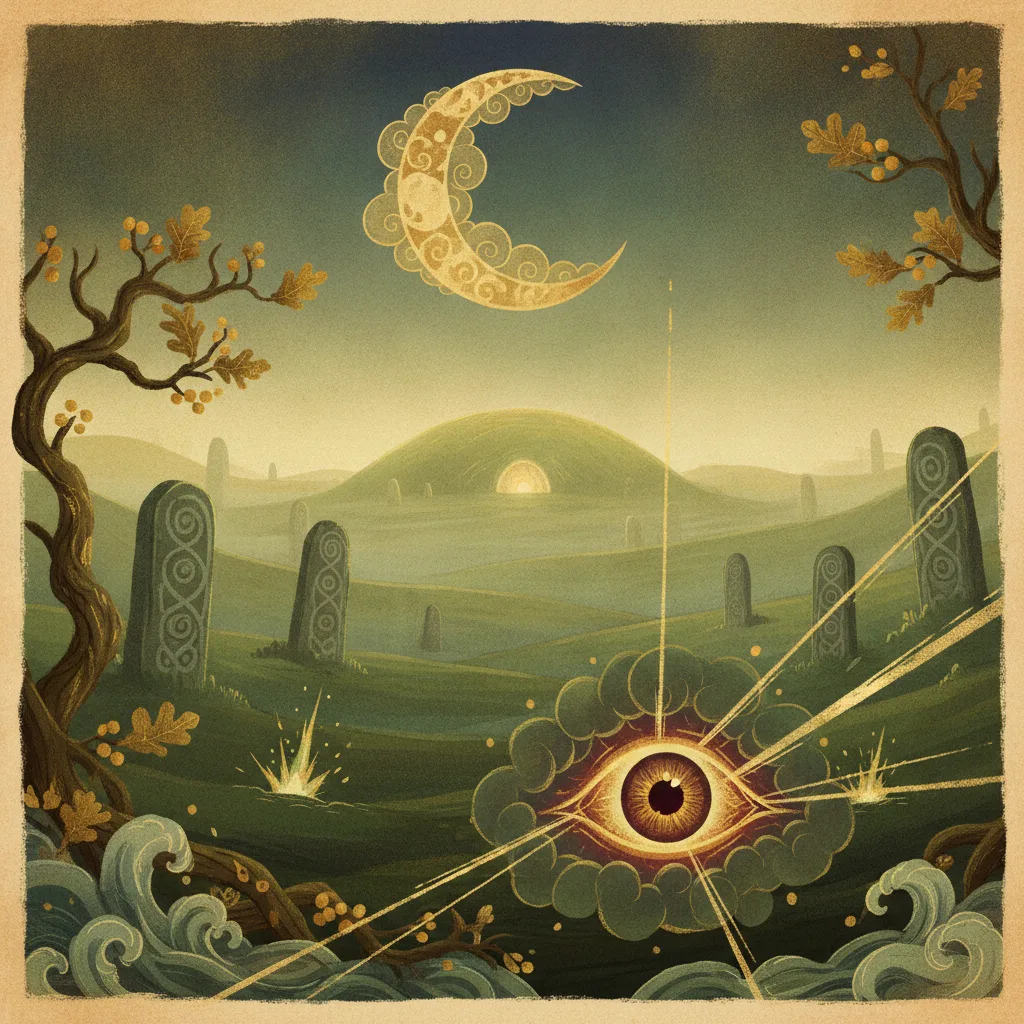
Balor is the one-eyed Fomorian king of Irish myth whose destroying eye lays waste to armies, killed at the second battle of Mag Tuired by his own grandson Lugh. His story survives in Cath Maige Tuired, a medieval text preserved in a sixteenth-century manuscript. The popular 'sun god' label is a contested nineteenth-century interpretation, not a source claim.
- Balor is the one-eyed Fomorian king of Irish myth, the great antagonist of the Mythological Cycle.
- His defining text is Cath Maige Tuired, preserved in a sixteenth-century manuscript from older material.
- Prophecy said his grandson would kill him; Lugh does so at the second battle of Mag Tuired.
- Later folklore drifts: varying eye-counts and a Tory Island giant, not in the medieval text.
- The 'sun god' or 'drought god' reading is a contested nineteenth-century interpretation.
| Tradition | Irish (Mythological Cycle) |
| Type | Fomorian king (the destroying eye; chief antagonist) |
| Earliest attestation | Cath Maige Tuired (surviving redaction 11th–12th c.; sole MS Harley 5280, 16th-c. copy) and Lebor Gabála Érenn (11th c.) |
| Associated places | Mag Tuired (the battlefield); later folklore localises him to Tory Island, Co. Donegal |
| Associated symbols | the single 'evil'/destroying eye; the lidded eye raised on a ring by four attendants |
Balor is the great antagonist of Irish myth: a Fomorian king whose single monstrous eye could destroy an army with a glance, and who dies exactly as prophecy said he would — at the hand of his own grandson, Lugh, on the field of the second battle of Mag Tuired. He is the Irish tradition’s clearest study in a doom you cannot outrun, and one of the few figures whose “evil eye” is meant with terrible literalness.
Where Balor comes from
Balor belongs to the Fomorians (Fomoire), the hostile, sea-associated race who oppose the Tuatha Dé Danann for control of Ireland in the mythological history. His defining appearance is in Cath Maige Tuired, “The (Second) Battle of Mag Tuired,” the central text of the Mythological Cycle. The tale survives in a single late manuscript — British Library Harley 5280, a sixteenth-century copy — but the language and material it preserves are considerably older, with the surviving redaction generally traced to the eleventh or twelfth century and drawing on earlier tradition. It was edited by Whitley Stokes in 1891 and translated by Elizabeth A. Gray for the Irish Texts Society in 1982, which remains the standard English version.
He also figures in Lebor Gabála Érenn (the “Book of Invasions,” compiled in the eleventh century), which frames the wars of the Tuatha Dé and the Fomorians within the pseudo-historical settlement of Ireland. Between these two, Balor is firmly a medieval literary figure — not a documented object of ancient cult worship, a distinction worth keeping, since it is easy to slide from “character in the sagas” to “god the Celts prayed to,” and the sources will not carry the second claim.
The Fomorians themselves are worth understanding, because Balor makes little sense without them. In the mythological history they are the older, hostile power of the land — variously described as raiders, tribute-takers and monstrous outsiders associated with the sea and with chaos — against whom each successive people of Ireland must contend. By the time of the second battle of Mag Tuired they are the last great obstacle to the Tuatha Dé, and Balor, as their king and their deadliest weapon, is the enemy on whom the whole conflict turns. His defeat is not a skirmish but the decisive break in the balance of power.
The eye
Balor’s power is concentrated in a single destroying eye. In Cath Maige Tuired the eye is so deadly that it is kept shut, and it takes four men to raise its lid by a ring or handle fixed to it — the effort itself a measure of the danger. When the lid comes up, whatever the eye falls on is undone. The text ties its venom to a druidic origin: in the account, Balor’s eye acquired its power from the fumes of a potion his father’s druids were brewing, which passed over it and poisoned it. This is the “evil eye” belief — a folk conviction found across many cultures that a malignant look can cause harm — rendered as literal weaponry.
His epithets keep the eye front and centre: he is remembered as Balor of the piercing or baleful eye. It is one of the most vivid single images in the whole tradition, and it is worth reading in Gray’s translation rather than in paraphrase, where the specific, mechanical horror of the lifted lid tends to get smoothed away.
The detail of the four attendants and the ring set into the eyelid matters more than it first appears. It makes the eye a weapon that must be deliberately aimed and deployed, not a passive curse — something closer to a siege engine than to a glance. That is precisely why the moment of its opening on the battlefield is the tale’s point of maximum danger, and why the timing of Lugh’s strike, as the lid comes up, is the hinge on which the whole battle swings.
The prophecy and the death
Balor’s story is governed by a prophecy: a druid foretells that he will be killed by his own grandson. He responds as the doomed king of myth always does — by trying to prevent any grandson from being born. He shuts his daughter, named Ethniu (Eithne), away from all contact with men. The confinement fails. Through the surrounding tradition she bears a son to Cian of the Tuatha Dé Danann, and that son is Lugh — so Balor is Lugh’s maternal grandfather, and the very child he sought to prevent.
The prophecy closes at the second battle of Mag Tuired. As Balor’s eye is being opened over the battlefield, Lugh strikes it. In Cath Maige Tuired the weapon is a sling-stone: Lugh casts the stone into the eye and drives it out through the back of Balor’s head, so that the eye’s destroying power now falls on the Fomorian host massed behind him, turning Balor’s own weapon against his army. The image of the falling king crushing his own men appears in the tradition too. The prophecy is fulfilled precisely, and by the exact means the king took such care to forestall.
Balor is the rare mythic villain whose defeat is also the whole point of his story: every precaution he takes is a step toward the outcome he is trying to avoid.
Later folklore and the modern drift
Here the layers must be separated. The medieval Balor above is one thing; the Balor of later Irish oral tradition, collected by folklorists mainly in the nineteenth century, is another — related, but visibly reshaped. In these later folk versions the details drift: Balor may have one, two, or three eyes; the killing weapon becomes a red-hot iron rod or a special spear rather than a sling-stone; and he is frequently localised to Tory Island off the Donegal coast, sometimes recast as a cattle-raiding giant with a fortress there. These are genuine folk traditions, and interesting in their own right, but they are late variants and should not be read back into the medieval text as if they were its original content.
A second modern habit is worth flagging: the confident labelling of Balor as a “sun god,” a “god of drought,” or a personification of the scorching summer, with Lugh as the young sun who overthrows him. These are readings from nineteenth- and early twentieth-century comparative mythology, which liked to resolve every god into a solar or seasonal symbol. They are interpretations, and contested ones, not statements the Irish sources make. The texts present Balor as a Fomorian king with a lethal eye and a fatal prophecy; the cosmic solar allegory is a layer laid on top by later scholars, and honest treatment keeps it labelled as such.
Why Balor still matters
Balor endures because his story is airtight. It is the tragedy of the self-fulfilling prophecy in its cleanest form: the effort to escape the fate is the mechanism that delivers it. His duel with Lugh is the hinge of the whole mythological history — the moment the Tuatha Dé break Fomorian power and the destroying eye is turned back on its own side. For the winners’ side of that same battle, read Lugh, the all-skilled god who casts the fatal stone, and the Tuatha Dé Danann, the people whose victory the prophecy secures. Read together, they make one of the most satisfying arcs in European myth — and one that rewards going back to Gray’s translation of Cath Maige Tuired to see how spare and strange the original actually is.
| Tradition | Irish (Mythological Cycle) |
| Earliest text | Cath Maige Tuired ('The Second Battle of Mag Tuired'); surviving redaction 11th–12th c., preserved solely in MS British Library Harley 5280 (16th-c. copy) |
| Also appears | Lebor Gabála Érenn (11th c.); as maternal grandfather of Lugh through his daughter Ethniu (Eithne) |
| Later additions | 19th-c. oral folklore varies the details (one, two or three eyes; a red-hot iron rod or spear in place of the sling-stone; a Tory Island setting); the 'sun/drought god' reading is 19th–20th-c. comparative mythology and is contested |
| Translation | Whitley Stokes (ed., 1891); Elizabeth A. Gray, Cath Maige Tuired (Irish Texts Society, 1982) |
| Reviewed | 2026-08 |
Frequently asked questions
Where does Balor's story come from?
His central appearance is in Cath Maige Tuired, the Mythological Cycle account of the second battle of Mag Tuired. Its surviving redaction is 11th–12th century, preserved in a single 16th-century manuscript (Harley 5280), and translated by Elizabeth A. Gray for the Irish Texts Society in 1982. He also figures in Lebor Gabála Érenn.
What was Balor's eye?
A single destroying eye, kept shut because whatever it looked upon was undone. In Cath Maige Tuired it takes four men to raise the lid by a ring fixed to it, and the text says the eye was poisoned by the fumes of a druidic brew — the 'evil eye' belief rendered as a literal weapon.
How did Balor die?
At the second battle of Mag Tuired. As the eye was being opened, Lugh cast a sling-stone into it, driving it out through the back of Balor's head so its destroying power fell on the Fomorian army behind him. (Later folk versions substitute a red-hot rod or spear.)
How is Balor related to Lugh?
Lugh is his grandson. A prophecy said Balor would be killed by a grandson, so he locked away his daughter Ethniu; she nonetheless bore Lugh to Cian of the Tuatha Dé Danann — the very child the prophecy named.
Is Balor a sun god?
That is a modern interpretation, not a source statement. The 'sun god' or 'god of drought' reading comes from 19th- and 20th-century comparative mythology and is contested; the medieval texts present him simply as a Fomorian king with a lethal eye and a fatal prophecy.
Why is Balor linked to Tory Island?
That localisation belongs to later Irish oral folklore, mainly collected in the 19th century, which recast him as a giant with a fortress on Tory off the Donegal coast. It is a genuine folk tradition but a late one, and not part of the medieval text.
