Celtic Legends Irish · Mythological Cycle
Lugh
Lugh Lámhfhada, the all-skilled god (samildánach) who slays Balor in Cath Maige Tuired and fathers Cú Chulainn — with the ‘sun god’ label and pan-Celtic Lugus kept honestly separate.
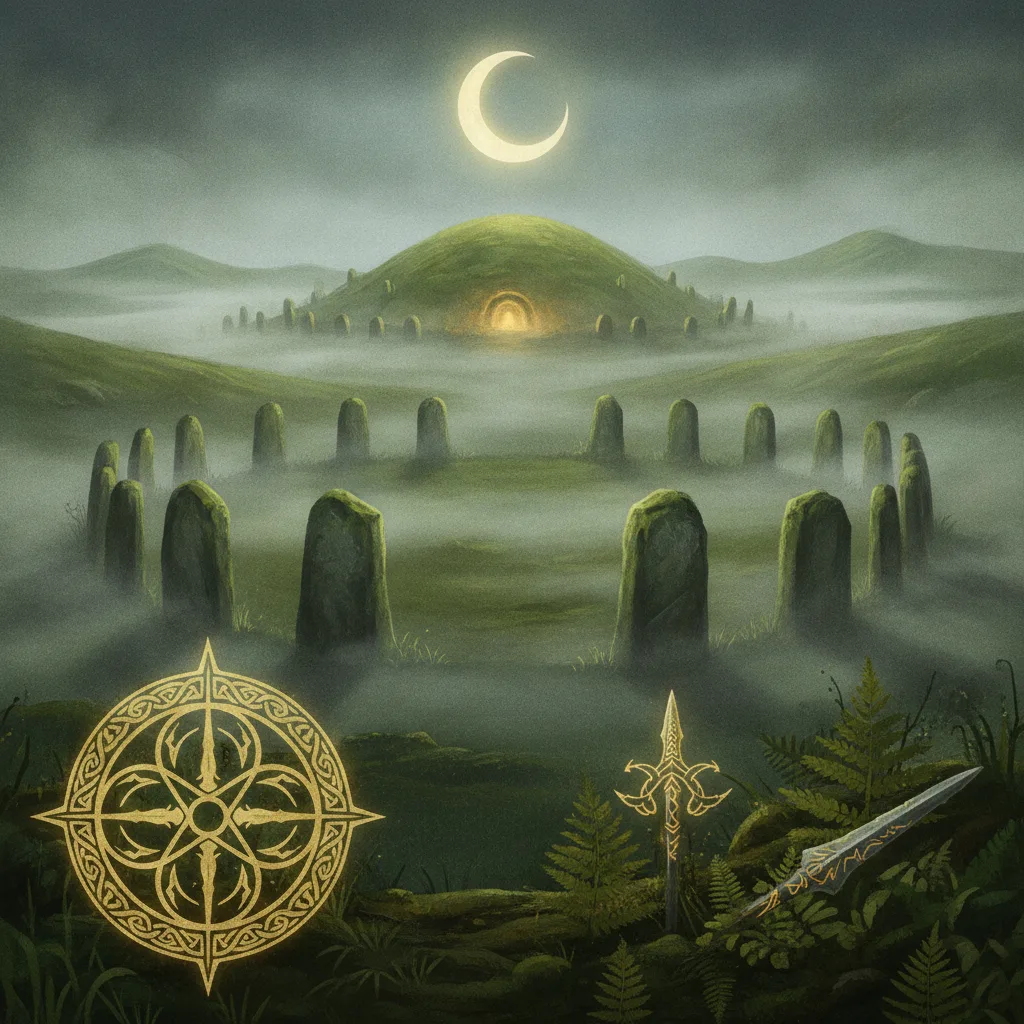
Lugh is the all-skilled god (samildánach) of the Tuatha Dé Danann, best known from Cath Maige Tuired, where he kills his grandfather Balor and wins Ireland for the gods. He fathers Cú Chulainn and gives his name to the harvest festival Lughnasadh. A wider Celtic 'Lugus' is a strong hypothesis from place-names and inscriptions, but no continental myth survives.
- Lugh is the all-skilled god (samildánach) of the Tuatha Dé Danann.
- In Cath Maige Tuired he kills his Fomorian grandfather Balor with a sling-stone.
- He is the otherworldly father of the hero Cú Chulainn (Compert Con Culainn).
- He names Lughnasadh (around 1 August), the harvest festival still called 'Lúnasa' in Irish.
- A pan-Celtic 'Lugus' is inferred from names and inscriptions, but no continental myth survives.
| Tradition | Irish (Mythological Cycle; also Ulster Cycle) |
| Type | god (master of all arts; kingship, skill, war) |
| Earliest attestation | Cath Maige Tuired and Lebor Gabála Érenn (compiled 11th c.); as father of Cú Chulainn in Compert Con Culainn (Lebor na hUidre, c.1100) |
| Associated places | Tara; Tailtiu/Teltown; Lughnasadh (~1 Aug) |
| Associated symbols | the spear, the sling, mastery of every craft |
A young stranger comes to the gate of Tara and asks to be let in. The doorkeeper says no one enters unless he has an art to offer. “I am a wright,” says the stranger. We already have a wright. “I am a smith.” We have one. Harper, warrior, poet, sorcerer, physician, cupbearer, craftsman in bronze — every art the young man names, the court of the Tuatha Dé Danann already possesses. So he asks a single question: do they have one man who possesses all of these arts together? They do not. And so Lugh is let in. This scene, from the heart of Irish myth, is the perfect introduction to a god defined not by one power but by mastery of everything at once.
The story the sources tell
Lugh’s great epithet is samildánach — “skilled in many arts together,” the master of all crafts — and he is also called Lugh Lámhfhada, “Lugh of the Long Arm” or “Long Hand,” a name usually understood to refer to his reach with a spear or sling. He is of mixed blood, and that is the engine of his story. His father, Cian, is of the Tuatha Dé Danann; his mother, Ethniu (Ethlinn), is a daughter of Balor, the terrible one-eyed king of the Fomorians. A prophecy warned Balor that he would be killed by his own grandson, so he shut his daughter away — but Lugh was born regardless, and the prophecy waited.
The reckoning comes in Cath Maige Tuired (“The Second Battle of Mag Tuired”). Admitted to Tara as the all-skilled one, Lugh takes command of the Tuatha Dé against the oppressive Fomorians. On the battlefield he faces Balor, whose single monstrous eye destroys everything its gaze falls upon; it takes four men to lift its lid. As the lid is being raised, Lugh strikes — with a sling-stone in the most famous version — driving the deadly eye back through Balor’s own head, so that it kills the Fomorian host ranged behind him. The grandson kills the grandfather, the prophecy is fulfilled, and the Tuatha Dé win Ireland. It is one of the great set-pieces of the mythology.
Father of Cú Chulainn
Lugh also reaches into the Ulster Cycle. In Compert Con Culainn (“The Conception of Cú Chulainn“), Lugh is the otherworldly father of the hero Cú Chulainn. During the great single-handed defence of Ulster in the Táin Bó Cúailnge, when Cú Chulainn is exhausted and wounded, Lugh appears to him, identifies himself as his father, and stands guard so that the young man can sleep and heal for three days. It is a rare, tender moment in a brutal epic, and it links the chief god of the Mythological Cycle directly to the chief hero of the Ulster Cycle.
Lughnasadh
Lugh gives his name to one of the four great quarter-festivals of the Irish year, Lughnasadh (around 1 August), the harvest festival. Tradition holds that Lugh founded it as a funeral assembly in honour of his foster-mother Tailtiu, who died clearing the plains of Ireland for agriculture; the great fair and games held at Teltown (Tailtiu) carried her name. The festival’s memory survived remarkably late in Irish rural custom — most famously in events like the Puck Fair at Killorglin — as documented in Máire MacNeill’s landmark study The Festival of Lughnasa (1962).
The Children of Tuireann — a later elaboration
Lugh is also the driving force of Oidheadh Chloinne Tuireann (“The Tragic Death of the Children of Tuireann”), counted among the “Three Sorrows of Storytelling.” When the three sons of Tuireann kill his father Cian, Lugh demands as their blood-fine (éraic) a set of near-impossible treasures from around the world — a magic spear, a healing pigskin, a chariot and horses, and more — sending them on a chain of deadly quests that ultimately destroys them. It is a rich, romantic adventure, and it is a favourite in modern retellings. But it should be dated honestly: while its kernel is old, the elaborate version we read is an Early Modern Irish composition, taking its developed shape centuries after the terse mythological material of Cath Maige Tuired. It is a later flowering of the tradition, not part of its oldest layer, and readers deserve to know which is which.
Where he is written down
Lugh’s core material is in the Mythological Cycle. His defining story is Cath Maige Tuired, which survives in the later British Library manuscript Harley 5280 but preserves much older matter; the standard modern edition and translation is Elizabeth A. Gray’s for the Irish Texts Society (1982). He also appears throughout Lebor Gabála Érenn (“The Book of the Taking of Ireland”), compiled in the eleventh century, in R. A. S. Macalister’s edition (1938–1956), and his spear is counted among the Four Treasures the Tuatha Dé brought from their northern cities (it came from Gorias). His fatherhood of Cú Chulainn is in Compert Con Culainn, preserved in Lebor na hUidre (c.1100).
The continental question
Was Lugh once worshipped across the Celtic world? There are strong hints, but they must be handled carefully. A god Lugus is inferred from continental evidence: several major Roman-era towns bear names built on the element — Lugdunum (Lyon), possibly Laon, Leiden and Carlisle (Luguvalium) — and there are Gaulish and Iberian inscriptions dedicated to the plural Lugoves. Julius Caesar reported that the Gauls’ most-worshipped god was one he equated with Mercury, and many scholars connect that figure with Lugus. In Wales, the Fourth Branch of the Mabinogi tells of Lleu Llaw Gyffes (“Lleu of the Skilful Hand”), a clear linguistic cognate. All of this makes a pan-Celtic Lugus a well-supported hypothesis. But note the honest limit: no continental myth of Lugus survives. We have place-names, inscriptions and a Roman’s interpretation — not a story. The rich narrative Lugh belongs specifically to medieval Ireland.
What the sources say vs. what circulates
- “Lugh the sun god” is a popular but shaky label. The identification of Lugh as a solar deity owes more to nineteenth-century comparative mythology (the fashion for reading gods as sun-symbols) than to the Irish texts, which present him as a god of skill, kingship and war. Treat “sun god” as a modern interpretation, not a source statement.
- “Lug” spelled as if a common noun of light. The old idea that the name simply means “light” or “shining” is now doubted; other etymologies (linked to oaths, or to “lynx”/”the one who binds”) are argued. The meaning is not settled.
- Neopagan Lughnasadh “correspondences” (fixed crystals, deities, ritual formats) are modern devotional practice, valuable as living tradition but not medieval attestation.
Lugh in modern art, fiction and games
Lugh recurs across modern fantasy and games that draw on the Irish and wider Celtic pantheons, and appears in Japanese role-playing series such as Shin Megami Tensei. But his most durable modern presence is the calendar: Lughnasadh survives as a living seasonal marker, revived in contemporary Irish festivals and in the Neopagan Wheel of the Year, and August is still “Lúnasa” in the modern Irish language — a god’s name doing quiet work in everyday speech.
Keeping him properly
Lugh is the all-skilled god of the Tuatha Dé Danann, best known from Cath Maige Tuired (where he kills Balor) and Lebor Gabála Érenn, and reaching into the Ulster Cycle as the father of Cú Chulainn. A wider Celtic Lugus is a strong hypothesis built on place-names and inscriptions — but without a surviving continental myth. The “sun god” tag and the tidy etymology of “light” are later interpretations, not source facts, and this site keeps the vivid Irish storyteller’s Lugh distinct from the reconstructed one.
| Tradition | Irish (Mythological Cycle; also Ulster Cycle) |
| Earliest text | Cath Maige Tuired (older material; MS Harley 5280) and Lebor Gabála Érenn (compiled 11th c.) |
| Also appears | Compert Con Culainn and the Táin (father of Cú Chulainn); the Four Treasures (his spear, from Gorias); Welsh cognate Lleu Llaw Gyffes in the Fourth Branch of the Mabinogi |
| Later additions | Pan-Celtic ‘Lugus’ inferred from place-names (Lugdunum/Lyon) and Gaulish ‘Lugoves’ inscriptions — no surviving continental myth; ‘sun god’ reading is 19th-c. comparative mythology; Lughnasadh survivals studied in MacNeill (1962) |
| Translation | Gray, Cath Maige Tuired (Irish Texts Society, 1982); Macalister, Lebor Gabála Érenn (1938–1956) |
| Reviewed | 2026-08 |
Frequently asked questions
What does samildánach mean?
‘Skilled in many arts together’ — the master of all crafts. In Cath Maige Tuired, Lugh is admitted to Tara not for any single skill but because he alone possesses every art at once.
How did Lugh kill Balor?
In Cath Maige Tuired, Lugh strikes his grandfather Balor’s deadly single eye as its lid is being raised — with a sling-stone in the best-known version — driving the eye back through Balor’s head so it destroys the Fomorians behind him, fulfilling the prophecy that Balor would die by his grandson’s hand.
Is Lugh the father of Cú Chulainn?
Yes. In Compert Con Culainn, Lugh is the hero’s otherworldly father, and in the Táin he appears to guard the wounded Cú Chulainn while he sleeps and heals for three days.
Is Lugh a sun god?
That is a popular label but not a source statement. It owes more to 19th-century comparative mythology, which liked to read gods as sun-symbols, than to the Irish texts, which present Lugh as a god of skill, kingship and war.
Was Lugh worshipped across the Celtic world?
Probably a related god, Lugus, was — inferred from place-names like Lugdunum (Lyon) and Gaulish ‘Lugoves’ inscriptions, and the Welsh cognate Lleu. But no continental myth of Lugus survives; only Ireland preserves the full story.
What is Lughnasadh?
The harvest festival around 1 August, which tradition says Lugh founded in honour of his foster-mother Tailtiu. August is still ‘Lúnasa’ in modern Irish, and the festival’s survivals were documented in Máire MacNeill’s The Festival of Lughnasa (1962).
