Myth & Folklore Irish
The aos sí (the sidhe): the good folk and the fairy mounds
The aos sí are the Irish "good people" of the fairy mounds — descended in the sagas from the Tuatha De Danann, and hedged about with a careful etiquette of names and offerings.
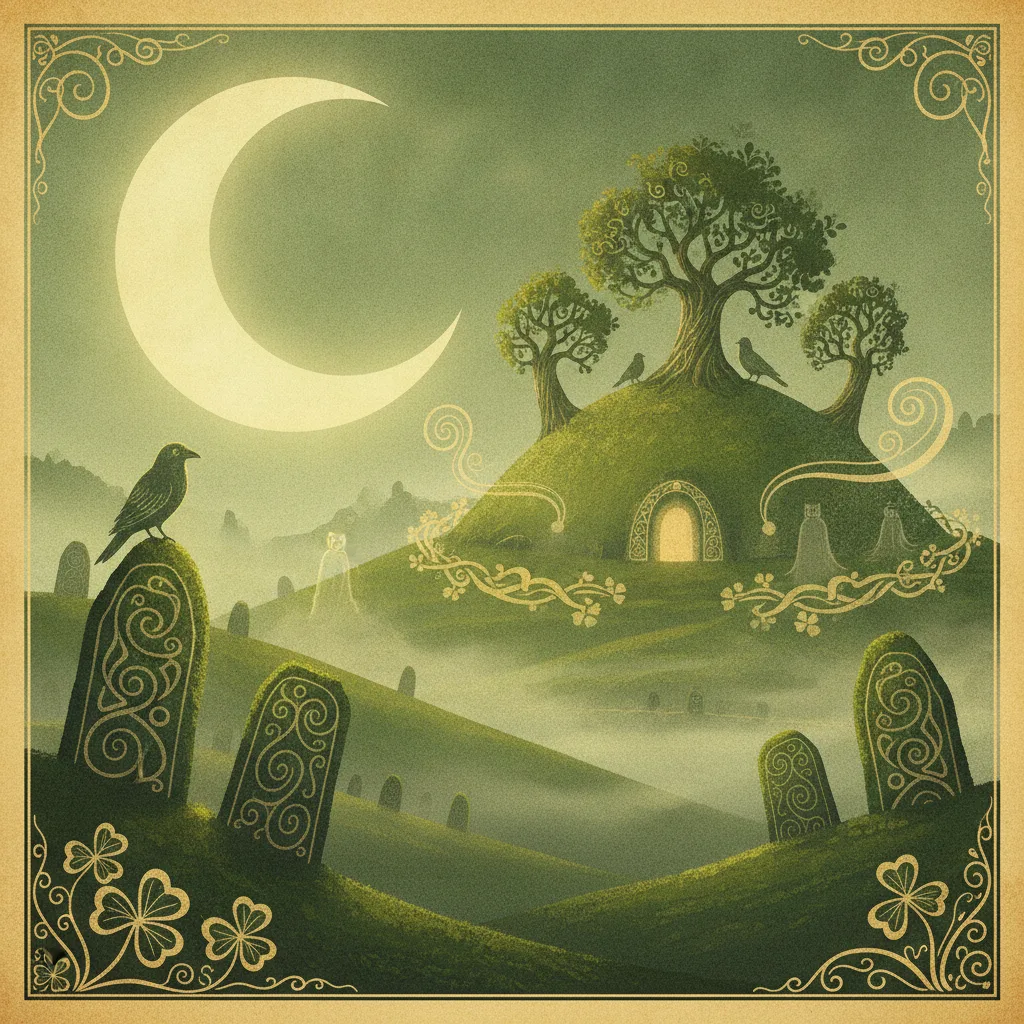
The aos sí (older aes sídhe, anglicised "the sidhe") are the fairy people of Irish tradition — literally "the people of the mounds," the hollow hills and ancient earthworks. Called euphemistically "the good people," they are a separate, easily offended order of being, descended in the medieval literature from the Tuatha Dé Danann.
- Irish people of the mounds; sí means the fairy hill, not the beings themselves.
- Euphemisms like the good people avoided naming touchy, dangerous neighbours directly.
- Etiquette: leave fairy roads, ringforts and lone thorns alone; give small offerings.
- Descend in medieval texts (Lebor Gabála, Cath Maige Tuired) from the Tuatha Dé Danann.
- Irish specifically (cf. Scottish daoine sìth); the Seelie/Unseelie courts are a later Scots graft.
| Tradition | Irish (with Scottish Gaelic cognate daoine sìth) |
| Type | Otherworldly people / fairy race |
| Earliest attestation | Medieval Irish literature (Cath Maige Tuired; Lebor Gabála Érenn, 11th-c. compilation) |
| Associated places | Síde — passage tombs, cairns, ringforts, lone hawthorns |
| Associated symbols | Green mounds, iron, milk offerings, the hawthorn |
Ask an older person in rural Ireland about the folk who live under the green mounds and, even a generation ago, you might have been answered with a careful phrase rather than a name. Not “the fairies.” Not anything so blunt. Instead: na daoine maithe — “the good people” — or simply “the good folk,” “the gentry,” “them that’s in it.” The circumlocution is the whole point. To speak plainly of the aos sí was thought to draw their attention, and their attention was not a thing you courted lightly.
The people of the mounds
The Irish term aos sí (older spelling aes sídhe; also daoine sídhe, “people of the síd”) means, quite literally, “the people of the mounds.” The word sí / sídhe refers not to the beings themselves but to the síde — the hollow hills, the grassy tumuli, the ancient earthworks scattered across the Irish landscape. Over time the name of the dwelling became attached to the dweller, which is why English speakers ended up with “the sidhe” as though it were the race’s own name. Strictly, it is their address.
Those mounds were real, and older than the stories. Many are Neolithic passage tombs, Bronze Age burial cairns, or early-medieval ringforts — places that were plainly the work of earlier hands, standing in fields long after anyone remembered who raised them. Folk memory did what folk memory does: it filled the gap. The people who had gone before had not gone away. They had gone under.
They are not ghosts, and they are not devils. They are a separate order of being — older, prouder, and easily offended.
Why the euphemisms
The names Irish tradition gives them are almost all soft, flattering, or evasive: the good people, the gentry, the wee folk, the fair family (whence the Welsh cousin Tylwyth Teg, “the fair family”). This is not politeness for its own sake. It belongs to a very old logic of naming, in which to call a dangerous thing by its true name is to summon it. You praised the aos sí because they were touchy, powerful neighbours who could sour milk, steal a child, blight a field, or — if pleased — leave a family quietly prosperous for generations.
Hence the etiquette, which was elaborate and taken seriously well within living memory:
- Leave their roads alone. Certain paths across the land were held to be fairy roads; building a house across one invited misfortune until the offending corner was removed.
- Do not disturb their forts or their lone thorns. Ringforts (ráth, lios) and solitary hawthorn trees were their property. To cut them was to court ruin.
- Give the first and the last. A little spilled milk, the dregs of the churn, a portion left out at night — small offerings that acknowledged the older tenants.
- Guard the thresholds of life. Newborns and new mothers were thought especially vulnerable to being taken; iron, salt, fire, and baptism were the countermeasures.
What the sources actually say
Here the folklore has a genuinely deep pedigree, which is worth separating from what circulates online. The aos sí are not a Victorian invention. They descend, in the medieval Irish literary imagination, from the Tuatha Dé Danann — the “peoples of the goddess Danu,” a divine race who, in the pseudo-historical scheme of the Lebor Gabála Érenn (“The Book of the Taking of Ireland,” commonly “The Book of Invasions”), ruled Ireland before the coming of the Gaels. The Lebor Gabála was compiled in the eleventh century from older traditions, and it tells how, after their defeat by the Milesians, the Tuatha Dé Danann did not leave but withdrew into the síde, dividing the hidden country among themselves.
Earlier still, the two saga texts known as Cath Maige Tuired (“The Battle of Mag Tuired”), part of the Mythological Cycle, show these same beings as gods and warriors, not yet the diminished “little people” of later centuries. The trajectory from divine race to fairy folk — from the shining Tuatha Dé Danann to the shy, dangerous daoine sídhe tucked under the hills — is one of the clearest arcs in all of Irish tradition.
Distinguish the traditions
This is an Irish body of lore first and foremost, in the Irish language. Its close relative in Scottish Gaelic is the daoine sìth (or sìthichean), the “people of peace,” carrying the same word sìth for the fairy mound. The Manx and Welsh have their own cognate figures. It is worth resisting the flattening word “Celtic,” which papers over real differences of language, place, and story. The aos sí are specifically the Irish version of a shared Gaelic inheritance.
The collectors and the revival
Most of what a modern reader encounters as “fairy lore” was shaped by a wave of nineteenth- and early-twentieth-century collectors who wrote down oral belief before it faded. Thomas Crofton Croker’s Fairy Legends and Traditions of the South of Ireland (1825) was the first major printed gathering of the material and set the template. Lady Wilde (Speranza) published her Ancient Legends, Mystic Charms, and Superstitions of Ireland in 1887. W. B. Yeats, editing Fairy and Folk Tales of the Irish Peasantry (1888), drew on Croker and others and did more than anyone to fix the aos sí in the literary imagination. Lady Gregory’s Visions and Beliefs in the West of Ireland (1920) recorded testimony gathered around Galway, and W. Y. Evans-Wentz’s The Fairy-Faith in Celtic Countries (1911) attempted the first comparative, quasi-anthropological survey across Ireland, Scotland, Wales, the Isle of Man, Cornwall, and Brittany.
These collectors are indispensable and also a layer of interpretation. They chose what to record, translated it into English, and often framed peasant belief through Romantic or theosophical lenses. When a website tells you “the Celts believed” some tidy thing, it is usually repeating a Victorian editor, not an ancient text. The honest position is that the medieval layer (the sagas) and the collected oral layer (1825 onward) are different kinds of evidence, and the folk belief itself was living, local, and full of regional variation right up to the twentieth century.
A world with its own weather
One reason the belief held on so long is that it was never a single tidy doctrine but a dense web of local, practical knowledge — closer to a body of weather-lore than to a religion. Different districts kept different customs and different names. In parts of Munster the emphasis fell on the slua sí, the “fairy host,” a troop that rode the wind and could sweep up the unwary; a sudden dust-devil crossing a road was an sí gaoithe, the “fairy wind,” and the proper response was to bless yourself and turn away. In Connacht the testimony Lady Gregory gathered dwells more on individual encounters — people “away with the fairies,” taken for a night or for years, returning changed. Time itself was said to run differently under the hill: an evening’s dancing there might be a hundred years above.
The Otherworld, then, was not a distant heaven but a parallel country folded into the ordinary one, entered at the edges — at dusk and dawn, at the turning of the year, at boundaries between field and field, land and water, this life and the next. Samhain (the first of November) and, to a lesser degree, Bealtaine (the first of May) were the thin times when the mounds were said to open. Much of the etiquette was simply a way of keeping the two countries at a respectful distance from one another.
What circulates now
In contemporary fantasy, “the Sidhe” or “the Seelie and Unseelie Courts” have become stock furniture — tall, beautiful, morally ambiguous immortals. The Seelie/Unseelie division is itself largely a Scots Lowland classification (seelie, “blessed”; unseelie, its opposite) that modern authors have grafted onto the Irish aos sí; it is not native to the Irish tradition. Treat it as a useful literary shorthand rather than as authentic Irish belief.
The older attitude survives in quieter ways: in the Irish farmer who still will not plough out a ringfort, in the lone thorn left standing in the middle of a field, in the instinct to say “the good people” and mean it. The etiquette outlasted the theology. You do not have to believe in the aos sí to understand why, for a very long time, it was thought wiser to be polite.
| Tradition | Irish |
| Earliest text | Cath Maige Tuired and Lebor Gabála Érenn (medieval Irish; 11th-c. compilation of older material) |
| Also appears | Scottish Gaelic daoine sìth; Welsh Tylwyth Teg (cognate 'fair family') |
| Later additions | Croker (1825), Lady Wilde (1887), Yeats (1888), Evans-Wentz (1911); the Seelie/Unseelie 'Courts' are a later Scots-derived literary graft, not native Irish |
| Translation | aos sí = 'people of the mound(s)' |
| Reviewed | 2026-08 |
Frequently asked questions
Are the sidhe the same as the Tuatha Dé Danann?
In the medieval Irish scheme, yes by descent. The Lebor Gabála Érenn tells how the Tuatha Dé Danann, defeated by the Milesians, withdrew into the síde (the mounds). Over centuries the divine race of the sagas became the fairy 'good people' of oral tradition.
Why is it called the sidhe if that means 'mound'?
Sí/sídhe names the dwelling, not the dweller. The proper term for the beings is aos sí, 'people of the mounds.' English speakers shortened it, so 'the sidhe' came to stand for the folk themselves — strictly, that is their address, not their name.
Why did people avoid saying 'fairies'?
Naming a dangerous power was thought to attract it. So Irish tradition used flattering euphemisms — na daoine maithe ('the good people'), 'the gentry,' 'the fair folk' — to stay on safe terms with touchy, powerful neighbours.
Is this 'Celtic' folklore?
It is specifically Irish, in the Irish language, with a close Scottish Gaelic relative (daoine sìth). 'Celtic' blurs real differences of language and place; the aos sí are the Irish form of a shared Gaelic inheritance.
Are the Seelie and Unseelie Courts part of this tradition?
Not originally. The seelie ('blessed') / unseelie division comes from Lowland Scots belief and has been grafted onto the Irish aos sí by modern fantasy writers. It is a useful literary shorthand, not authentic Irish lore.
Did anyone really keep the etiquette?
Yes, well into the twentieth century. Farmers left ringforts and lone thorns undisturbed, avoided 'fairy roads,' and left small offerings. The customs outlasted literal belief; being polite simply seemed wiser.
