Celtic Legends Gaelic Ireland (medieval)
Samhain: What It Actually Was
Separating the medieval Irish evidence for Samhain from the Christian Halloween lineage and the 20th-century neopagan Wheel of the Year — carefully dated.
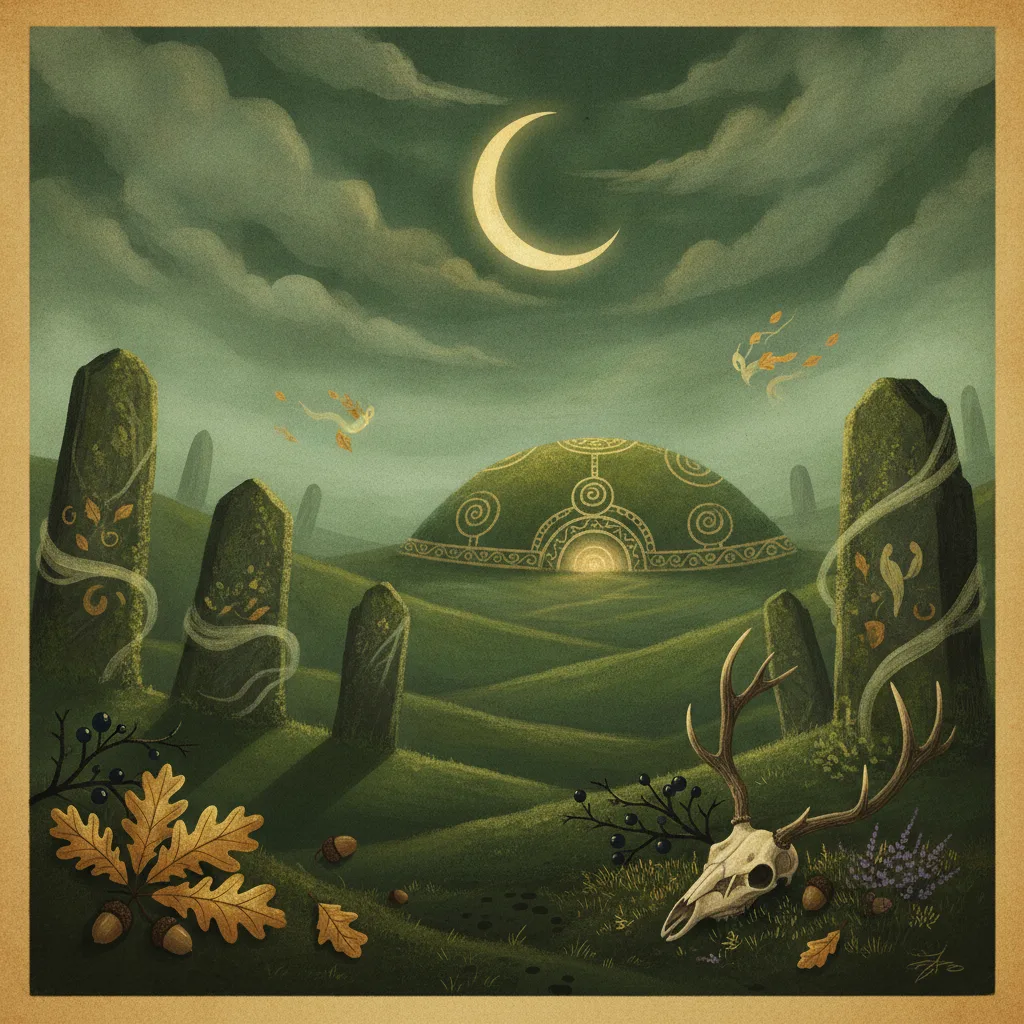
Samhain was a Gaelic quarter-day marking the start of winter, a time of assembly and feasting when medieval Irish literature says the Otherworld drew near. The name's oldest evidence is the Gaulish Coligny calendar (c. 2nd century AD). The 'festival of the dead,' 'Celtic New Year' and Wheel of the Year labels are later inferences, not early source facts.
- Samhain was a Gaelic quarter-day marking winter's start, a time of assembly (óenach) and feasting.
- The oldest evidence for the name is the Gaulish Coligny calendar (c. 2nd century AD).
- Medieval Irish tales treat it as liminal, when the Otherworld draws near (Echtra Nerai, Cath Maige Tuired).
- 'Festival of the dead' and 'Celtic New Year' are modern inferences, not explicit early-source claims.
- Halloween's Christian and folk layers, and the 1950s Wheel of the Year, are all later additions.
| Tradition | Gaelic Ireland; name also in Gaulish (Coligny calendar) |
| Type | Quarter-day / seasonal festival marking the start of winter |
| Earliest attestation | Name: Coligny calendar, c. 2nd c. AD; festival: early Irish literature, from c. 8th c. onward |
| Associated places | Tara, Cruachan (Rathcroghan), Óenach assembly sites |
| Associated symbols | Open síd mounds, bonfires, feasting and games, the turning of the year |
Few words in the folklore vocabulary are used as loosely as Samhain. It gets called an ancient “festival of the dead,” the “Celtic New Year,” a druidic rite, and the origin of Halloween — sometimes all in one sentence. Some of that is defensible. Much of it is later reconstruction. This piece separates what the medieval Irish sources actually record from what was added by Christian Europe, and from what was assembled in the twentieth century.
What the earliest evidence says
The oldest hard attestation of the name is not Irish at all. It is Gaulish. The bronze Coligny calendar, found in eastern France and usually dated to around the 2nd century AD, marks a month SAMONIOS and a note reading trinox[tion] Samoni — “the three nights of Samonios.” That tells us a Samonios-reckoning existed on the Continent in the Roman period. It does not, by itself, describe a festival of the dead or anything Halloween-like.
For that we turn to Ireland — but with a caution about dates. The Irish tales were written down by Christian scribes in manuscripts from roughly the 8th century onward; the compositions themselves may be older in oral form, but every text we can actually read is medieval and Christian-era. Within that literature, Samain is everywhere as a fixed point in the calendar. The tale Tochmarc Emire (“The Wooing of Emer”) lists the four quarter-days that divide the Irish year: Samain, Imbolc, Beltaine and Lugnasad — the scaffolding of the seasonal round. Samain opens the dark half of the year; Beltaine opens the light half.
Assembly, not just eeriness: the Óenach
In the sagas, Samain is above all a time of gathering. The word óenach denotes a great assembly or fair — games, contests, law, feasting and the settling of communal business. Several texts describe such gatherings clustered around Samain: three days before, the day itself, and three days after. This social, legal and political dimension is easy to lose under the modern “spooky” reading, but it is right there in the earliest layer. Whether a single grand “Feast of Tara” was literally held every Samain is more doubtful — that is partly a later literary idealisation of Tara’s kingship.
Was it a “festival of the dead”?
Here we have to be precise. The medieval tales do treat Samain as a liminal time when the boundary with the Otherworld thins. In Echtra Nerai (“The Adventure of Nera”), the story opens at Samain in the court of Ailill and Medb; the night is described as one of darkness and horror when demons appear, the mounds (síde) stand open, and Nera passes into the Otherworld for what feels like a year. In Cath Maige Tuired (“The Second Battle of Mag Tuired”), the decisive clash of the Túatha Dé Danann and the Fomoire is set at Samain, and the Morrígan keeps her tryst at the same turning of the year.
So the sources do give us open mounds, otherworldly visitors and danger. What they do not straightforwardly give us is a cult of the human dead — ancestors returning to be fed and honoured. That “festival of the dead” emphasis owes a great deal to the Christian calendar that was laid over Samain, and to later folklorists. It is fair to call medieval Samain a threshold festival; it is an overstatement to call it, without qualification, a pagan Day of the Dead.
The label “Celtic New Year” is a similar case. Because Samain opens the dark half, it is often read as the year’s beginning, and the medieval material is at least consistent with that. But it is an inference drawn by modern writers, not a phrase the early texts hand us. Honest wording is “the start of the winter half-year,” which the sources do support.
The name, and why its meaning is debated
The popular gloss “summer’s end” (from sam, “summer,” plus fuin, “end”) is attractive and widely repeated, but linguists generally treat it as a folk etymology. The root is the Proto-Celtic word for summer (*samo-; compare Old Irish sam, Welsh haf). As early as 1907 the scholar Whitley Stokes argued instead for a connection to a word for “assembly” (Proto-Celtic *samoni-, cognate with Sanskrit samana and Gothic samana) — which fits the óenach evidence nicely. The truth is that the earliest meaning is genuinely uncertain, and any confident single translation should be treated with suspicion.
How Halloween actually descends
The modern holiday is a layered thing, and each layer can be dated. The Christian overlay came first: Pope Gregory III (731–741) dedicated an oratory in old St Peter’s to all the saints on 1 November, and by the reign of Gregory IV the feast of All Saints (All Hallows) was fixed on that date across the Western church. All Souls’ Day on 2 November was promoted by Odilo, abbot of Cluny, around 998, as a day to pray for the dead. It is this Christian pairing — Hallows and Souls — that most strongly ties the season to the departed.
The folk customs we recognise are attested much later. Souling (going door to door for soul-cakes in return for prayers) and guising (dressing up and performing for food or coin) are recorded from the medieval and especially the early-modern period. Robert Burns’s poem Halloween (1785) is a vivid snapshot of the divination games of 18th-century Scotland. Carved lanterns began as hollowed turnips and mangel-wurzels in Ireland and Scotland; the pumpkin jack-o’-lantern is an American adaptation after Irish and Scottish emigrants carried the custom across the Atlantic in the 19th century, where the larger, softer squash proved easier to carve.
The twentieth-century layer: the Wheel of the Year
Finally, the framing many people now meet first — Samhain as one of eight “sabbats” on a Wheel of the Year — is the most recent layer of all. That eight-spoke calendar was assembled in 1950s Britain by Gerald Gardner, the central figure of modern Wicca, and Ross Nichols of the Order of Bards, Ovates and Druids, who merged the four Gaelic fire-festivals with the four solar solstices and equinoxes. The phrase “Wheel of the Year” was circulating by the mid-1960s, and several of the now-familiar sabbat names (Ostara, Litha, Mabon) were coined only in the 1970s by the American Wiccan Aidan Kelly. This is a living, modern religious calendar — meaningful to those who keep it — but it should not be read back onto the medieval Irish evidence as if it were ancient.
What we can, and can’t, say
We can say that Samain was a real quarter-day of the Gaelic year, marking the start of winter; that it was a time of assembly and feasting; and that medieval Irish literature treats it as a night when the Otherworld draws near. We cannot responsibly say that we possess a detailed pagan liturgy of the dead, that “Samhain” reliably means “summer’s end,” or that the neopagan Wheel of the Year descends unbroken from the druids. Kept apart, each layer is genuinely interesting. Collapsed together, they produce the confident myth that this page exists to unpick.
Fire, divination and the regional record
By the time folklore collectors were writing systematically — largely in the 18th and 19th centuries — the living customs of the season had a strong shape of their own. Communal bonfires are recorded across Ireland, Scotland and the Isle of Man, sometimes with the practice of relighting the hearth from a shared flame. Divination games clustered around the night: nut-burning to test a couple’s faithfulness, apple-based rites, and the pulling of kale stalks to read a future spouse’s temper. Burns’s Halloween catalogues a whole evening of these games in Ayrshire. It is important to date this material honestly: it tells us richly what people did in early-modern Britain and Ireland, and only indirectly, if at all, what was done a thousand years earlier. Reading 19th-century custom straight back into the Iron Age is one of the commonest errors in popular accounts.
The transatlantic chapter matters too. The Great Famine and the wider Irish and Scottish emigration of the 19th century carried these customs to North America, where they mingled with other traditions, shed some of their older religious framing, and were gradually commercialised into the trick-or-treating, costuming and pumpkin-carving of the modern holiday. The version most of the world now recognises is, in that sense, a 19th- and 20th-century American reworking of much older Gaelic and Christian material — not a direct window onto the medieval feast.
| Tradition | Gaelic Ireland (medieval), with a Gaulish name-cognate |
| Earliest text | Coligny calendar (SAMONIOS / trinox Samoni), c. 2nd c. AD; Echtra Nerai and Cath Maige Tuired in medieval Irish manuscripts |
| Also appears | Tochmarc Emire (the four quarter-days), Táin Bó Cúailnge cycle, Fenian tales |
| Later additions | All Saints (Gregory III, 731–741) and All Souls (Odilo of Cluny, c. 998); souling, guising, Burns' Halloween (1785); neopagan Wheel of the Year (Gardner & Nichols, 1950s; sabbat names, 1970s) |
| Translation | Best rendered "the start of winter"; "summer's end" and "assembly" are competing etymologies |
| Reviewed | 2026-08 |
Frequently asked questions
Is Samhain the origin of Halloween?
Partly. The seasonal timing and some folk customs descend from the Gaelic quarter-day, but modern Halloween is really a layered thing: the Christian feasts of All Saints (1 Nov) and All Souls (2 Nov) supplied the focus on the dead, and customs like souling, guising and carved turnip lanterns are attested much later and were reshaped in 19th-century North America.
Does "Samhain" mean "summer's end"?
That is the popular gloss (from sam, "summer," plus fuin, "end"), but linguists usually regard it as a folk etymology. The root is the Celtic word for summer; an alternative scholarly proposal links the name to a word for "assembly." The earliest meaning is genuinely uncertain.
Was Samhain the "Celtic New Year"?
The medieval Irish material treats Samhain as the opening of the dark, winter half of the year, which is consistent with a year-beginning. But "Celtic New Year" is a modern inference, not a phrase the early texts give us. "Start of the winter half-year" is the safer description.
Was it a festival of the dead?
The tales make Samhain a liminal night when the Otherworld draws near and the síd mounds stand open — but that is not the same as a documented ancestor cult. The strong association with the human dead owes much to the overlaid Christian feast of All Souls and to later folklore.
How do we even know about it?
Almost entirely from texts written by Christian scribes in Irish manuscripts from around the 8th century onward, such as Echtra Nerai and Cath Maige Tuired, plus the earlier Gaulish Coligny calendar for the name. There is no surviving pagan liturgy.
Is the neopagan "Wheel of the Year" ancient?
No. The eight-sabbat wheel was assembled in 1950s Britain by Gerald Gardner and Ross Nichols; the term "Wheel of the Year" spread in the mid-1960s and several sabbat names were coined in the 1970s. It is a modern religious calendar, not a druidic survival.
