Myth & Folklore Irish
The Púca (pooka): the shapeshifting trickster of Irish folklore
The púca is the shapeshifting trickster of Irish tradition — a midnight black horse, a blackberry-spoiler at Samhain, sometimes a household helper — with cousins across the Isles and a contested Norse-linked name.
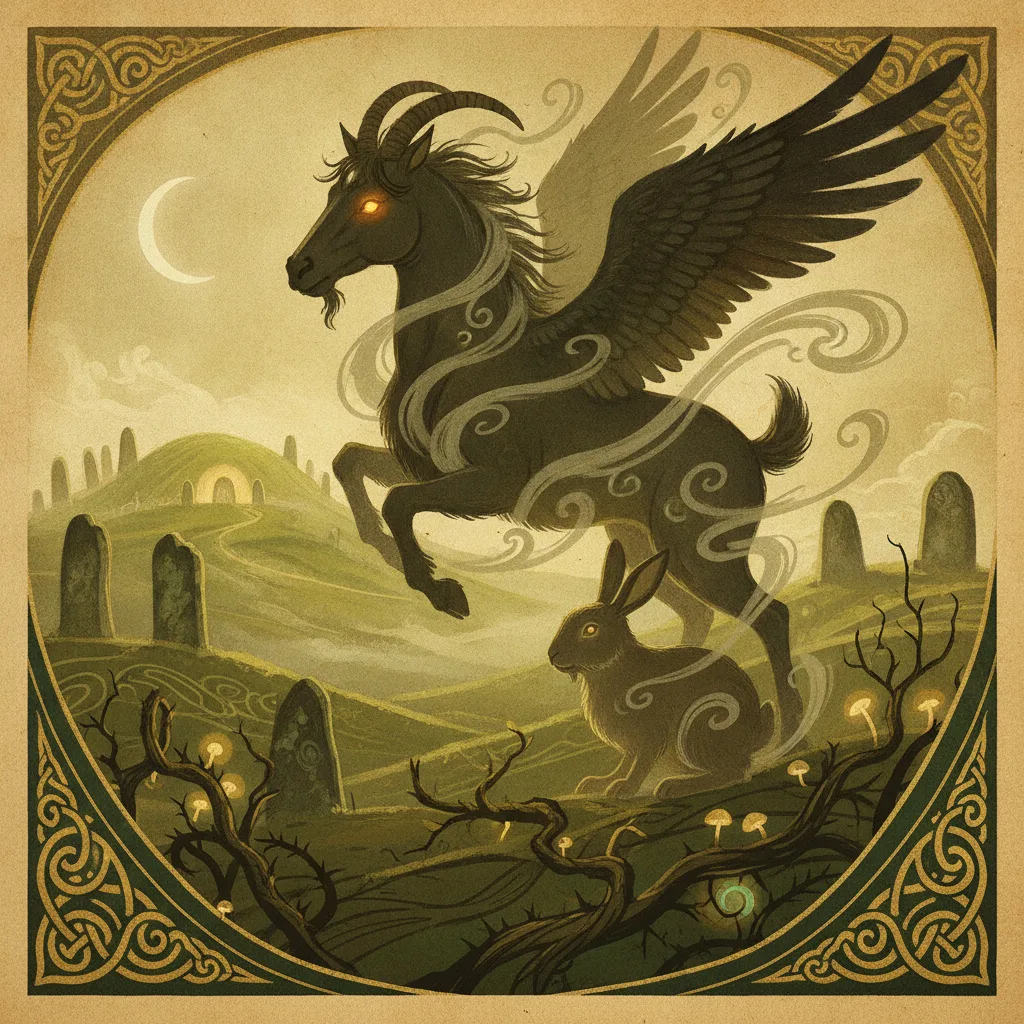
The púca (anglicised "pooka") is the shapeshifting trickster of Irish folklore, appearing as a black horse, goat, hare, dog, bird or part-animal man. Best known as the midnight horse that carries off a rider on a wild gallop, it terrifies and humiliates but rarely kills, and in some regions is a helpful, brownie-like farm-spirit.
- Irish shapeshifting trickster taking horse, goat, hare, dog, bird or part-animal man form.
- The midnight horse gives a terrifying gallop but rarely drowns or kills, unlike the water-horse.
- Traditionally spoils wild blackberries after Samhain — a superstition with practical sense.
- In some regions a benevolent brownie-like farm helper; never just one fixed character.
- Enters print with Croker (1825); its etymology and Norse púki / English Puck links are contested.
| Tradition | Irish (cousins in Man, Wales, Cornwall, England) |
| Type | Shapeshifting trickster spirit |
| Earliest attestation | In print from Croker's 'The Phooka' (1825); belief older |
| Associated places | Roadsides at night, farms, bramble hedges |
| Associated symbols | The black horse, black goat, hare; Samhain; spoiled blackberries |
Of all the beings in Irish tradition, the púca is the hardest to pin down — which is entirely appropriate, since pinning down is the one thing it will never allow. It is a shapeshifter. It comes as a black horse, a black goat, a hare, a dog, a bull, a bird, sometimes a man with animal features, and its intentions shift as readily as its skin. To some tellers it is a terror that runs travellers ragged; to others a rough-humoured household helper. The one safe generalisation about the púca is that you should not generalise about the púca.
The midnight horse
The best-known form is the horse. In this shape the púca waits by a road at night, glossy and inviting, and the unwary rider who mounts it is carried off on a wild gallop over hedge, ditch, bog, and cliff-edge, only to be flung into a ditch at dawn, bruised and shaken but — importantly — usually alive. This is the crucial difference between the púca and the Scottish water-horses it superficially resembles: the púca terrifies and humiliates, but it rarely sets out to drown or devour. Its cruelty is the cruelty of a prank taken much too far, not of a predator.
The púca is the trickster of the Irish countryside — dangerous, unpredictable, and not, on the whole, murderous.
The blackberry taboo
One of the most persistent and genuinely traditional beliefs attached to the púca concerns blackberries. After a certain date in autumn — most often given as Samhain, the night of 31 October / 1 November, sometimes “Púca’s Day” or Michaelmas depending on the region — the púca was said to spoil the wild blackberries, spitting or fouling on them so that they were no longer fit to eat. There is a neat kernel of practical wisdom inside the superstition: by late autumn, frost and damp really do turn brambles mouldy and sour, and a child warned off “the púca’s berries” was a child kept from a stomach-ache. Folk belief often works like this — a real observation wearing a supernatural coat.
Helpful, harmful, or both
Regional variation here is real and worth naming rather than smoothing over. In some traditions, particularly as recorded by Lady Wilde, the púca could be domesticated into something like the Scottish or English brownie — a spirit that would thresh the corn or do the farm work at night in exchange for being left alone and perhaps a share of the crop. Yeats notes this benevolent strand explicitly, contrasting it with the more common mischievous or malevolent horse. Whether your púca was a helper or a hazard depended a great deal on where in Ireland you were standing and whom you asked. It is a mistake to insist on one true púca.
Cousins across the Isles
The púca is not unique to Ireland; it belongs to a family of names and figures spread across the neighbouring traditions, and the relationships between them are close but not identical:
- Ireland — púca (older púcán; anglicised “pooka,” “phouka,” and, in Croker, “the Phooka”).
- Isle of Man — the glashtin (or glashtyn) overlaps heavily with the púca as a shapeshifting, sometimes horse-formed water-creature; Manx tradition also keeps the buggane.
- Wales — the pwca, a near-identical name and trickster role.
- Cornwall — the Bucca.
- England — Puck, the “Robin Goodfellow” of folk tradition, famously given literary form in Shakespeare’s A Midsummer Night’s Dream (c. 1595).
Bargaining with a trickster
Because the púca was capricious rather than simply evil, the lore around it is full of bargains, bindings, and lucky escapes — a sign that people imagined it as something you could, with nerve and cunning, negotiate with. A recurring motif tells of a bold figure who manages to ride the púca to a standstill, or who wins from it a promise: that it will no longer harm travellers, or will confine its mischief to a single night of the year. In one widespread class of tale associated with the kings of Ireland, a legendary ruler bridles the púca with a special halter made partly of the creature’s own hair, and extracts from it exactly such a truce. The moral is consistent across versions: the púca respects courage and honesty, and punishes cowardice, greed, and drunkenness — the traveller most likely to be carried off is the one staggering home late and unwary.
Protective customs followed the same logic as elsewhere in Irish belief. Iron, a blessing, or the crossing of running water could break the púca’s hold, and leaving its share of the harvest unthreshed or a little food set by was a way of keeping a helpful púca helpful. The being was powerful but bound by its own rules, and knowing the rules was the countryman’s real defence.
What the sources say, and what is contested
The púca enters the printed record with Thomas Crofton Croker’s Fairy Legends and Traditions of the South of Ireland (1825), which gave one of its five sections to “The Phooka.” From there it passes into the great Victorian collections: Lady Wilde’s Ancient Legends (1887) and W. B. Yeats’s Fairy and Folk Tales of the Irish Peasantry (1888), the latter citing Croker among his sources. Douglas Hyde, in his Irish-language collecting (Beside the Fire, 1890), preserved púca tales closer to their spoken originals. As with most Irish fairy lore, the belief is older than these books, but the books are where the modern shape of the story was set.
The etymology is genuinely contested, and honest sources say so. A widely cited proposal derives púca from the Old Norse púki, a word for a mischievous nature-spirit or minor devil brought to Ireland during the Viking age — which would tie it to English Puck, Welsh pwca, and a cluster of Germanic and Scandinavian cognates. That is a plausible and popular theory, not a settled fact; other scholars argue for a native origin or leave the question open. The related and even more popular claim that “the púca is Shakespeare’s Puck” overstates it: the names are almost certainly related, and Shakespeare drew on English folk belief about Robin Goodfellow, but the Irish púca and the English Puck are cousins with a shared ancestor, not the same character.
Naming the day
One frequently repeated online claim — that 1 November is universally “Lá na Púca,” the Púca’s Day, across Ireland — is better treated as a regional tradition than a nationwide festival. The link between the púca and Samhain is real and old, but the exact dating of the “spoiled berries” and the púca’s special night varies from place to place, and modern festival branding (there is now a “Púca Festival” marketed around Samhain in County Meath) has tidied a messy folk calendar into a single date. The folklore is real; the neat calendar is partly modern packaging.
The púca now
The trickster has aged well. The púca turns up in fantasy fiction, games, and children’s books, usually as a mischievous shapeshifter, and it left a famous fingerprint on twentieth-century culture through Mary Chase’s 1944 play Harvey — and the 1950 James Stewart film made from it — in which the invisible six-foot rabbit is explicitly identified as a pooka, a benign Irish spirit. That gentle, helpful pooka is a real strand of the tradition, even if it is the minority one. It is worth remembering both faces: the black horse that dumps you in a ditch at dawn, and the unseen friend at your elbow. The púca has always been the being that refuses to be only one thing.
| Tradition | Irish |
| Earliest text | Thomas Crofton Croker, 'Fairy Legends and Traditions of the South of Ireland' (1825), section 'The Phooka' |
| Also appears | Manx glashtin; Welsh pwca; Cornish Bucca; English Puck / Robin Goodfellow |
| Later additions | Lady Wilde (1887), Yeats (1888), Douglas Hyde (1890); benign 'pooka' in the film Harvey (1950) |
| Translation | púca = a mischievous spirit; possibly from Old Norse púki (contested) |
| Reviewed | 2026-08 |
Frequently asked questions
Is the púca good or evil?
Both, depending on region and teller. Most often it is a dangerous trickster — the black horse that gallops off with a rider and dumps them in a ditch at dawn — but in some traditions, notably Lady Wilde's, it acts like a brownie, doing farm work at night. It is a mistake to insist on one true púca.
Why not eat blackberries after Samhain?
Because the púca was said to spoil or foul the wild blackberries after Samhain (around 31 October/1 November). The belief carries practical sense: by late autumn, frost and damp genuinely turn brambles mouldy, so the taboo kept people from eating spoiled fruit.
Is the púca the same as Shakespeare's Puck?
They are closely related but not identical. The names Púca, Welsh pwca, Cornish Bucca and English Puck share a common ancestor, and Shakespeare drew on English belief about Robin Goodfellow. The Irish púca and the English Puck are cousins, not the same character.
Where does the word 'púca' come from?
It is genuinely contested. A popular theory derives it from Old Norse púki, a mischievous nature-spirit brought during the Viking age, linking it to Puck and pwca. Other scholars argue for a native origin. Honest sources leave the question open.
What forms does the púca take?
Most famously a sleek black horse, but also a black goat, hare, dog, bull, bird, or a man with animal traits. Shapeshifting is its defining trait; its intentions shift as readily as its shape.
Is 1 November really 'the Púca's Day'?
The link between the púca and Samhain is old and real, but the exact date of its special night and the spoiled-berry taboo varies by region. The single tidy 'Púca's Day' owes something to modern festival branding rather than a uniform folk calendar.
