Myth & Folklore Orcadian & Scottish (Norse-Gaelic seam); Irish roane
Selkies: the seal-folk of Orkney, Shetland, Scotland and Ireland
Selkies are the seal-folk of the northern seas — beings who shed their skins to walk as humans, and whose stories of stolen skins and inescapable longing sit on the seam between the Norse and Gaelic worlds.
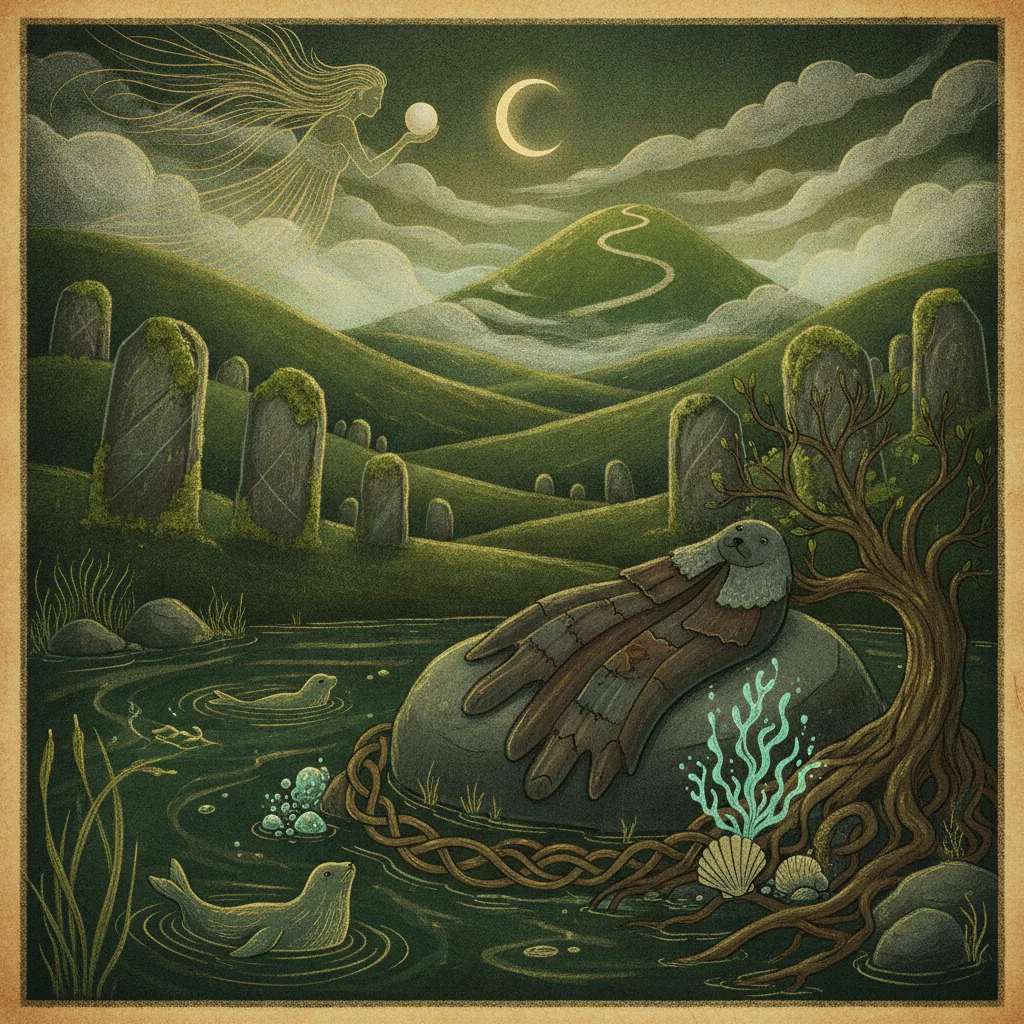
Selkies are the seal-folk of Orkney, Shetland, Scotland and Ireland: beings who shed their sealskin to take human form and must reclaim it to return to the sea. In the classic tale a man hides a selkie-wife's skin to keep her, but she finds it and leaves. Their core belt (Orkney and Shetland) is as Norse as it is Gaelic.
- Seal-folk who shed their skin to become human and need it to return to the sea.
- Classic tale: a man steals a selkie-wife's skin; she later recovers it and leaves.
- Male selkies come ashore as seducers of lonely or unhappy women.
- Named traditions: Orcadian/Shetland selkie, Hebridean seal-people, Irish roane — as Norse as Gaelic.
- Earliest firm text is the ballad The Great Silkie of Sule Skerry (Child 113), collected 1850s.
| Tradition | Orcadian & Shetland (Norse-influenced), Scottish Gaelic, and Irish (roane) |
| Type | Shapeshifting seal-folk |
| Earliest attestation | Ballad 'The Great Silkie of Sule Skerry', published 1850s (Child 113) |
| Associated places | Orkney, Shetland, the Hebrides, and the west/north coasts of Ireland |
| Associated symbols | The sealskin, the shore at moonlight, seven tears, seal ancestry |
On a moonlit beach in the Northern Isles, so the stories go, a seal hauls itself from the water, works free of its skin, and steps out as a man or a woman — human in every way, and heartbreakingly beautiful. These are the selkies, the seal-folk, and their tales are among the most tender and most sorrowful in all the folklore of the Scottish islands and the Irish coast. They are stories about love that cannot last, because one of the lovers belongs to the sea.
The skin is everything
The heart of selkie belief is the sealskin. A selkie can take human form only by shedding its skin, and can return to the sea only by putting it back on. Hide or steal that skin, and you trap the selkie on land. This is the engine of the most famous selkie tale, told in countless local variants across Orkney, Shetland, the Hebrides, and the west of Ireland:
A fisherman or crofter watches the seal-women dancing on the shore, steals one of their skins, and so compels its owner to become his wife. She lives with him for years and bears his children — but she is always drawn to the sea, always searching. One day a child finds the hidden skin. She takes it up, slips it on, and is gone, back into the water, sometimes pausing only to look once at the children she leaves behind.
It is not a story of a wicked husband punished, exactly, nor of a triumphant escape. It is a story of a marriage founded on captivity, and of a longing that no amount of human happiness can cure. The selkie wife is kind, and she loves her children, and she leaves anyway, because the sea is what she is. That refusal to resolve into a simple moral is what gives the tale its long, cold power.
The male selkie
The male selkies are a different matter. Where the selkie wife is a captive, the selkie man is a seducer. He comes ashore to lonely or unhappy women — often fishermen’s wives whose husbands are long at sea, or unmarried women who shed seven tears into the water at high tide to call him — and fathers children on them before returning to the waves. Islanders sometimes explained a family’s dark hair and eyes, or the appearance of webbed fingers or a horny growth on the hands, as “the selkie in the blood.” Certain Orkney and Hebridean families were reputed to have seal ancestry.
Naming the traditions
It matters where a selkie story is from, because the word and the flavour change with the place:
- Orkney and Shetland — the classic selkie country. The Northern Isles were settled by Norse speakers and kept the Norn language into the modern era, and the word itself is from Scots selch / selkie, “seal.” Orcadian and Shetland tradition is the richest source of seal-folk lore.
- The Scottish Hebrides — Scottish Gaelic tradition has its own seal-people, sometimes linked to the drowned or to specific clans said to descend from seals (the MacCodrums of North Uist were nicknamed “the MacCodrums of the seals”).
- Ireland — the Irish seal-folk are the roane (Irish rón, “seal”), found especially along the western and northern coasts, with the same skin-and-longing pattern.
Lumping all of these under “Celtic selkies” hides the fact that the core selkie belt — Orkney and Shetland — is culturally as much Norse as it is Gaelic. The seal-folk sit exactly on the seam between the Scandinavian and Gaelic worlds of the northern seas.
Why seals, and why here
The selkie belief did not come from nowhere. Anyone who has met the gaze of a grey or common seal on a northern shore understands the root of it: the large, dark, forward-set eyes, the almost expressive face, the low half-human cry of a seal colony carrying across the water at dusk. In communities that lived intimately with these animals — hunting them for meat, oil, and skins, and depending on the same dangerous sea — it is a small imaginative step from “the seal watches us like a person” to “the seal is a person, sometimes.” Some islanders held that it was unlucky, even sinful, to kill a seal, precisely because you could never be sure it was not one of the seal-folk; a wounded seal that escaped might turn up later as a scarred stranger. The taboo protected an animal the community both used and half-revered, which is a very old kind of double relationship.
That closeness also explains why the seal-folk are gentler, on the whole, than the water-horses of inland Scotland. The seal was a neighbour, not a monster of the loch. Where the each-uisge devours, the selkie grieves and departs. The difference in temperament tracks the difference in the real animals behind the two beliefs — one a shy, watchful companion of the shore, the other the drowning cold of deep dark water.
What the sources say, and when
The oldest widely known text is a ballad. “The Great Silkie of Sule Skerry” — Sule Skerry being a real rocky islet west of Orkney — tells of a seal-man who fathers a child on a human woman, foretells that she will marry a gunner, and that the gunner will one day shoot both the selkie and their son. A short version of seven verses was collected from a woman of Snarra Voe in Shetland and published by Captain F. W. L. Thomas in the 1850s; Francis James Child later included it in his great collection The English and Scottish Popular Ballads, where it is catalogued as Child ballad 113 (Roud 197). That mid-nineteenth-century publication is the earliest firm date for the seal-folk in the printed record, though the oral tradition behind it is certainly older.
The classic modern gathering of the living oral tradition is David Thomson’s The People of the Sea (1954), an account of the author’s travels along the coasts and islands of Scotland and Ireland in search of seal legends, recording the stories and the very cadences of the fishermen and crofters who still told them. It remains the single best doorway into the tradition as it was actually spoken. Alongside it stand the Orcadian folklore collections of the nineteenth and twentieth centuries — the work of writers such as Walter Traill Dennison, who recorded much Orkney seal-lore.
What is contested — and what is romantic overlay
A few cautions. The oft-repeated rule that a woman calls a male selkie by shedding exactly seven tears into the sea at high tide is a real motif in some tellings, but it is not a universal law of the folklore; treat precise “rules” like this as local colour rather than fixed doctrine. The idea that selkies are the souls of the drowned, or of people who died at sea, appears in some traditions but not others — a genuine regional variation, not a contradiction to be resolved. And a good deal of what now circulates as “ancient selkie lore” online has been smoothed and prettified by twentieth-century retellings; the raw versions are stranger, harsher, and more local.
The selkie on screen
The seal-folk have had a remarkable modern revival, largely through film and fiction. John Sayles’s The Secret of Roan Inish (1994), set on the Irish coast, drew directly on the roane tradition; Neil Jordan’s Ondine (2009) plays with the belief in a contemporary Irish setting; and the animated Song of the Sea (2014) brought the selkie to a global audience, weaving it together with other strands of Irish lore. These films are affectionate and often well-researched, but they are modern art built on the folklore, not the folklore itself — they tend to soften the captivity at the story’s heart into something more redemptive.
The older tale keeps its edge. Strip away the modern warmth and the selkie story is about a being who can love you, live with you, raise your children — and who will still, given the chance, choose the sea. It is a folklore of the coast written by people who knew exactly how much the sea takes, and never quite gives back.
| Tradition | Orcadian/Shetland and Scottish Gaelic; Irish (the roane) |
| Earliest text | 'The Great Silkie of Sule Skerry' (Child 113 / Roud 197), 7 verses collected in Shetland and published by Capt. F. W. L. Thomas in the 1850s |
| Also appears | Scottish Gaelic seal-clan lore (e.g. the MacCodrums of North Uist); Irish rón/roane traditions |
| Later additions | David Thomson, 'The People of the Sea' (1954); films The Secret of Roan Inish (1994), Ondine (2009), Song of the Sea (2014) |
| Translation | selkie = 'seal' (Scots); Irish roane from rón, 'seal' |
| Reviewed | 2026-08 |
Frequently asked questions
What is a selkie?
A shapeshifting seal-person of the northern seas. In seal form it lives in the water; by shedding its skin it can take human shape on land. The skin is the key to everything: without it, a selkie cannot return to the sea.
Why does the selkie wife always leave?
In the classic tale a man steals a seal-woman's skin and so forces her to marry him. She lives with him and bears children, but when the hidden skin is found she puts it on and returns to the sea. The story is about a marriage built on captivity and a longing that human happiness cannot cure.
Are selkies Scottish or Irish?
Both, with regional names. The richest tradition is Orcadian and Shetland (Norse-influenced), 'selkie' being a Scots word for seal. Scottish Gaelic tradition has seal-clan lore, and Ireland has the roane (from rón, 'seal'). The core selkie belt straddles the Norse-Gaelic seam.
What is the earliest source for selkies?
The ballad 'The Great Silkie of Sule Skerry', catalogued as Child ballad 113. A seven-verse version was collected in Shetland and published by Captain F. W. L. Thomas in the 1850s. The oral tradition is older, but that is the earliest firm printed date.
Do you really call a male selkie with seven tears?
That motif appears in some tellings — a woman sheds seven tears into the sea at high tide to summon a selkie lover — but it is local colour, not a universal rule. Precise 'laws' like this vary from place to place.
Are the selkie films accurate?
Films like The Secret of Roan Inish (1994) and Song of the Sea (2014) draw genuinely on the tradition but soften it, turning the captivity at the story's heart into something more redemptive. They are modern art built on the folklore, not the folklore itself.
