Celtic Legends Irish & Manx · Mythological Cycle
Manannán mac Lir: the sea-god of Ireland and the Isle of Man
The sea-god of the Irish and the Manx: the rider who sees a flowering plain where we see waves, husband of Fand, first king of Man, first attested in eighth-century Immram Brain.
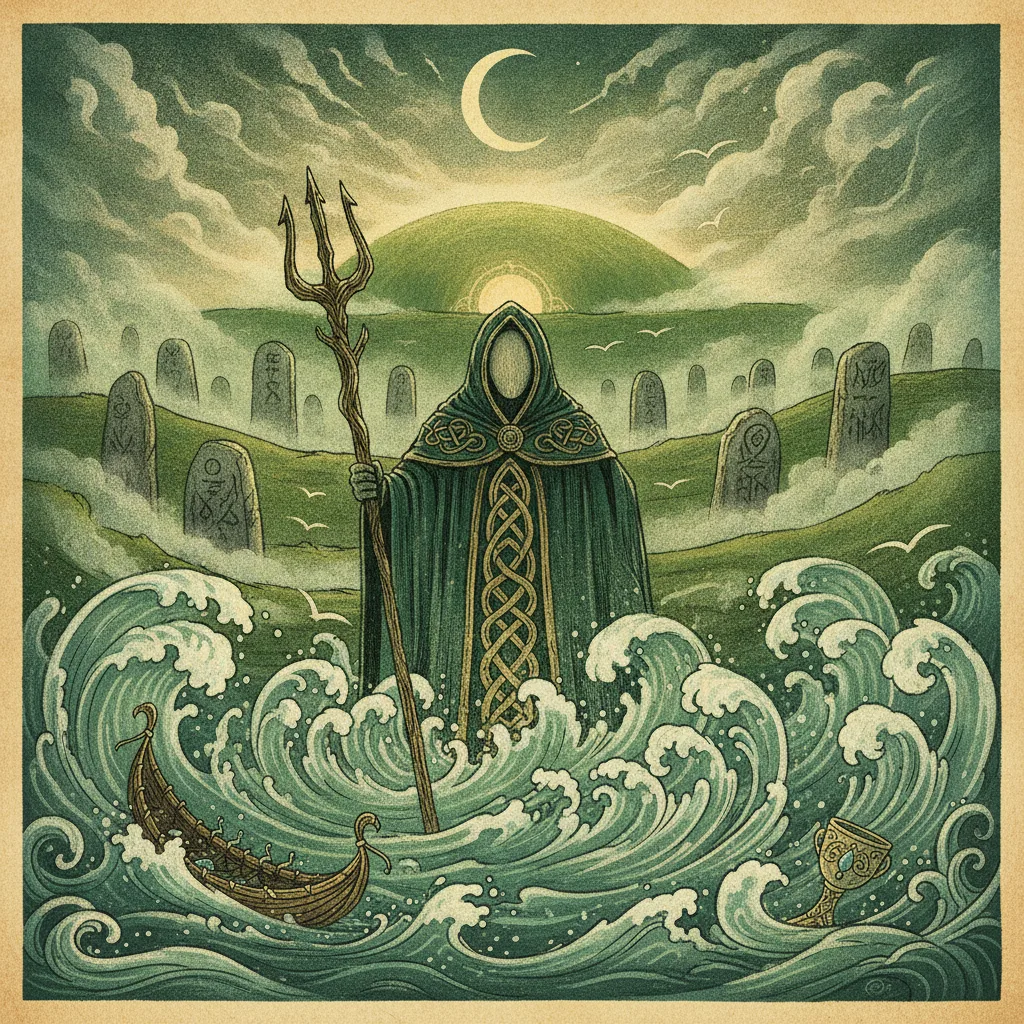
Manannán mac Lir is the sea-god of Irish and Manx tradition - rider over the waves, guardian of the Otherworld islands, husband of Fand - whose name the Isle of Man still carries. His earliest attestation is Immram Brain, dated to the late seventh or early eighth century; his famous magical 'kit' and romantic image are largely later.
- Manannán mac Lir is the sea-god of both Irish and Manx tradition, not a generic 'Celtic' deity.
- His earliest and key text is Immram Brain, dated to the late seventh or early eighth century.
- Cormac's Glossary (c.900) euhemerises him as a skilled Manx merchant and navigator.
- His magical 'kit' - Fragarach, the horse Aonbharr, the cloak of mist - is largely a later assembly.
- The Isle of Man takes its name from him; the Manannan Ballad (c.1500) is early Manx.
| Tradition | Irish & Manx (Mythological / Ulster Cycles) |
| Type | sea-god / Otherworld ruler |
| Earliest attestation | Immram Brain maic Febail (late 7th–early 8th c.) |
| Associated places | the sea; Mag Mell / Emain Ablach; the Isle of Man |
| Associated symbols | the cloak of mist, the wave-horse Aonbharr, the boat Scuabtuinne (Wave-Sweeper), the sword Fragarach, the crane-bag |
He comes riding towards Bran across the open sea, and where Bran sees waves the rider sees a flowering plain. His chariot rolls over the tops of the swells as over a meadow; salmon leap around him like calves; the ocean is his country and he keeps it the way a chieftain keeps his land. This is Manannán mac Lir, the sea-god of the Gael and the Manxman — “Manannán son of Ler (the sea)” — the ferryman between this world and the Otherworld, and the figure whose name the Isle of Man still carries.
Who he is
Manannán is the great sea-deity of Irish and Manx tradition: lord of the ocean, guardian of the Otherworld islands beyond the waves, a shapeshifter, trickster and giver of gifts. He is counted among (or closely allied to) the Tuatha Dé Danann, and in the story of how the old gods went under the hills it is Manannán who is said to have shrouded them in the féth fíada, the magic mist, and apportioned the mounds among them. He is bound up with the aos sí as their sea-going kinsman and provisioner — the owner of the self-refilling feast and the pigs that can be eaten and live again.
His patronymic tells you what he governs. Lir is the genitive of Ler, an older word simply meaning “sea”; so “mac Lir” is “son of the sea.” (Do not confuse this Ler with the Lir of the Children of Lir — the medieval tradition itself keeps them as different figures, however the names blur in retelling.)
The story the sources tell
Manannán is less a single plot than a presence who steps into other people’s stories at the water’s edge. A few scenes recur.
The rider on the sea
In Immram Brain maic Febail — “The Voyage of Bran son of Febal” — Bran is lured to sea by a woman from the Otherworld and, mid-voyage, meets Manannán driving his chariot across the water. The god sings that what Bran sees as the heaving sea is to him a blossoming plain of Mag Mell, the Plain of Delights, and foretells the birth of his own son Mongán. It is one of the oldest and most beautiful statements of the Otherworld-under-the-waves in Irish literature.
The husband of Fand
In the Ulster Cycle tale Serglige Con Culainn (“The Wasting Sickness of Cú Chulainn“), Manannán is the husband of the Otherworld woman Fand. When Cú Chulainn and Fand fall into a doomed love, it is Manannán who arrives to reclaim her and shakes his cloak of mist between the lovers so that they will never meet again, and a draught of forgetfulness ends the grief. The wronged, dignified sea-husband is one of his most human turns.
The father of Mongán
In Compert Mongáin (“The Birth of Mongán”) Manannán fathers the historical-legendary Ulster king Mongán mac Fiachnai, a device that lets a real seventh-century dynasty claim descent from the sea-god.
The merchant of Man
The early glossary Sanas Cormaic (“Cormac’s Glossary”) takes the opposite tack and euhemerises him: here Manannán is explained not as a god but as a famous merchant and navigator of the Isle of Man, so skilled at reading sea and sky that the Irish and the Britons called him a god of the sea. This is exactly the kind of demotion the Christian scholars applied across the pantheon — worth flagging, because it shows the “god” being written down by people who did not want to call him one.
What the sources say vs. what circulates
- Name the traditions: Irish and Manx. Manannán is not a generic “Celtic” sea-god. He is central to Irish literature and, quite separately, to the Isle of Man, whose very name derives from him. The Manx material is its own tradition, not a footnote to the Irish.
- His famous “kit” is mostly later. The catalogue people love — the sword Fragarach (“The Answerer”), the horse Aonbharr that gallops over water, the boat Scuabtuinne (“Wave-Sweeper”), the crane-bag of treasures, the cloak that erases memory — is assembled from across the tradition, and several items attach to him chiefly in the later Early Modern Irish romance Oidheadh Chloinne Tuireann (“The Fate of the Children of Tuireann”). The tidy modern gear-list flattens a messier history.
- Ler and Lir are two figures. The sea-word Ler (Manannán’s father) and the Lir whose swan-children are enchanted are kept distinct in the medieval texts, even though popular retellings collapse them.
Where he is written down
The earliest and most important attestation is Immram Brain maic Febail, a narrative usually dated to the late seventh or early eighth century (edited and translated by Kuno Meyer, The Voyage of Bran, 1895). He also appears in Serglige Con Culainn; in Compert Mongáin; in Sanas Cormaic (Cormac’s Glossary, c. 900); in Lebor Gabála Érenn; and, with his most elaborate equipment, in the later Oidheadh Chloinne Tuireann. For the Manx side, the key text is the Manannan Ballad, an early Manx poem traditionally dated to about 1500 and reckoned the oldest datable work in the Manx language, which names “little Manannan son of the sea” as the first ruler of the island.
Manx living tradition and the revival layer
On the Isle of Man the sea-god never quite became a museum piece. Folk custom held that Manannán’s cloak — the mists — protected the island, and there is a well-attested Midsummer practice of carrying green rushes up South Barrule and to Tynwald as a “rent” paid to Manannán, a custom still consciously remembered today. As always, keep the dating honest: the picture of Manannán most people now hold, the romantic Otherworld sea-king, owes a great deal to the Celtic Revival of the late nineteenth and early twentieth centuries and to popular retellers who tidied the medieval scraps into a single glorious biography. That reception is real and lovely; it is not the seventh-century text.
Manannán in modern art, fiction and games
He has had a vivid modern afterlife. In 2014 a striking six-foot statue of Manannán by the sculptor John Sutton (a set-builder on Game of Thrones) was installed on Binevenagh mountain above Limavady in Northern Ireland; in January 2015 it was stolen and a wooden cross left in its place bearing the words “You shall have no other gods before me,” an episode that made international news before a replacement was installed later that year — a strange modern echo of the old struggle between the sea-god and the new religion. The Isle of Man’s fast ferry is named Manannan; he recurs across fantasy fiction, comics (including Marvel’s Irish-myth material) and video games that draw on the Tuatha Dé; and he remains the presiding spirit of Manx identity, invoked in song and on the three-legged emblem of the island he named.
Keeping him properly
Manannán mac Lir is the sea-god of the Irish and the Manx: the rider who sees a flowering plain where we see waves, the husband of Fand, the father of Mongán, the merchant-god of Sanas Cormaic, and the first king of Man. His earliest home is Immram Brain in the eighth century; his richest gear is later; his living Manx customs and his romantic Revival image are later still and worth holding a little apart. Name the tradition, date the layers, and the son of the sea keeps his depth. Old stories, kept properly.
| Tradition | Irish & Manx |
| Earliest text | Immram Brain maic Febail (‘The Voyage of Bran’), late 7th–early 8th c. |
| Also appears | Serglige Con Culainn (as Fand’s husband); Compert Mongáin; Sanas Cormaic / Cormac’s Glossary (c. 900, euhemerised as a merchant of Man); Lebor Gabála Érenn; the Manx Manannan Ballad (c. 1500) |
| Later additions | His full ‘kit’ (Fragarach, Aonbharr, Scuabtuinne, crane-bag) is assembled across the tradition, several items chiefly from the later Oidheadh Chloinne Tuireann; the unified romantic sea-king owes much to the Celtic Revival (late 19th–early 20th c.) |
| Translation | Kuno Meyer, The Voyage of Bran (1895) |
| Reviewed | 2026-08 |
Frequently asked questions
What does ‘Manannán mac Lir’ mean?
‘Manannán son of Ler (the sea)’. Lir is the genitive of Ler, an old word simply meaning ‘sea’, so the name marks him as the sea’s own son and lord.
Is Manannán Irish or Manx?
Both, in their own right. He is a major figure of Irish literature and, separately, the presiding god of the Isle of Man, whose name derives from him. Name the specific tradition rather than calling him generically ‘Celtic’.
What is the earliest source for Manannán?
The Voyage of Bran (Immram Brain maic Febail), usually dated to the late 7th or early 8th century, where he rides his chariot across the sea and tells Bran the waves are a flowering plain.
Did he really own a magic sword and a sea-horse?
Those items — Fragarach, the horse Aonbharr, the boat Scuabtuinne, the crane-bag — are drawn from across the tradition, and several attach to him mainly in the later Oidheadh Chloinne Tuireann. The neat gear-list is a modern tidy-up of messier texts.
Why is there a statue of him in Northern Ireland?
A 2014 statue by sculptor John Sutton stood on Binevenagh above Limavady. In January 2015 it was stolen and a cross left reading ‘You shall have no other gods before me’; a replacement was installed later that year.
Is the Lir of the Children of Lir the same Lir?
No. The medieval tradition keeps Manannán’s father Ler (the sea) distinct from the Lir whose swan-children are enchanted, though popular retellings often blur the two names.
