Celtic Legends Irish · Ulster Cycle
Cú Chulainn
The Hound of Ulster who defended a province alone: birth in Compert Con Culainn, glory in the Táin (Lebor na hUidre c.1100), death at the pillar-stone — with the modern nationalist statue kept separate.
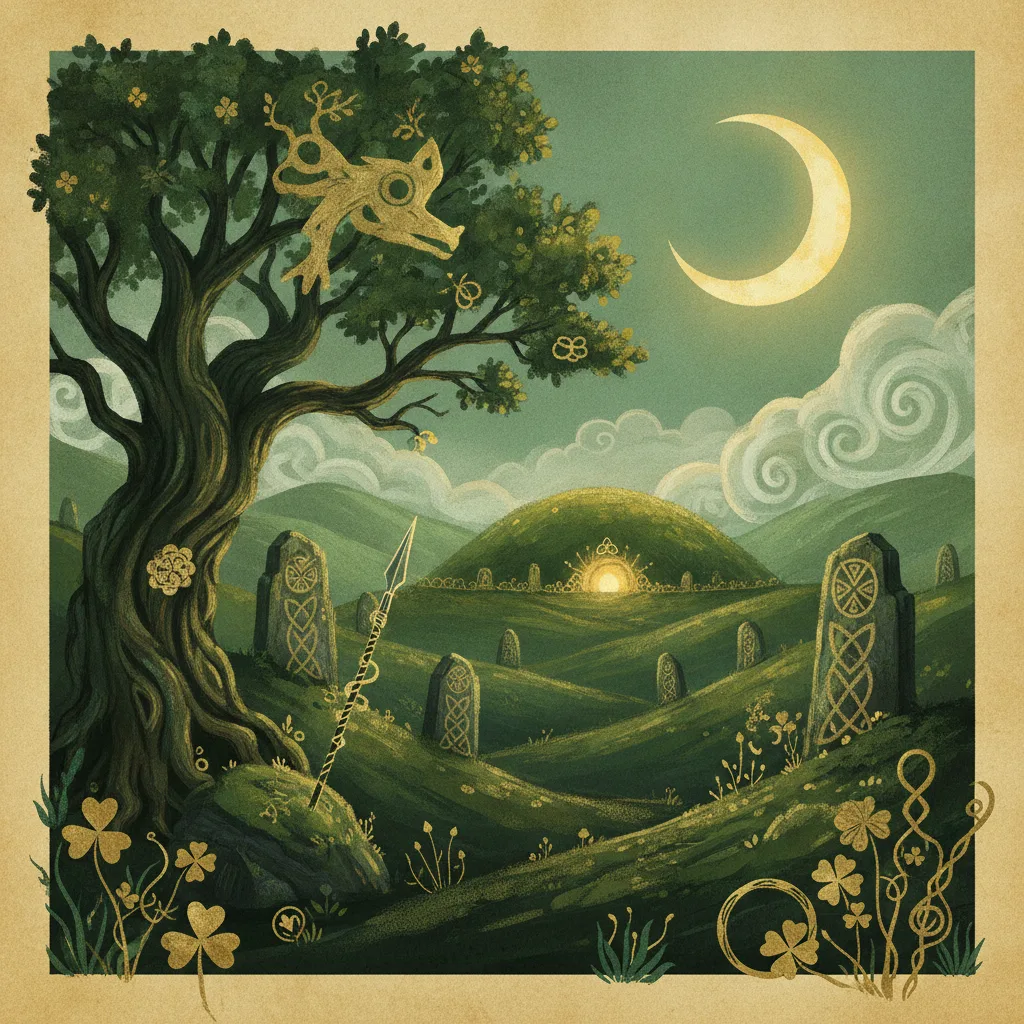
Cú Chulainn is the central hero of Ireland's Ulster Cycle: born Sétanta of the god Lugh, he single-handedly defends Ulster against Queen Medb's army in the Táin Bó Cúailnge, undergoing his monstrous battle-frenzy (ríastrad), and dies tied upright to a standing stone. His tales survive in named medieval texts, chiefly Lebor na hUidre (c.1100) and the Book of Leinster (c.1160).
- Cú Chulainn is the central hero of Ireland's Ulster Cycle, born Sétanta, son of the god Lugh.
- In the Táin Bó Cúailnge he single-handedly defends Ulster against Queen Medb's army.
- His battle-frenzy, the ríastrad, distorts his body; he kills his friend Ferdiad with the Gáe Bolga.
- He dies lashed upright to a standing stone (Aided Con Culainn); a crow marks his death.
- Texts survive in Lebor na hUidre (c.1100) and the Book of Leinster (c.1160); 'Irish Achilles' is a modern tag.
| Tradition | Irish (Ulster Cycle) |
| Type | hero (semi-divine) |
| Earliest attestation | Táin Bó Cúailnge and Compert Con Culainn; Lebor na hUidre, c.1100; Book of Leinster, c.1160 |
| Associated places | Ulster; Emain Macha; the fords of the Táin |
| Associated symbols | the Gáe Bolga (barbed spear), the hound, the ríastrad (warp-spasm) |
He is the hero who defends a whole province alone, a boy who takes up arms knowing the price is a short and glorious life, and a man so terrible in battle that his own body contorts into something barely human. Cú Chulainn is the central hero of the Ulster Cycle, and the finest way to meet him is not through a summary but through the shape of his own story — birth, naming, single-handed defence, and death — because each stage is carried by a specific medieval text we can name.
The story the sources tell
Conception and naming
His birth is told in Compert Con Culainn (“The Conception of Cú Chulainn”). Born Sétanta, of divine and human parentage — the god Lugh is his otherworldly father — he is raised at the court of his uncle Conchobar, king of Ulster. The famous naming comes when the boy kills the ferocious guard-hound of the smith Culann, who is left without a watchdog. To make amends, Sétanta pledges to guard Culann’s house himself until a replacement hound is reared. From then he is Cú Chulainn, “the Hound of Culann” — a name that binds the hero to the dog, and marks him as a young man who pays his debts in person.
Warned by the druid Cathbad that whoever takes up arms on a certain day will be famous forever but short-lived, the boy demands his weapons anyway. That choice — glory bought with an early death — is the engine of everything that follows.
The Táin: the defence of Ulster
The heart of his legend is the Táin Bó Cúailnge (“The Cattle Raid of Cooley”), the great epic of the Ulster Cycle. Queen Medb of Connacht invades Ulster to seize the prize bull Donn Cúailnge. By an old curse, the fighting men of Ulster are laid low with birth-pangs at the crucial moment — and only Cú Chulainn, exempt because of his youth, stands against the whole army. He invokes the right of single combat at the fords, killing Medb’s champions one by one, day after day, to slow the advance and buy Ulster time.
Two episodes define him. The first is the ríastrad — the “warp-spasm” or battle-distortion — in which fury transforms his body into a grotesque, boiling shape, one eye swallowed into his head and the other bulging out, heat radiating from his skull. The second is his combat with Ferdiad, his foster-brother and dearest friend, whom Medb goads into fighting him. They battle for days at the ford, resting and tending each other’s wounds each night, until Cú Chulainn kills Ferdiad with the Gáe Bolga, his barbed spear — and then breaks down in grief over the body. It is the emotional summit of the whole cycle.
The boy-deeds and the training with Scáthach
Between his naming and the great cattle-raid, the tradition preserves a run of macgnímrada, “boyhood deeds,” embedded in the Táin itself: the child Sétanta setting out alone for Emain Macha, defeating the hostile boy-troop of Ulster at their games, and taking arms far too young. As a young man he is sent to be trained in warfare by the woman-warrior Scáthach in her fortress overseas (associated with the Isle of Skye), where he learns his feats of arms and receives the Gáe Bolga. His wooing of Emer, told in Tochmarc Emire (“The Wooing of Emer”), belongs to this same stage. These tales matter because they show the tradition was never a single narrative but a whole constellation of stories orbiting one hero, each preserved in its own text.
The death
His end is told in Aided Con Culainn (“The Death of Cú Chulainn”). Trapped by enemies and by broken taboos (gessa) he cannot honour without breaking others, mortally wounded, he ties himself upright to a standing stone so that he will die on his feet, facing his foes. Only when a crow — the Morrígan, or her sister Badb — settles on his shoulder do his enemies dare approach. The image of the hero lashed to the pillar-stone, dying upright, is the one that has fixed him in the modern Irish imagination.
Where he is written down
This is a hero we can source precisely. The Táin survives in three recensions. Recension I is preserved partly in Lebor na hUidre (“The Book of the Dun Cow”), compiled at Clonmacnoise around 1100 — the oldest surviving manuscript written largely in Irish — and partly in the fourteenth-century Yellow Book of Lecan; its language points to material considerably older than the manuscripts. Recension II, a fuller and more polished version, is in the Book of Leinster, from around 1160. The birth-tale Compert Con Culainn also survives in Lebor na hUidre.
For readers today, the standard scholarly editions are those of Cecile O’Rahilly, who edited and translated both Recension I (1976) and the Book of Leinster version (1967). The best-known literary translation is Thomas Kinsella’s The Táin (1969), illustrated by Louis le Brocquy — the version through which most modern readers first meet the hero.
What the sources say vs. what circulates
A few corrections worth making:
- “The Irish Achilles” is a useful shorthand — both are half-divine heroes doomed young — but it is a modern comparison, and it can mislead. Cú Chulainn’s world, his taboos, and the sovereignty-and-cattle logic of the Táin are specifically Irish, not Homeric.
- The single “canonical” biography people repeat is really a modern stitching-together of many separate tales (birth-tale, wooing-tale, death-tale, and the Táin), each surviving independently and sometimes disagreeing. There was never one authoritative “Life of Cú Chulainn.”
- The hound taboo. It is often said his key geis was never to eat dog meat, and that his death follows from being tricked into breaking it. That is genuinely in the death-tale — but it is one strand of a web of conflicting obligations, not a simple curse.
There is also a distinct modern-political reception to flag. In the twentieth century Cú Chulainn was adopted as a nationalist symbol: Oliver Sheppard’s bronze statue The Death of Cúchulainn (sculpted 1911) was installed in the General Post Office in Dublin in 1935 as a memorial to the 1916 Rising. Later, the same figure was claimed by Ulster loyalists as a defender of Ulster against the south. One medieval hero, pulled two opposite political ways — a good reminder that “the tradition” is always also about who is telling it, and when.
Cú Chulainn in modern art, fiction and games
He is everywhere in contemporary media. In Japan he is a franchise fixture: he appears repeatedly in the Fate series (as the spear-wielding “Lancer”) and across anime and video games inspired by it. He is a playable hero in the online game SMITE. He has featured in comics, in W. B. Yeats’s cycle of Cuchulain plays a century ago, and in a long line of retellings for younger readers. The barbed spear, the warp-spasm, and the death at the pillar-stone are the details that travel best.
Keeping him properly
Cú Chulainn is the Ulster Cycle’s defining hero, known to us through named, datable texts: his birth in Compert Con Culainn, his glory in the Táin Bó Cúailnge (Lebor na hUidre, c.1100; Book of Leinster, c.1160), and his end in Aided Con Culainn. What the medieval tradition gives us is not a tidy biography but a cluster of powerful, sometimes contradictory tales. The “Irish Achilles” tag and the modern political statue are later frames worth knowing — and worth keeping separate from the strange, ferocious, grief-struck young man the manuscripts actually describe.
| Tradition | Irish (Ulster Cycle) |
| Earliest text | Táin Bó Cúailnge, Recension I, partly in Lebor na hUidre (c.1100) and the Yellow Book of Lecan (14th c.) |
| Also appears | Book of Leinster (Recension II, c.1160); Compert Con Culainn (birth); Aided Con Culainn (death); Serglige Con Culainn; Tochmarc Emire |
| Later additions | 20th-c. nationalist reception — Oliver Sheppard’s statue (sculpted 1911) installed in the GPO, Dublin, 1935; later loyalist appropriation |
| Translation | O’Rahilly, Táin Bó Cúailnge Recension I (1976) and Book of Leinster recension (1967); Kinsella, The Táin (1969) |
| Reviewed | 2026-08 |
Frequently asked questions
Why is he called the Hound of Ulster?
Born Sétanta, he killed the guard-hound of the smith Culann and pledged to protect Culann’s home himself until a new hound was reared, earning the name Cú Chulainn, ‘the Hound of Culann’.
What is the warp-spasm?
The ríastrad, a battle-distortion in which fury transforms his body into a grotesque, boiling shape — one eye sucked in, the other bulging — described most vividly in the Táin.
Who was Ferdiad?
Cú Chulainn’s foster-brother and closest friend, goaded by Queen Medb into fighting him. Their days-long duel at the ford, and Cú Chulainn’s grief after killing him with the Gáe Bolga, is the emotional peak of the Táin.
Is Cú Chulainn ‘the Irish Achilles’?
It is a modern comparison — both are half-divine heroes doomed to a short, glorious life — but it can mislead. His world, his taboos and the cattle-and-sovereignty logic of the Táin are specifically Irish, not Homeric.
What are the earliest manuscripts?
The Táin’s Recension I survives partly in Lebor na hUidre (c.1100) and the Yellow Book of Lecan; the fuller Recension II is in the Book of Leinster (c.1160). His birth-tale is also in Lebor na hUidre.
Why is there a statue of him in Dublin’s GPO?
Oliver Sheppard’s bronze The Death of Cúchulainn (sculpted 1911) was installed in the General Post Office in 1935 as a memorial to the 1916 Easter Rising — a 20th-century political use of the medieval hero.
