Celtic Legends Irish · Fenian Cycle
Fionn mac Cumhaill (Finn McCool): the hero of the Fenian Cycle
Leader of the Fianna and hero of the Irish Fenian Cycle: the boy who tasted the Salmon of Knowledge. The Giant's Causeway giant is a much later folk layer, dated here.
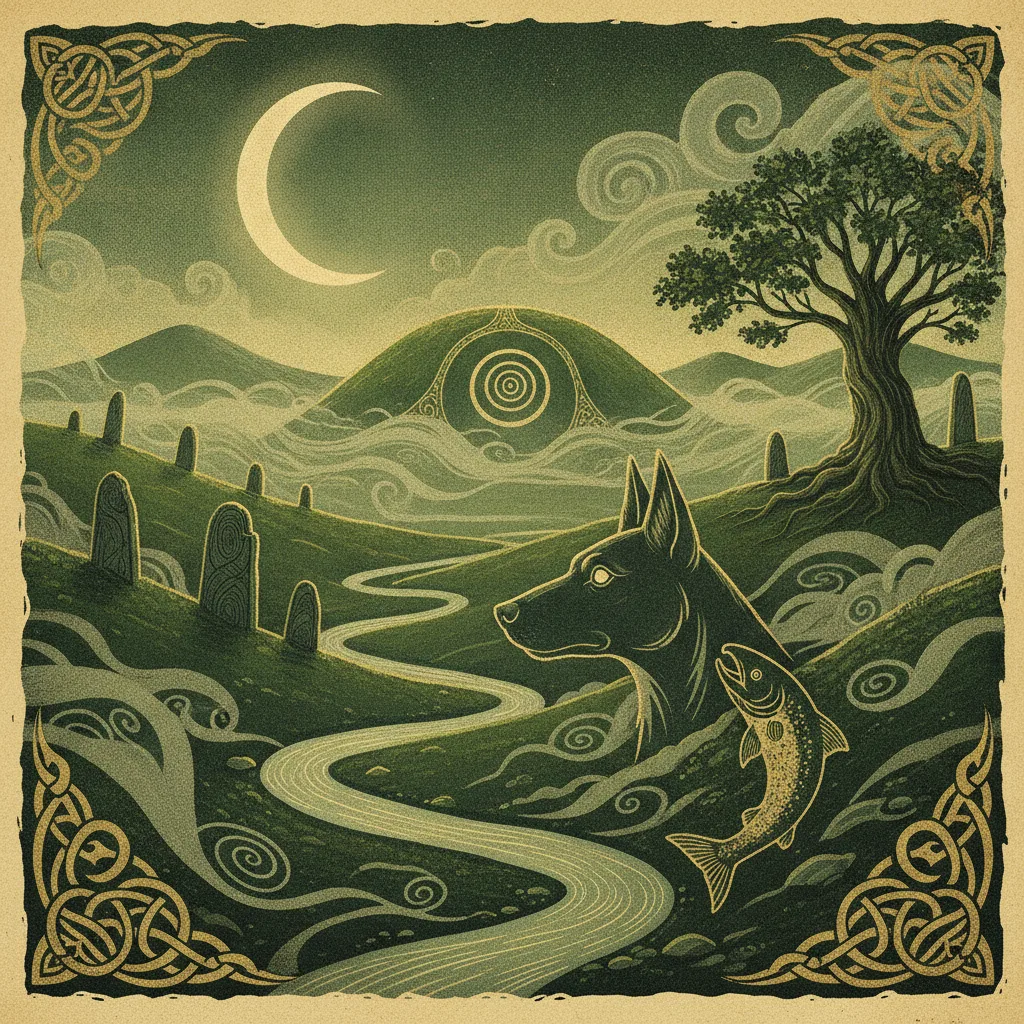
Fionn mac Cumhaill (Finn McCool) is the human hero-sage of Ireland's Fenian Cycle: the boy who tasted the Salmon of Knowledge and grew to lead the Fianna warrior-band. His core texts are medieval - Macgnímartha Finn (twelfth century) and Acallam na Senórach (c.1200). The Giant's Causeway giant and Macpherson's 'Ossian' are much later additions, not medieval sources.
- Fionn mac Cumhaill (Finn McCool) is the human hero-sage leading the Fianna in Ireland's Fenian Cycle.
- He gains wisdom by tasting the Salmon of Knowledge and sucking his burned thumb.
- Core medieval texts: Macgnímartha Finn (12th c.) and Acallam na Senórach (c.1200).
- The Giant's Causeway giant tale is later folklore (18th-19th c.), not in the medieval sources.
- Macpherson's 'Ossian' (1760s) is largely his own composition, not a medieval source.
| Tradition | Irish (Fenian Cycle) |
| Type | hero / leader of the Fianna |
| Earliest attestation | 9th–10th c. fragments; Macgnímartha Finn (12th c.); Acallam na Senórach (c. 1200) |
| Associated places | Almu (the Hill of Allen); Tara; the Boyne; later the Giant's Causeway |
| Associated symbols | the thumb of knowledge, the Salmon of Knowledge, the hounds Bran and Sceolan |
A boy is set to cook a salmon he must not taste. The fish is the Salmon of Knowledge, and whoever eats it first will hold all the wisdom of the world. He burns his thumb on the hot skin, sucks it to ease the pain — and the knowledge is his by accident. From that day, whenever he needs to know a hidden thing, he has only to put his thumb to his mouth. That boy is Fionn mac Cumhaill, and he grows up to lead the Fianna, the roving warrior-band of Ireland: hunter, poet, war-leader, and the hero around whom a whole cycle of Irish storytelling turns.
Who he is
Fionn (older Find, “the fair one,” “the white one”) mac Cumhaill is the central figure of the Fenian Cycle — an Fhiannaíocht — one of the four great cycles of medieval Irish literature. He leads the Fianna, bands of hunter-warriors who live half outside settled society, guarding Ireland and answering to the High King. Around him stands a fixed cast: his son the poet Oisín; his grandson Oscar; the peerless Diarmuid Ua Duibhne; his sometime-rival Goll mac Morna; and his hounds Bran and Sceolan, who are his own transformed kin. He belongs to the Irish tradition specifically — not to a blurred pan-“Celtic” one — though his legend later crosses to Gaelic Scotland.
The story the sources tell
The boyhood deeds
The making of Fionn is told in Macgnímartha Finn, “The Boyhood Deeds of Fionn.” His father Cumhall, leader of the Fianna, is killed before he is born; the child is raised in secret in the forest by two wise-women. He earns his name Fionn (“fair”) for his looks, masters running, hunting and verse, and comes to the poet Finn Éces (Finnegas) on the Boyne, who has spent years trying to catch the Salmon of Knowledge. When at last it is caught and given to the boy to cook, Fionn burns his thumb, sucks it, and takes the wisdom meant for his master. Thereafter his thumb of knowledge — linked to the old divinatory arts of imbas forosnai — lets him see what is hidden. He avenges his father, wins the leadership of the Fianna, and defends Tara from the fire-breathing burner Aillen.
Diarmuid and Gráinne
The most famous tale of his later years is the tragedy of jealousy: the aging Fionn is promised Gráinne, daughter of the High King, but she elopes with the young Diarmuid, and Fionn pursues them across Ireland. When Diarmuid is at last gored by a boar, Fionn — who can heal with a drink of water from his hands — hesitates fatally, and Diarmuid dies. It is the darkest portrait of the hero: great, but capable of a small, deadly spite.
The Fianna and their tests
Fionn’s world is the world of the Fianna — landless warrior-hunters who lived in the wild for part of the year and took the King’s pay for the rest, a kind of standing frontier-force half-romanticised in the texts. The tradition preserves a famous (and famously demanding) list of entry-tests a man had to pass to join them: he had to defend himself, buried to the waist, with only a shield and a hazel stick against nine spear-casts; run through the forest without cracking a dry stick underfoot or disturbing a braided lock of his hair; leap a branch level with his brow and pass under one at knee height; and pull a thorn from his foot at a run, all without slowing. Whether or not any band ever really did these things, the list tells you what the storytellers admired: speed, poise, endurance and cool nerve, the very qualities Fionn embodies. The Fianna also lived by a code of loyalty and generosity, and their slow breakdown — through jealousy, oath-breaking and the coming of a new order — is the tragic arc the whole cycle moves toward.
The colloquy of the ancients
The richest source imagines the Fianna already gone. In Acallam na Senórach (“The Colloquy of the Ancients”), Oisín and Caílte mac Rónáin survive into the time of St Patrick, generations later, and travel Ireland with the saint, naming places and telling him the deeds of Fionn and the Fianna. It is an elegy as much as an adventure — the old pagan world explaining itself, wistfully, to the new Christian one.
What the sources say vs. what circulates
- The medieval Fionn is a man, not a giant. In the Fenian texts he is a warrior-sage of human size. The image of Finn as a colossus who could throw mountains belongs to a much later folk layer, not to the manuscripts.
- The Giant’s Causeway story is later folklore — date it. The beloved tale in which Finn builds the causeway to fight the Scottish giant Benandonner and is disguised as a baby by his wife Oonagh is not in the medieval Fenian sources. It is early-modern and nineteenth-century folklore, popularised as County Antrim tourism grew (a literary version appears in William Hamilton Drummond’s poem of 1811). It is a wonderful story — but it is a later addition, and it turns the human Fionn into a giant to explain a basalt landscape.
- “Ossian” is a special case. The Scottish writer James Macpherson published poems in the 1760s that he claimed to translate from ancient verse by Oisín (his “Ossian,” with Fionn as “Fingal”). They swept Europe — and are now known to be largely Macpherson’s own composition, loosely built on genuine Gaelic ballad tradition. Enormously influential, but not a medieval source.
Where he is written down
Fionn is glancingly attested as early as the ninth and tenth centuries in annals, glosses and verse, but the substantial texts are from the twelfth century onward. Macgnímartha Finn survives in the manuscript Laud Misc. 610 and is assigned to the twelfth century (edited by Kuno Meyer, who translated it as “The Boyish Exploits of Finn,” 1904). Acallam na Senórach is a Middle Irish work of c. 1200 and, at roughly 8,000 lines, the longest surviving work of medieval Irish literature (translated by Ann Dooley and Harry Roe as Tales of the Elders of Ireland, 1999). The Diarmuid-and-Gráinne tale as we usually read it, Tóruigheacht Dhiarmada agus Ghráinne, is an Early Modern Irish romance surviving in far later manuscripts. Beyond these lies a vast body of later Fenian ballads (the Duanaire Finn) and living oral tradition in Ireland and Gaelic Scotland.
The revival and folk layers, dated
Three later strata sit on top of the medieval core, and it is worth keeping them apart: the early-modern folk Fionn, the giant of the Causeway and of countless landscape legends (18th–19th c.); Macpherson’s Ossian (1760s), the pan-European romantic craze; and the Celtic Revival of the late nineteenth and early twentieth centuries, when writers such as Lady Gregory (Gods and Fighting Men, 1904) retold the Fianna for a new readership. Each is real and worth knowing; none should be mistaken for the twelfth-century texts.
Fionn in modern art, fiction and games
He is everywhere once you look. Flann O’Brien built the comic masterpiece At Swim-Two-Birds (1939) partly around a wandering Finn; James Joyce wound “Finn again” through Finnegans Wake; the Fianna feed modern fantasy and children’s retellings; and Fionn appears as a summonable hero in video games that mine world myth (the Fate franchise, SMITE-style rosters and others). The Giant’s Causeway sells his giant self to millions of visitors a year, and “Finn McCool” remains the most recognisable name in Irish legend after Cú Chulainn.
Keeping him properly
Fionn mac Cumhaill is the human hero-sage of the Irish Fenian Cycle: the boy who tasted the Salmon of Knowledge, the leader of the Fianna, the flawed pursuer of Diarmuid, the memory Oisín carries to St Patrick in Acallam na Senórach. The giant of the Causeway, Macpherson’s “Fingal,” and the Revival’s romantic warrior are later and worth loving on their own terms — held a little apart from the twelfth-century manuscripts that made him. Old stories, kept properly.
| Tradition | Irish (Fenian Cycle) |
| Earliest text | Macgnímartha Finn (‘The Boyhood Deeds of Fionn’), 12th c., MS Laud Misc. 610; with 9th–10th c. fragmentary references in annals and glosses |
| Also appears | Acallam na Senórach (c. 1200, longest medieval Irish text); Tóruigheacht Dhiarmada agus Ghráinne (Early Modern Irish); Duanaire Finn ballads |
| Later additions | The Giant's Causeway / Benandonner giant story is early-modern & 19th-c. folklore, not medieval (cf. W. H. Drummond, 1811); Macpherson's ‘Ossian’ / Fingal (1760s) is largely his own composition; Celtic Revival retellings (Lady Gregory, Gods and Fighting Men, 1904) |
| Translation | Kuno Meyer (Macgnímartha Finn, 1904); Ann Dooley & Harry Roe, Tales of the Elders of Ireland (1999) |
| Reviewed | 2026-08 |
Frequently asked questions
Who was Fionn mac Cumhaill?
The central hero of the Irish Fenian Cycle: leader of the Fianna, a warrior-band of hunter-soldiers, and a poet-seer who gained wisdom from the Salmon of Knowledge. His name means ‘the fair one, son of Cumhall’.
How did Fionn get his wisdom?
As a boy he cooked the Salmon of Knowledge for the poet Finn Éces, burned his thumb on it and sucked the burn, taking in the wisdom meant for his master. Afterwards his ‘thumb of knowledge’ revealed hidden things.
Did Fionn build the Giant's Causeway?
Not in the medieval sources. The tale of Finn as a giant building the causeway to fight Benandonner is early-modern and 19th-century folklore, popularised with Antrim tourism. In the Fenian texts he is a human warrior, not a giant.
Is ‘Ossian’ a genuine ancient source?
No. James Macpherson's 1760s ‘Ossian’ poems, with Fionn as ‘Fingal’, are largely his own work loosely based on Gaelic ballad tradition. They were hugely influential but are not a medieval source.
What are the main early texts?
Macgnímartha Finn (‘The Boyhood Deeds of Fionn’, 12th c.) and Acallam na Senórach (‘The Colloquy of the Ancients’, c. 1200) — the latter the longest surviving work of medieval Irish literature — plus the later romance of Diarmuid and Gráinne and the Duanaire Finn ballads.
How is his name pronounced?
Roughly ‘FYUN mac COOL’, anglicised as ‘Finn McCool’. Fionn means ‘fair’ or ‘white’; Cumhaill is the genitive of Cumhall, his father.
