Beltane and the May customs: decorating for early summer
Decorating for Beltane the rooted way: the genuinely old May Bush and yellow flowers, hawthorn and rowan at the threshold, dated honestly against later custom.
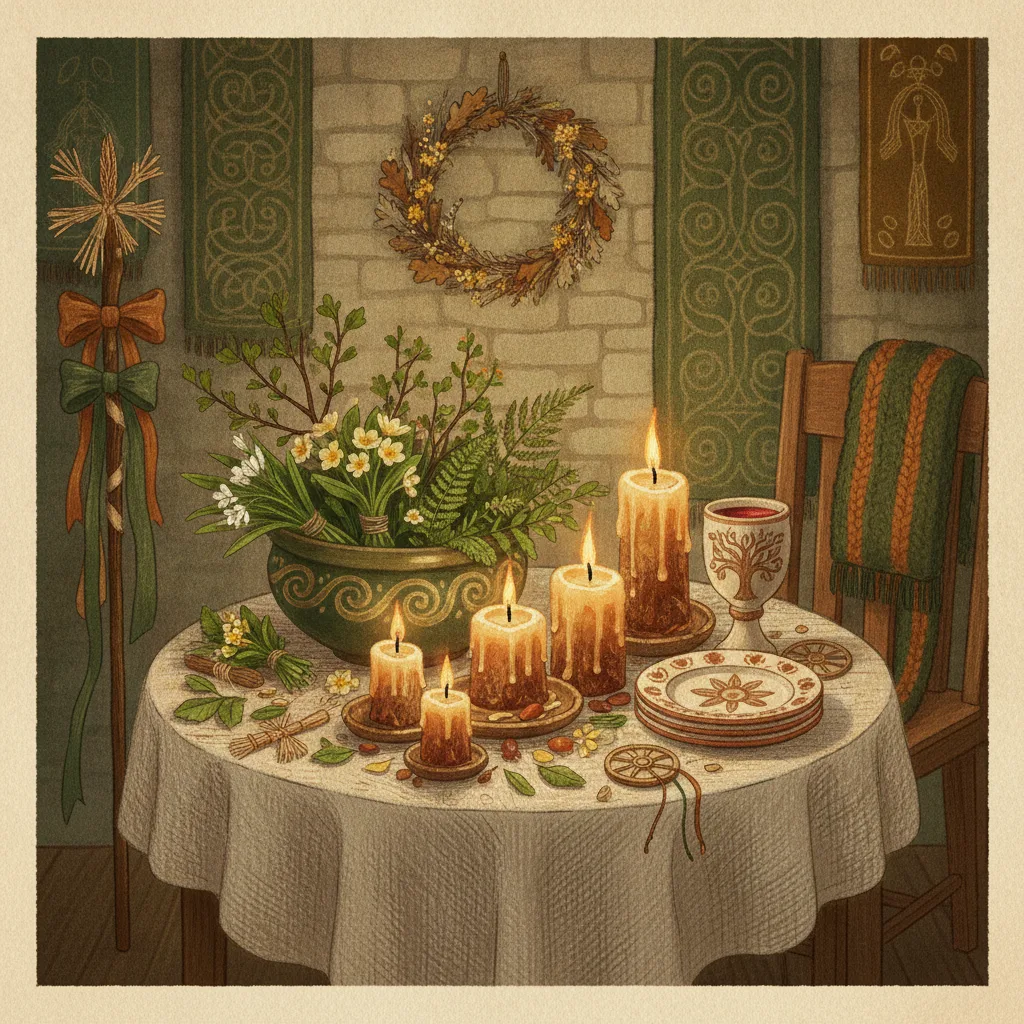
Beltane (1 May) is a genuinely ancient Gaelic fire-festival marking summer's start and cattle moving to pasture, first named in Cormac's glossary. Decorate with the May Bush: a rowan or hawthorn bough dressed with ribbons and yellow flowers, kept outdoors since bringing hawthorn blossom inside was thought unlucky. Hang rowan at the threshold. The maypole and eightfold Wheel are later.
- Beltane (1 May) is a genuinely ancient Gaelic fire-festival.
- Cattle were driven between two bonfires for protection.
- The May Bush is dressed with ribbons and yellow flowers.
- Keep hawthorn blossom outdoors; it was traditionally unlucky indoors.
- The maypole and eightfold Wheel are later additions, not original.
Of the four Gaelic fire-festivals, Beltane is the one that arrives with the year already tipping into abundance. It falls on 1 May and marks the beginning of summer and the moving of cattle out to their summer pasture. Unlike some of the calendar dates that later got tidied into a neat eightfold scheme, Beltane is genuinely old: the first written mention of it appears in a glossary attributed to Cormac, a bishop and king of Munster killed in 908, who linked the name to the Old Irish tene, “fire.” If you want to decorate for early summer in a way that is rooted rather than invented, this is a festival that gives you real, documented custom to work from.
What Beltane actually was
Beltane sat opposite Samhain across the year, the two poles of the old Gaelic calendar: winter beginning at one, summer at the other. Its central rite was fire. To protect the herds from disease before they went out to grass, cattle were driven between two bonfires, the smoke, flame and ash all held to carry protective power. Household hearth fires were sometimes extinguished and relit from the communal Beltane fire. This was a working festival for a pastoral people, tied to the practical turning-out of livestock, not a decorative theme.
Its opposite number is worth knowing properly too; we set out what the darker pole of the year really involved in Samhain: what it actually was. Keeping the pair in mind stops you treating either as generic “Celtic” mood.
The May Bush: the decoration that is genuinely traditional
If Imbolc has the rush cross, Beltane has the May Bush, and it is the single most useful thing to know for decorating. The May Bush was a branch or small bush, often of hawthorn but also cut from rowan, sycamore or elder, set up outside the house or in a shared space and decorated. According to the National Museum of Ireland’s folklife record, the tradition was strongest in Leinster, the Midlands, west into Galway and north to south Ulster and Donegal.
The decoration itself is easy to reproduce honestly: ribbons, cloth streamers, sometimes tinsel, and above all flowers. Yellow flowers were used most often, most likely in reference to the summer sun, primroses, marsh marigolds, gorse and buttercups among them. The whole thing was believed to help ensure plentiful milk in the coming year, which ties it straight back to the cattle theme of the festival. A branch of hawthorn or rowan in a heavy jug by the door, dressed with real ribbon and yellow spring flowers, is a decorated home for Beltane that would be recognised across a wide swathe of Ireland.
Hawthorn: the flower of the festival, indoors with care
Hawthorn, the “May” itself, is the plant most bound up with the festival: it blossoms right around now and gives the month its old name. It is worth flagging one genuine piece of folk belief here, because it is widespread and consistent: bringing hawthorn blossom indoors was traditionally thought to be unlucky, sometimes said to bring illness or death into the house. Modern botany even offers a grimly plausible reason, since hawthorn blossom contains trimethylamine, a compound also produced by decaying tissue, so the scent carried an association with death for people who prepared their own dead at home.
You do not have to believe any of it, but the honest, tradition-aware move is to keep hawthorn as an outdoor plant for Beltane, dressing a bush or bough by the threshold rather than cutting blossom for the mantel. Rowan, whose protective reputation is just as strong, is the safer cut branch for indoors.
Protection at the threshold
Beltane was an anxious hinge as well as a joyful one. May morning was one of the times when the boundary with the Good Folk was felt to be thin, and a good deal of custom aimed at guarding milk, butter and cattle from being “taken.” On the first of May, sprigs of rowan and hawthorn were hung above the barn door for protection; yellow flowers were scattered on doorsteps and windowsills. For a modern home this translates cleanly into threshold decoration: a small bunch of rowan tied above a door, flowers along a sill. It reads as seasonal styling and it is entirely faithful to what people actually did.
May dew, wells and the softer customs
Two gentler customs round out the picture. May dew was gathered on the morning of 1 May and used on the face for health and beauty; one account collected from Castleknock has it that the sun dances on May morning, and that washing in the dew wards off headaches for the year. And holy wells were visited and dressed at Beltane, often with rags or ribbons tied to a nearby tree. These are not things to stage as décor so much as to know about, but a jug of flowers by a bowl of water on a May shelf is a quiet nod to both.
Old festival, recent framing
Here is the distinction worth dating clearly. The festival of Beltane on 1 May is genuinely ancient, attested over a thousand years ago and rooted in a real pastoral calendar. The maypole and its ribbon dance, by contrast, are best understood as a broader European May custom that became attached to the day, not part of the original Gaelic fire-festival, and the idea of Beltane as one neat spoke of an eight-part “Wheel of the Year” is a twentieth-century synthesis. The individual festival is old; the wheel is modern. We lay out that whole calendar honestly in The Wheel of the Year, honestly dated, and it is worth reading before you commit to any “ancient eightfold” framing.
Styling it, maker-first
For the objects themselves, keep to what the season gives and buy made where you can. A heavy stoneware jug or a simple earthenware pitcher from a small-batch potter holds a hawthorn or rowan bough far better than anything moulded. Real ribbon, ideally plant-dyed silk or cotton from an independent weaver or dyer, does the dressing. Beeswax candles from a small chandler carry the fire theme indoors without pretending to be a bonfire. A length of undyed or naturally dyed linen from a hand-weaver makes a fresh, early-summer cloth for a shelf or sill.
The scheme should look like the actual turn into summer: green just fully arrived, yellow flowers, pale linen, the smell of hawthorn kept firmly outside the door. Set a dressed bough by the threshold on May Eve, hang a sprig of rowan above a door, put yellow flowers on the sill, and light a candle. That is a home decorated for Beltane that is rooted, dated and quietly true to the people who kept it, which is worth more than any amount of generic “Celtic summer” stock.
Frequently asked questions
When is Beltane and how old is it?
Beltane falls on 1 May and marks the start of summer and the turning-out of cattle to pasture. It is genuinely ancient: the first written mention appears in a glossary attributed to Cormac, a bishop and king of Munster killed in 908, who linked the name to the Old Irish tene, fire. It is one of the four Gaelic fire-festivals, alongside Samhain, Imbolc and Lughnasadh.
What is a May Bush?
The May Bush is the genuinely traditional Beltane decoration: a branch or small bush, often hawthorn but also rowan, sycamore or elder, set up outside the house or in a shared space and dressed with ribbons, cloth streamers and flowers. Yellow flowers were used most often, probably echoing the summer sun, and the custom was believed to help ensure plentiful milk. The National Museum of Ireland records it as strongest in Leinster, the Midlands, west into Galway and north to south Ulster and Donegal.
Is it unlucky to bring hawthorn indoors?
There is a widespread and consistent folk belief that bringing hawthorn (May) blossom indoors is unlucky, sometimes said to bring illness or death. Modern botany offers a plausible reason: hawthorn blossom contains trimethylamine, also produced by decaying tissue, so the scent carried a death association for people who prepared their own dead at home. The tradition-aware move is to keep hawthorn outdoors as part of a May Bush and use rowan as the safe cut branch for indoors.
Is the maypole part of the ancient Gaelic festival?
No. The festival of Beltane on 1 May is genuinely ancient, but the maypole and its ribbon dance are best understood as a broader European May custom that became attached to the day, not part of the original Gaelic fire-festival. Likewise, framing Beltane as one spoke of an eight-part Wheel of the Year is a twentieth-century synthesis; the individual festival is old, the wheel is modern.
How should I decorate for Beltane?
Dress a bough of hawthorn or rowan by the threshold with real ribbon and yellow spring flowers, in the May Bush tradition. Hang a sprig of rowan above a door for protection, scatter yellow flowers along a sill, and light a beeswax candle to carry the fire theme indoors. Keep the palette to what the season gives: full green, yellow flowers, pale linen, and hawthorn blossom kept outside the door.
