Celtic Legends Irish · Mythological Cycle
The Dagda
The ‘Good God’ of the Tuatha Dé Danann — chieftain, druid and giant — with his club, cauldron of plenty and harp of three strains, as told in Cath Maige Tuired and Lebor Gabála Érenn.
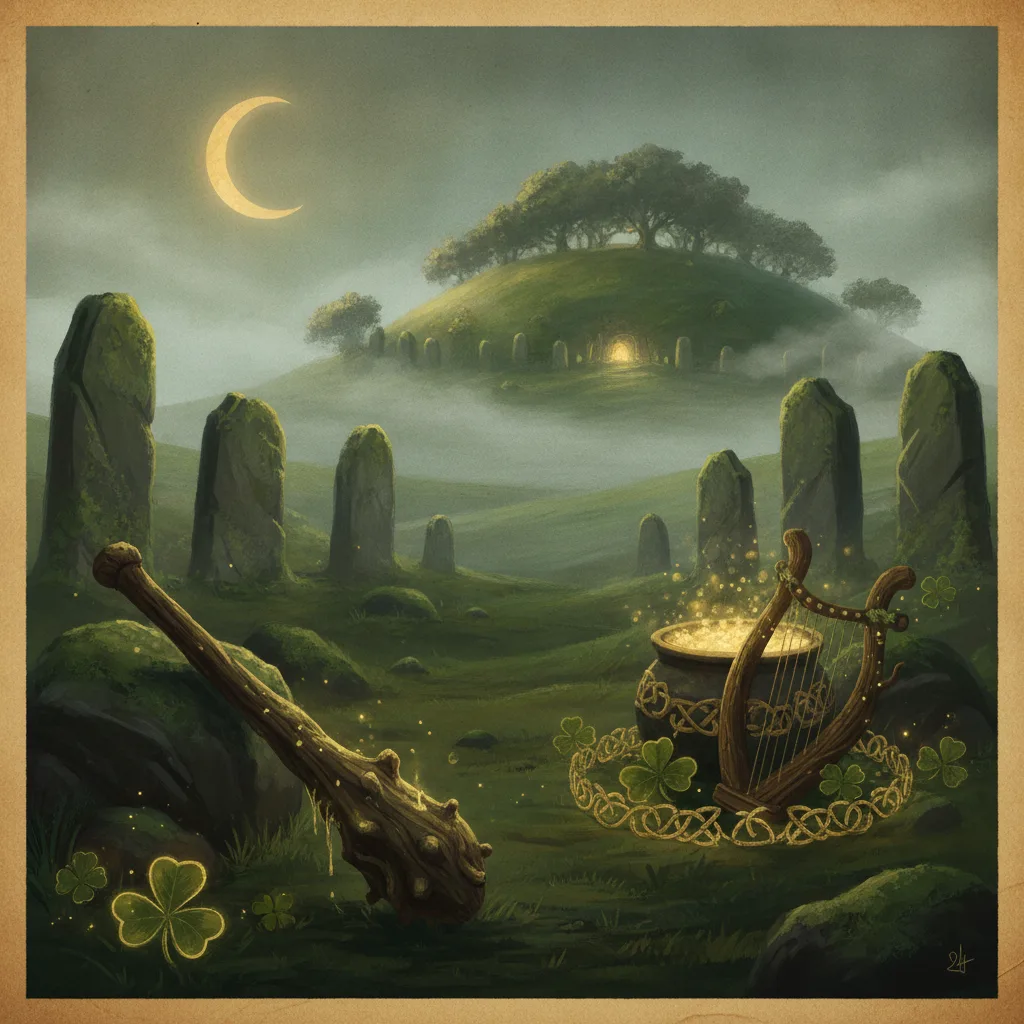
The Dagda ('the Good God') is the father-figure of the Tuatha Dé Danann - chieftain, druid and provider - best seen in Cath Maige Tuired. He wields a club that kills and revives, an inexhaustible cauldron of plenty, and the harp Uaithne of the three strains. 'Good' means good at everything, not morally good; the all-father comparison to Zeus misleads.
- The Dagda, 'the Good God,' is the father-figure of the Tuatha Dé Danann.
- 'Good' means skilled at everything, not morally good; his fullest portrait is in Cath Maige Tuired.
- His treasures: a club that kills and revives, an inexhaustible cauldron, and the harp Uaithne.
- The harp plays three strains - weeping, laughter and sleep - in the famous rescue scene.
- He dwells at Brú na Bóinne (Newgrange); the myth is younger than the ancient mound it claims.
| Tradition | Irish (Mythological Cycle) |
| Type | god (father-figure / chieftain-druid) |
| Earliest attestation | Cath Maige Tuired (older material; MS Harley 5280) and Lebor Gabála Érenn (compiled 11th c.) |
| Associated places | Brú na Bóinne (Newgrange), River Boyne |
| Associated symbols | the club (lorg mór), the cauldron of plenty (coire ansic), the harp (Uaithne) |
He is enormous, appetite and all — a god who drags a club so heavy it leaves a track like a boundary-ditch, eats porridge from a pit in the ground with a ladle big enough to hold two people, and yet plays a harp that can make an army weep, laugh, or fall asleep at will. The Dagda (“the Good God”) is the father-figure of the Irish gods: chieftain, druid, provider, and comic giant all at once. He is one of the most human of the Irish deities precisely because he is so extravagantly physical, and the medieval texts describe him with a relish they rarely allow anyone else.
The story the sources tell
The Dagda is a leading figure of the Tuatha Dé Danann, the divine race of Irish myth, and his defining appearance is in Cath Maige Tuired (“The Second Battle of Mag Tuired”), the account of the war between the Tuatha Dé and the oppressive Fomorians. His name is glossed in the text itself: he is called the Dagda, the “Good God,” not because he is morally good but because he is good at everything — “I am able to do all that you can do,” he tells the assembly.
Before the battle he goes to the Fomorian camp under a truce to spy and to buy time. The Fomorians, mocking his famous hunger, fill a vast cauldron sunk in the earth with eighty gallons of milk, meal and fat, along with whole goats, sheep and pigs, and tell him he must eat all of it or be killed. He does — scraping the pit clean with his hand — and then, grotesquely bloated, waddles away. The scene is broad comedy, but it is also a display of the god’s boundless capacity, the same abundance he embodies as a giver of plenty.
It is also in Cath Maige Tuired that he keeps his tryst with the Morrígan, meeting her as she straddles a river at Samhain; their union secures her aid against the Fomorians. And it is here that his harp performs its most famous feat, discussed below.
His three great treasures
The Dagda is known by his possessions, and each is attested:
- The club (lorg mór). So huge it must be dragged on wheels, one end kills the living and the other restores the dead. Its track, they say, was deep enough to mark the border between provinces.
- The cauldron (coire ansic, “the un-dry cauldron”). A vessel of abundance “from which no company ever went away unsatisfied.” It is listed among the Four Treasures the Tuatha Dé brought from their four northern cities — the cauldron came from the city of Murias.
- The harp (Uaithne). An ornate oaken harp. In Cath Maige Tuired, after the battle, the fleeing Fomorians carry off the Dagda’s harper and harp. The Dagda pursues them into their hall and calls the harp to him by name; it leaps from the wall, killing nine men on the way, and then he plays upon it the “three noble strains” a great harper must command — the strain of weeping, the strain of laughter, and the strain of sleep — putting the whole hall to sleep so he can escape.
The Dagda and the Brú na Bóinne
The Dagda is deeply tied to the sacred landscape of Ireland, above all to Brú na Bóinne — the great Neolithic passage-tomb complex on the River Boyne that includes Newgrange. In the mythological tradition the Brú is his dwelling, later won from him (in one famous tale) by his son Aengus through a clever trick of words. That later medieval storytellers attached their gods to a monument already thousands of years old is itself telling: the myth is younger than the mound it claims.
His many names
“The Dagda” is really a title, and the sources give him a string of other names that fill out his character. He is Eochaid Ollathair, “Eochaid the All-Father” or “great father”; Ruad Rofhessa, “the Red One of Great Knowledge,” pointing to his role as a druid and keeper of wisdom; and he is called Dáire and Eochu in various texts. A god with this many names is a god who has been important to many storytellers over a long time — each byname is a small window onto a different aspect of him, from fatherhood to occult learning, and together they warn us against reducing him to a single cartoon of the hungry giant.
Where he is written down
The Dagda’s core stories belong to the Mythological Cycle. His fullest portrait is in Cath Maige Tuired, which survives in the sixteenth-century British Library manuscript Harley 5280 but preserves much older material; the standard modern edition and translation is Elizabeth A. Gray’s for the Irish Texts Society (1982), following Whitley Stokes’s edition in Revue Celtique (1891). He also features in Lebor Gabála Érenn (“The Book of the Taking of Ireland,” often “The Book of Invasions”), the pseudo-historical compilation of Ireland’s mythical settlements, put together in the eleventh century and surviving in several recensions; its standard edition and translation is R. A. S. Macalister’s, in five volumes for the Irish Texts Society (1938–1956). The tale of how his son won the Brú is preserved separately in Tochmarc Étaíne (“The Wooing of Étaín”) and related material.
What the sources say vs. what circulates
- “Father god / all-father” is a fair summary, but not a Zeus. The Dagda is a chieftain among equals, a provider and craftsman-druid, not an enthroned sky-king ruling a pantheon. Reading him through a Greek or Roman template misses his specifically Irish flavour — earthy, humorous, tied to feasting and the land.
- The “four treasures” are cleanest in the sources for the group, not the individual. The cauldron is genuinely his; the sword, spear and Lia Fáil belong to Nuada, Lugh and the sovereignty of Tara respectively. Lists that hand the Dagda all four are a modern simplification.
- Neopagan “Dagda correspondences” — fixed lists of crystals, colours and ritual tools — are contemporary devotional invention, not medieval attestation. Worth engaging with as living practice, but not as ancient lore.
As with all the Irish gods, there is a reception layer to date. The late-nineteenth and early-twentieth-century Celtic Revival brought the Dagda back into art and literature, and modern Gaelic-polytheist and Druid movements have since made him a focus of practice. Both are real and interesting; neither is the medieval text.
The Dagda in modern art, fiction and games
He has a distinctive modern afterlife. Most prominently, “Dagda” is a central figure in the video game Shin Megami Tensei IV: Apocalypse, where he serves as the protagonist’s patron deity — a striking reinterpretation of the “good god.” He recurs in fantasy fiction that draws on the Tuatha Dé Danann, and his harp, club and bottomless cauldron are favourite motifs for illustrators of Irish myth. The comic contrast — a grave god of magic who is also a ravenous, mud-spattered giant — is exactly what makes him so usable.
Keeping him properly
The Dagda is the “Good God” of the Irish, best seen in Cath Maige Tuired and Lebor Gabála Érenn: chieftain and druid of the Tuatha Dé Danann, master of the club that kills and revives, the cauldron of plenty, and the harp of the three strains, and lord of the Brú na Bóinne. The all-father comparisons, the tidy four-treasures lists, and the modern correspondences are later frames — some helpful, some misleading — and this site keeps them clearly apart from the extravagant, funny, generous god the manuscripts actually give us.
| Tradition | Irish (Mythological Cycle) |
| Earliest text | Cath Maige Tuired (older material; surviving MS Harley 5280) and Lebor Gabála Érenn (compiled 11th c., several recensions) |
| Also appears | Tochmarc Étaíne (his son Aengus winning the Brú); the Four Treasures material; Dindshenchas place-lore |
| Later additions | Celtic Revival reception (late 19th–early 20th c.); modern Gaelic-polytheist and Druid devotion; ‘all four treasures’ lists are a modern simplification |
| Translation | Gray, Cath Maige Tuired (Irish Texts Society, 1982); Macalister, Lebor Gabála Érenn (Irish Texts Society, 1938–1956) |
| Reviewed | 2026-08 |
Frequently asked questions
What does ‘the Dagda’ mean?
‘The Good God’ — but ‘good’ in the sense of skilled, not moral. In Cath Maige Tuired he claims to be able to do everything the other gods can do, which is why he earns the title.
What are the Dagda’s treasures?
His club (lorg mór), one end of which kills and the other revives; his cauldron of plenty (coire ansic), from which no company left unsatisfied; and his harp, Uaithne, on which he plays the strains of weeping, laughter and sleep.
What is the porridge story?
In Cath Maige Tuired the Fomorians force the Dagda to eat a vast cauldron of porridge and meat sunk in the ground, mocking his hunger. He eats it all, scraping the pit clean, and waddles off bloated — a comic display of his boundless appetite and abundance.
Is the Dagda connected to Newgrange?
Yes. In the mythological tradition the Brú na Bóinne — the passage-tomb complex including Newgrange — is his dwelling, later won from him by his son Aengus. The myth is far younger than the Neolithic monument it claims.
Is the Dagda an ‘all-father’ like Zeus or Odin?
Loosely. He is a father-figure, provider and chieftain-druid, but not an enthroned sky-king ruling a pantheon. The comparison is a modern convenience that flattens his earthier, more humorous Irish character.
What are the main sources for the Dagda?
Chiefly Cath Maige Tuired (Elizabeth Gray’s 1982 edition) and Lebor Gabála Érenn (R. A. S. Macalister’s 1938–1956 edition), with the Brú tale in Tochmarc Étaíne.
