Drawing Cú Chulainn and the Táin: a reference for artists
Drawing Cú Chulainn from the Táin's own words — the ríastrad, the Gáe Bolg and the three-coloured hair — not the familiar dying-hero statue.
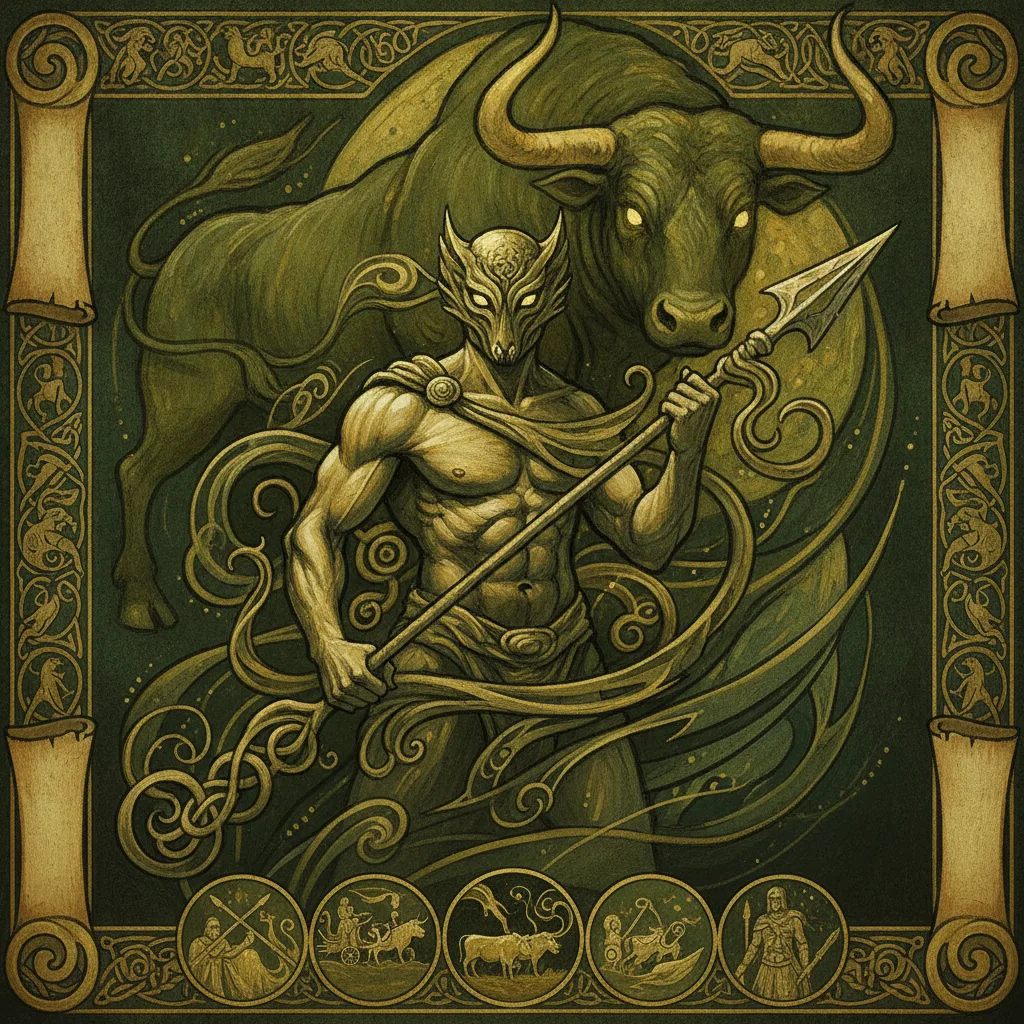
Draw Cu Chulainn from the Tain, not from Sheppard's 1911-12 statue. The sources give the riastrad, a body-horror battle-frenzy of reversed joints, knotted sinews and a contorted face, set against his described marvellous beauty. Use grounded specifics: the Gae Bolg cast with the foot, the chariot and charioteer Laeg, his youth, the ford duels, and the Morrigan.
- Draw from the Tain, not Sheppard's 1911-12 statue.
- The riastrad is a body-horror frenzy, not a heroic flex.
- Show reversed joints, knotted sinews and a contorted face.
- Balance the monster against his described marvellous beauty.
- Use the Gae Bolg, chariot, his youth and ford duels.
Most drawings of Cú Chulainn descend, whether the artist knows it or not, from a single bronze. Oliver Sheppard’s The Death of Cú Chulainn (modelled 1911–12, now in the General Post Office in Dublin) shows a slumped, dying, athletically idealised youth bound to a standing stone, a raven at his shoulder. It is a fine sculpture and a poor guide to the medieval hero, whom the sources describe as something far stranger and far more frightening. If you want to draw the Hound of Ulster from the material rather than from the statue, this is where to start.
What the sources are
Cú Chulainn belongs to the Ulster Cycle, and his central text is the Táin Bó Cúailnge (the Cattle Raid of Cooley), preserved in manuscripts such as the twelfth-century Book of the Dun Cow (Lebor na hUidre) and the Book of Leinster. The two most-used English versions are Thomas Kinsella’s The Táin (1969) and Ciaran Carson’s translation (2007). Read one of these before drawing anything: the details you need are specific and they are in the text.
His origin — the boy Sétanta killing the smith Culann’s hound and taking its place — and his death belong to shorter connected tales. The famous crow that settles on the dying hero comes from the death-tale, which is where the statue’s raven ultimately comes from too.
The ríastrad: draw the distortion, not the beefcake
The single most important thing the sources give an artist is the ríastrad, usually Englished as the “warp-spasm” (Kinsella) or “torque” (Carson). This is the battle-frenzy that seizes Cú Chulainn and physically deforms him. It is not a heroic power-up; it is described as making him monstrous. Kinsella’s rendering is worth quoting because it is so concrete:
“The first warp-spasm seized Cúchulainn, and made him into a monstrous thing, hideous and shapeless, unheard of.”
The text then itemises the transformation in near-anatomical detail. Working from that description, an artist has plenty to draw:
- The body turns inside its skin. His feet, shins and knees are said to switch to the rear while his heels and calves come to the front — a wrenching, reversed-joint horror, not a bodybuilder’s flex.
- The sinews knot. The balled sinews of his calves migrate to his shins, each knot as big as a warrior’s fist; the temple-sinews stretch to the nape of his neck.
- The face contorts. One eye is sucked back until it is narrower than a needle’s eye; the other bulges wider than a goblet’s mouth. He bares his jaws to the ear and peels his lips back from his teeth.
- The lón láith. A “hero’s light” or spurt of dark blood rises straight up from the crown of his head like a mast, forming a mist. Kinsella describes it as tall and dark.
This is the image the tradition actually offers: closer to a body-horror transformation than to a serene warrior. Drawing it well means committing to the ugliness. The distortion is the point — it is what makes him unbeatable and what makes him a danger to his own side, since in the frenzy he cannot always tell friend from foe.
Objects and specifics the text hands you
Beyond the frenzy, the sources supply props that are worth getting right rather than inventing.
- The Gáe Bolg. His signature weapon is not a generic spear. It is thrown or cast with the foot along the water, enters by a single wound and opens into many barbs inside the body so it cannot be withdrawn intact. How it is delivered — low, from the water, with the foot — is unusual and drawable.
- The chariot and charioteer. Cú Chulainn fights from a chariot driven by Láeg mac Riangabra. The scythed war-chariot is a recurring image; the hero and his driver are a pair, not a lone figure.
- Youth. He performs his greatest feats as a beardless teenager. In one episode the Ulstermen disguise the fact of his youth from the enemy because it is shaming to be killed by a boy. The statue’s mature athlete is a Victorian-Edwardian idealisation.
- The single combats at the ford. Much of the Táin is a sequence of duels at a river-ford while Ulster lies under a debilitating curse. Water, the ford and the fixed location recur, including his grief-stricken fight with his foster-brother Fer Diad.
The other face: the beautiful youth
The frenzy is only half the picture the Táin gives. The same text also lingers on Cú Chulainn out of his rage, and here the description is almost the opposite — an idealised, near-fantastical beauty. He is said to have hair of three colours, dark next to the skin, blood-red in the middle and crowned with a fringe of gold; multiple dimples in each cheek; and an uncanny number of pupils in each eye and of fingers and toes. Whether or not you draw those exact prodigies, the contrast is the useful thing: the tradition deliberately sets a marvel of beauty against a monster of war, the same person seen in two states. An artist who shows only the calm youth or only the distorted fury is drawing half the character. The strongest images play the two against each other.
The Morrígan connection
Cú Chulainn’s story is tangled with the war-goddess. In Táin Bó Regamna and the Táin itself, the Morrígan offers him aid, is refused, and turns against him, attacking in the forms of an eel, a she-wolf and a hornless red heifer. If you are building a composition around him, she is the most source-grounded supernatural element to include — and we have a separate reference guide to drawing her that keeps to what the texts describe.
A working method
Put together, a source-led approach looks like this. First, read a full translation and mark the passages that describe him physically — you will find the ríastrad, the youth, the weapon and the chariot doing most of the work. Second, decide which moment you are drawing: the boyhood deeds, the frenzy at the ford, the fight with Fer Diad, or the death. Each has different emotional weight, and the frenzy in particular demands the distorted body rather than the idealised one. Third, resist importing the statue by reflex. The raven, the standing stone and the noble slump are one Edwardian sculptor’s interpretation of the death-tale, not the whole hero.
The reward for reading first is that the medieval Cú Chulainn is more interesting to draw than the modern shorthand. A shrieking, reversed-jointed teenager with one eye swallowed and the other bulging, a dark column of heat rising from his skull, casting a barbed spear along the water — that is what the tradition put on the page. It is stranger, more specific and more genuinely his than any calm bronze.
Frequently asked questions
What is the ríastrad?
It is Cú Chulainn's battle-frenzy or warp-spasm, described in the Táin as a hideous distortion of his body — reversed joints, migrating sinews, one eye sucked in and the other bulging, and a dark column of heat rising from his skull.
Where does the familiar Cú Chulainn statue come from?
From Oliver Sheppard's bronze The Death of Cú Chulainn, modelled 1911–12 and now in the GPO in Dublin. It is an Edwardian idealisation of the death-tale, not a portrait from the medieval text.
What was his signature weapon?
The Gáe Bolg, a barbed spear cast with the foot along the water; it entered by one wound and opened into many barbs inside the body so it could not be withdrawn intact.
Which translations of the Táin should I read?
Thomas Kinsella's The Táin (1969) and Ciaran Carson's translation (2007) are the two standard English versions.
How old is Cú Chulainn in the tales?
He performs his greatest feats as a beardless youth; in one episode the Ulstermen hide his youth from the enemy because being killed by a boy is shaming.
