Imbolc and Brigid’s Day: decorating for early spring
Decorating for Imbolc and St Brigid Day the rooted way: the rush-cross tradition sourced and dated, hearth customs, and folk custom split from modern additions.
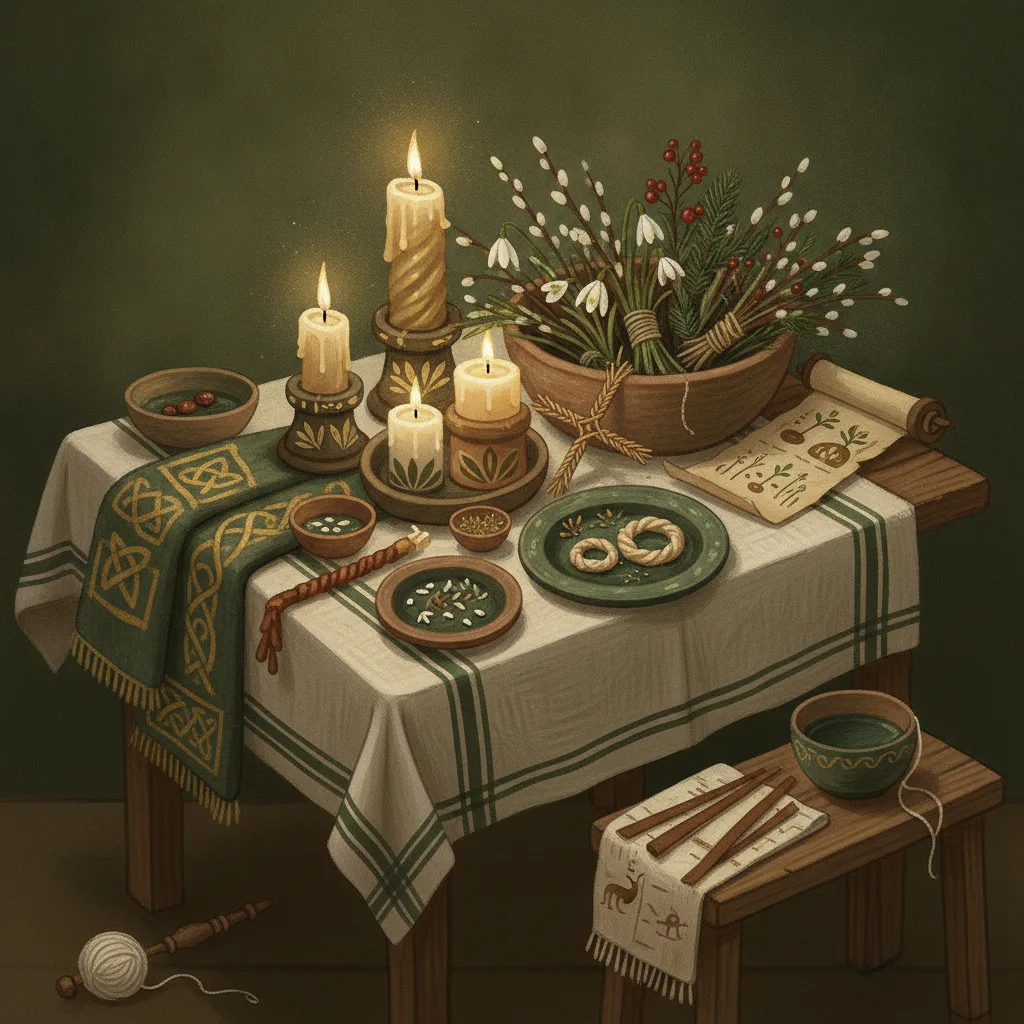
Imbolc (1 February) begins spring in the old Gaelic year, overlaid with St Brigid's Day. The Brigid's cross woven from rushes is a real folk custom documented from the 17th century, not an unbroken 1,500-year one. Decorate with rushes, snowdrops, undyed wool and hearth candlelight. The individual festival is old; the eightfold Wheel of the Year is modern.
- Imbolc (1 February) begins spring; name glossed in the belly.
- St Brigid's Day overlays the same date, devotional and seasonal.
- The rush Brigid's cross is documented from the 17th century.
- Decorate with rushes, snowdrops, undyed wool and hearth candlelight.
- The festival is old; the eightfold Wheel is a modern synthesis.
Of all the turning points in the year, the one at the start of February is the easiest to feel and the hardest to see. Nothing much has changed outside; the light has, just. This is Imbolc, and its Christian counterpart St Brigid’s Day, and it has one of the most genuinely durable folk customs attached to it: the making of a cross from rushes. If you want to decorate for early spring in a way that is rooted rather than invented, this is the festival to learn properly, because it rewards accuracy.
Imbolc and St Brigid’s Day: what they are
Imbolc falls on 1 February and marks the very beginning of spring in the old Gaelic reckoning, the first of the four fire festivals of the year. The name comes from Old Irish, most often glossed as i mbolg, “in the belly,” a reference to the pregnancy of ewes and the coming of milk: the first sign, underground and in the flock, that the year is turning back toward growth.
Overlaid on the same date is Lá Fhéile Bríde, St Brigid’s Day, honouring St Brigid of Kildare, one of Ireland’s patron saints. The relationship between the pre-Christian goddess Brigid and the Christian saint is genuinely tangled, and anyone who tells you it is simple is selling something; we untangle it as far as the evidence allows in our profile of Brigid. What matters for decorating is that the date carries both a seasonal, agricultural meaning and a devotional one, layered over centuries.
One modern marker worth knowing: since 2023, St Brigid’s Day has been an official public holiday in Ireland, the first Irish national holiday named for a woman, explicitly framed as a joint celebration of the saint and Imbolc. That is new, and it is a nice example of an old festival still visibly evolving.
The Brigid’s cross: sourced and dated
The centre of Imbolc decoration is the Brigid’s cross (Crosóg Bríde): a small cross woven from rushes, with a distinctive woven square at the centre and four arms, traditionally bound at the ends. It is one of the most recognisable folk objects in Ireland.
Here honesty matters. The legend ties the cross to St Brigid herself in the 5th century, weaving rushes from the floor into a cross at the bedside of a dying chieftain as she explained the faith to him. That is a devotional origin story, not a dated record. The actual documented practice of making these crosses is first attested in the 17th century, which is still a long and genuine folk tradition, just not a 1,500-year unbroken one. Holding both facts at once, the beautiful legend and the later documentation, is exactly the kind of accuracy this festival deserves.
The custom itself is well recorded. On St Brigid’s Eve, 31 January, families would gather fresh rushes (sometimes straw where rushes were scarce) and weave the crosses that evening. They were often left out overnight to receive Brigid’s blessing, then hung on 1 February over doors and windows, and out in the byres, stables and barns, to protect the household and animals from fire, lightning, illness and misfortune through the coming year. The previous year’s cross was traditionally taken down and burned as the new one went up, a clean annual renewal.
Rushes, the hearth and the threshold
Two other genuine customs give you far more to work with than any shop display.
Fresh rushes on the floor and an unlatched door. Spreading fresh rushes was an old, everyday sign of welcome, and on St Brigid’s Eve the door was left unlatched and a cloth or ribbon sometimes left out overnight, so that Brigid, walking the land that night, could enter and bless the house. You can honour this simply: a bundle of rushes by the door, a threshold kept clear and welcoming.
The hearth. Brigid is strongly associated with fire, the forge and the hearth, and Imbolc is a fire festival. A single lit candle or a swept, laid fireplace is more in keeping with the day than any amount of decoration. This is also where the connection to Candlemas, the Christian feast of lights on 2 February, sits alongside the Gaelic tradition.
For the decorative scheme itself, keep it to what the season actually offers: rushes and straw, the first snowdrops, bare and just-budding branches, undyed wool and linen, white and pale-green cloth, beeswax candlelight. It should look like the earliest, tentative spring, because that is what it is.
Separating the folk custom from the modern additions
This is where a rooted Imbolc parts company with a lot of contemporary content, and it is worth being clear so you can decorate with a straight face.
- Genuinely traditional: the rush cross (as a documented custom from the 17th century on), the Brídeóg, gathering rushes on St Brigid’s Eve, the unlatched door and the Brat Bríde (a cloth left out overnight to catch Brigid’s blessing, then kept for its supposed healing power), hearth and candle customs, and the protective hanging of the cross.
- The Brídeóg, incidentally, is a lovely and real one to revive: a small doll representing Brigid, made from rushes or straw and dressed, carried house to house by young people, especially girls, and welcomed in at each door.
- Modern neopagan additions: framing Imbolc as one spoke of an eight-part “Wheel of the Year” is a twentieth-century synthesis, not an ancient calendar; the individual festival is old, the wheel is recent. Likewise, elaborate goddess altars, correspondence tables of crystals and colours, and scripted “Imbolc rituals” are contemporary devotional practice. There is nothing wrong with any of it as living tradition, but it is modern tradition, and it is more honest, and frankly more interesting, to say so than to backdate it to the druids.
Doing it well
If you make one thing this Imbolc, make the cross, and make it from real rushes gathered fresh, following the shape rather than buying a moulded ornament. Hang it over a door on 1 February; take last year’s down. Light a single candle at the hearth. Leave the threshold clean and welcoming. That is a decorated home for early spring that would be recognised by people going back four centuries, which is a rarer and better thing than any amount of themed stock. Rooted, dated, and quietly alive.
Frequently asked questions
What are Imbolc and St Brigid Day?
Imbolc falls on 1 February and marks the start of spring in the old Gaelic year, the first of the four fire festivals; its name is usually glossed from Old Irish as in the belly, for the pregnancy of ewes and coming of milk. St Brigid Day (La Fheile Bride) is overlaid on the same date, honouring St Brigid of Kildare, and since 2023 it has been an Irish public holiday.
How old is the Brigid cross tradition?
The legend ties it to St Brigid in the 5th century, weaving rushes into a cross at a dying chieftain bedside. But the documented practice of making these crosses is first attested in the 17th century, still a long genuine folk tradition, just not a 1,500-year unbroken one. Holding both facts at once is the honest position.
How was the Brigid cross traditionally made and used?
On St Brigid Eve, 31 January, families gathered fresh rushes (or straw) and wove crosses that evening, often left out overnight to receive Brigid blessing. On 1 February they were hung over doors, windows and in byres and barns to protect against fire, lightning, illness and misfortune, and last year cross was taken down and burned.
What is traditional versus modern in Imbolc decorating?
Genuinely traditional: the rush cross (from the 17th century on), the Brideog doll, gathering rushes on St Brigid Eve, the unlatched door, the Brat Bride cloth, and hearth and candle customs. Modern additions include framing Imbolc as one spoke of an eight-part Wheel of the Year (a twentieth-century synthesis) and elaborate goddess altars and scripted rituals.
How should I decorate for early spring at Imbolc?
Keep to what the season offers: rushes and straw, the first snowdrops, bare and just-budding branches, undyed wool and linen, white and pale-green cloth, and beeswax candlelight. Make a real rush cross, hang it on 1 February, light a single candle at the hearth, and keep the threshold clean and welcoming.
