Jim Fitzpatrick and the Celtic art revival
Jim Fitzpatrick's Book of Conquests and The Silver Arm gave Irish myth its modern face — a "Celtic" style that is a 20th-century revival, not an ancient survival.
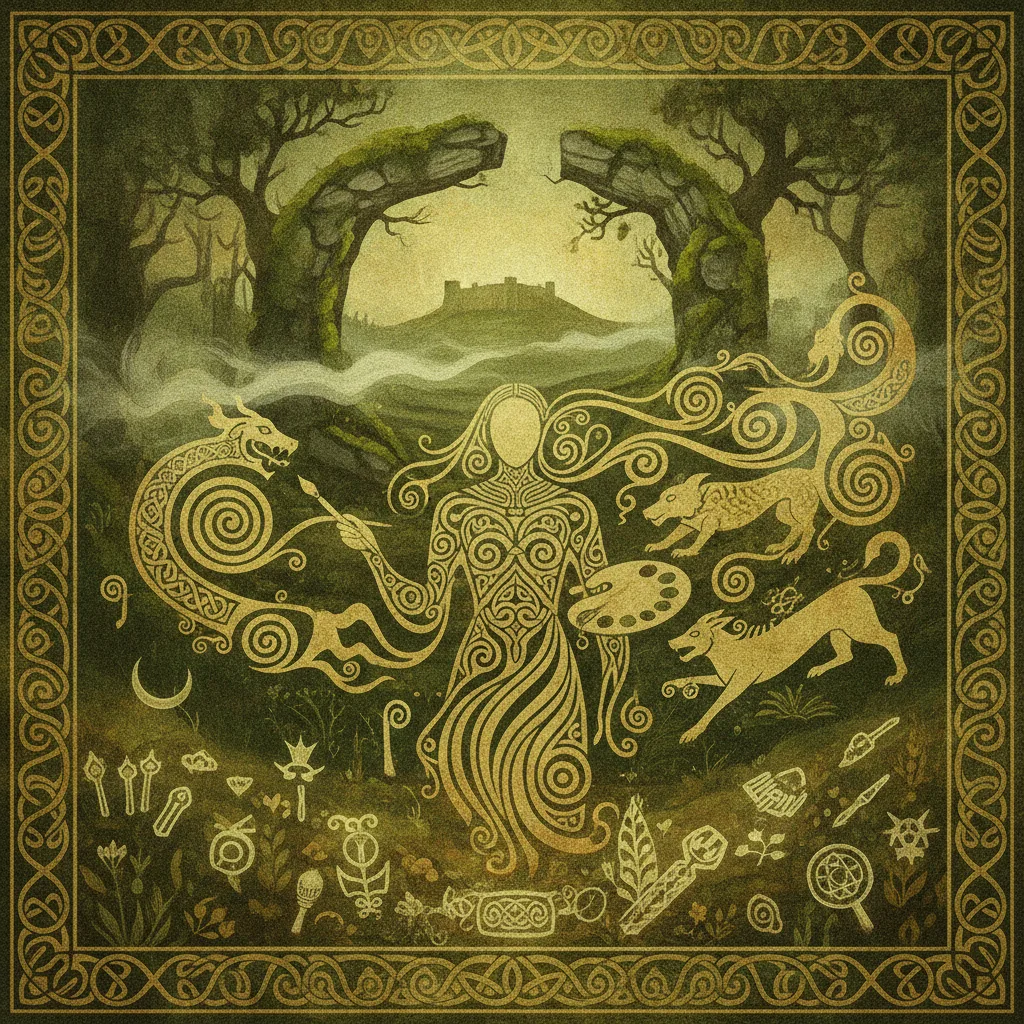
Jim Fitzpatrick gave modern readers a visual language for the Tuatha De Danann in The Book of Conquests (1978) and The Silver Arm (1981). His style blends Insular manuscript ornament, twentieth-century poster design and comic-book anatomy. The Celtic look is a modern construction, not Iron Age survival. Study the manuscripts directly, read the story, and own the modern parts.
- Fitzpatrick shaped the modern image of the Tuatha De Danann.
- Key works: The Book of Conquests (1978) and The Silver Arm (1981).
- His style blends manuscript ornament, poster design and comic anatomy.
- The Celtic look is modern invention, not Iron Age survival.
- Study manuscripts directly, read the story, own the modern choices.
If you have ever seen a poster of an Irish god rendered in gold and interlace — a warrior ringed by spirals, a battle frozen in enamel-bright colour — there is a fair chance it was drawn by Jim Fitzpatrick. Born in Dublin in 1946, Fitzpatrick is the artist who, more than anyone in the twentieth century, gave modern readers a visual language for the Tuatha Dé Danann. He is also, usefully for anyone thinking about how folklore art works, a case study in something the field rarely admits: that the look we call “Celtic” is largely a modern construction, and that this is not a flaw.
Who he is, and what he actually made
Fitzpatrick first became famous for something unconnected to myth. In 1968 he produced the stylised two-tone portrait of Che Guevara that became one of the most reproduced images of the century. But the work that matters here is the pair of illustrated books he wrote and painted in the late 1970s and early 1980s.
The Book of Conquests (1978) is his retelling of material from the Lebor Gabála Érenn, the medieval “Book of the Taking of Ireland.” It centres on Nuada, king of the Tuatha Dé Danann, and the First Battle of Mag Tuired. Its sequel, The Silver Arm (1981), continues the story into the deeds of Nuada of the Silver Arm and of Lugh against the Fomorians. Both are large-format books in which dense, jewel-coloured plates sit alongside Fitzpatrick’s own prose. He had already been working the same seam in a weekly newspaper strip, Nuada of the Silver Arm, for the Sunday Independent in the mid-1970s.
The books were not illustrations bolted onto someone else’s translation. Fitzpatrick did the retelling and the pictures together, which is why the two feel of a piece.
What the style is made of
Look closely at a Fitzpatrick plate and you can see the sources being blended. The interlace, the spirals, the triple knots and the zoomorphic borders come out of Insular manuscript art — the visual world of the Book of Kells and the Book of Durrow, produced by monastic scriptoria around the eighth and ninth centuries. The compositions, though, are pure twentieth-century poster design: strong central figures, flat planes of saturated colour, a graphic clarity you would never find on a vellum page crowded edge to edge.
There is a third ingredient that fans sometimes miss. The muscular, heroic anatomy and the fantasy staging owe a good deal to comics and to the mid-century illustrators Fitzpatrick grew up on. The result is a genuine hybrid: medieval ornament, modern graphic design, and adventure-comic dynamism, held together by a consistent hand.
Being honest about “the Celtic look”
Here is the part worth dwelling on. The bright, ornament-heavy style we now read as self-evidently “ancient Celtic” is not how the pre-Christian Irish decorated anything, and we have very little idea what their gods were imagined to look like. The insular manuscripts that supply the interlace were Christian books made centuries after the myths were first told, by scribes copying Gospels, not portraits of Nuada.
Fitzpatrick’s achievement was to take that authentic ornamental vocabulary and use it to picture stories it was never originally attached to. That is a creative act, and a defensible one — but it is invention, not reconstruction. When his palette and interlace get copied a thousand times over on tattoos, album covers and stock art, the copies quietly present a 1970s design decision as the timeless face of Irish myth.
None of this diminishes the work. It just means the honest way to describe it is “a modern Celtic revival style,” in the same lineage as the nineteenth-century Celtic Revival and the Arts and Crafts movement — a tradition of looking back, not a survival from the Iron Age. Fitzpatrick himself has always been open about drawing on the manuscripts; the flattening happens downstream, in the imitators.
What an artist can actually take from him
If you want to learn from Fitzpatrick rather than merely trace him, a few things repay study.
- Ornament as structure, not garnish. His interlace borders are not decoration added last; they frame the figure and lead the eye. Sketch the composition and the knotwork together, or the knotwork will look bolted on — which is exactly the failure mode of most imitations.
- Go to the manuscripts, not to other people’s Celtic art. The Book of Kells and the Book of Durrow are the primary sources for this vocabulary, and they are in the public domain. Copying from them, rather than from a Fitzpatrick poster, is how you learn the grammar instead of the accent. Our guide to public-domain manuscript art is a starting point.
- Read the story you are drawing. Fitzpatrick wrote his retellings before he painted them. If you are illustrating the Lebor Gabála or the Ulster Cycle, the text will hand you specifics — colours, objects, gestures — that generic “Celtic warrior” imagery never will.
- Own the modern part. The heroic anatomy and poster colour are yours to use, but know that they are choices. A muted, earthy palette would be no less “authentic,” because there is no authentic palette to betray.
Where he sits now
Fitzpatrick has kept working, kept selling prints, and kept an audience that runs from Irish-mythology readers to metal bands who have licensed his gods for their sleeves. His influence is so pervasive that many people who have never heard his name still picture Irish myth in his colours. That is the mark of an artist who did not just illustrate a tradition but, to a real extent, designed the modern version of it.
For anyone drawing from Irish legend, he is worth studying twice: once for the craft, which is superb, and once as a reminder that the “look of the myths” is something artists build, decade by decade, out of whatever sources are to hand. Knowing that is what separates homage from cliché — the same distinction that matters whether you are drawing Nuada or, as many do, drawing the Morrígan.
Frequently asked questions
What is Jim Fitzpatrick best known for?
Two lavishly illustrated books retelling Irish myth — The Book of Conquests (1978) and The Silver Arm (1981) — as well as the famous two-tone Che Guevara poster of 1968.
Is Fitzpatrick's style authentic ancient Celtic art?
No. It is a modern revival that blends genuine Insular manuscript ornament with 20th-century poster design and comic-book anatomy. There is no known ancient portrait style for the Irish gods to reconstruct.
What sources did Fitzpatrick draw on?
Chiefly the Lebor Gabála Érenn — the story of Nuada and the First Battle of Mag Tuired in The Book of Conquests, and the deeds of Nuada and Lugh against the Fomorians in The Silver Arm.
Where does the interlace in his work come from?
From Insular manuscript art such as the Book of Kells and the Book of Durrow, Christian books made around the eighth and ninth centuries — centuries after the myths were first told.
When and where was he born?
Jim Fitzpatrick was born in Dublin in 1946 and has continued to produce and sell his Irish-mythology work for decades.
