Celtic Legends Irish · Ulster Cycle
Medb: Queen Medb of Connacht
Queen of Connacht and driver of the Táin Bó Cúailnge — read by scholars as a sovereignty goddess, and the distant, contested source of English poetry's tiny 'Queen Mab'.
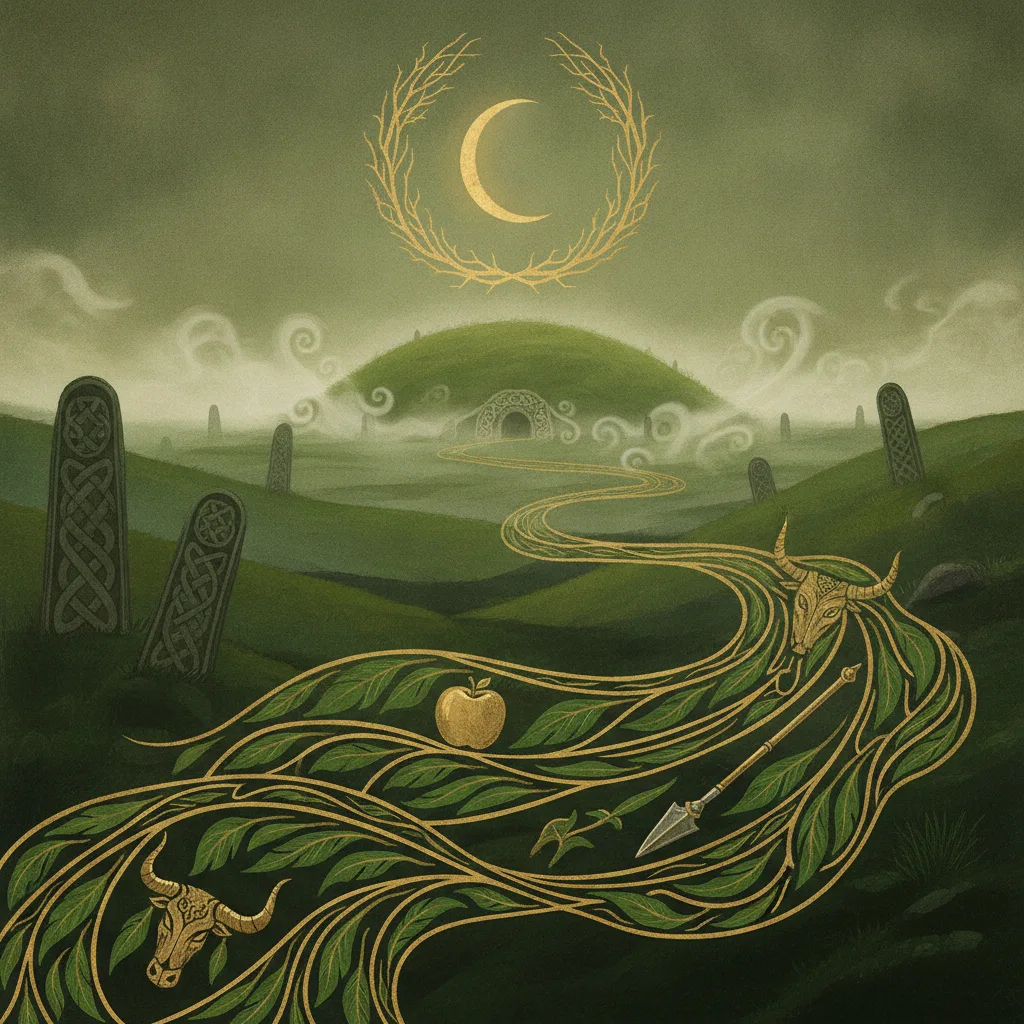
Medb (Maeve) is the warrior-queen of Connacht in Ireland's Ulster Cycle, whose cattle-raid drives the epic Táin Bó Cúailnge, first preserved in Lebor na hUidre around 1100. The medieval text presents her as a human queen; the popular 'sovereignty goddess' reading is a scholarly interpretation first proposed in 1928, not a source fact.
- Medb (Maeve) is the warrior-queen of Connacht, central figure of Ireland's Ulster Cycle.
- Her cattle-raid drives the epic Táin Bó Cúailnge, first preserved in Lebor na hUidre (c.1100).
- The medieval Táin presents her as a human queen, not explicitly a goddess.
- The 'sovereignty goddess' reading is a scholarly interpretation first proposed by Tomás Ó Máille in 1928.
- Her link to Shakespeare's fairy 'Queen Mab' is contested, not established fact.
| Tradition | Irish (Ulster Cycle) |
| Type | queen of Connacht; read by scholars as a sovereignty figure |
| Earliest attestation | Táin Bó Cúailnge — Recension I in Lebor na hUidre (c.1100) and the Yellow Book of Lecan (14th c.); Recension II in the Book of Leinster (c.1160) |
| Associated places | Cruachan / Rathcroghan (Co. Roscommon); Connacht; Lough Ree (her death) |
| Associated symbols | the prize bulls / cattle of the Táin; mead; sovereignty and kingship |
Medb — Queen of Connacht, ruling from Cruachan — is the driving force of Ireland’s greatest epic, the Táin Bó Cúailnge. It is her raid, her army, and her will that set the whole cattle-war in motion against Ulster and its lone young defender, Cú Chulainn. She is proud, strategic, sexually autonomous and utterly unwilling to be second to anyone, including her husband — and she is also the seed, by a long and contested road, of the tiny fairy “Queen Mab” of English poetry.
Where Medb comes from
Medb belongs to the Ulster Cycle, and her home text is the Táin Bó Cúailnge (“The Cattle Raid of Cooley”). The Táin survives in more than one recension. The earliest, Recension I, is preserved chiefly in Lebor na hUidre (the “Book of the Dun Cow,” around 1100) and in the fourteenth-century Yellow Book of Lecan; a fuller, more polished Recension II appears in the Book of Leinster, around 1160. The standard scholarly editions are Cecile O’Rahilly’s of both recensions (Dublin Institute for Advanced Studies), and the best-known literary translation is Thomas Kinsella’s The Táin (1969).
A note on names before we go further: “Medb” is the Old Irish spelling, pronounced roughly “Mayv,” and it is anglicised as Maeve or Meave. The same figure therefore turns up under several spellings across editions and retellings, all of them the one queen of Connacht.
In the story, Medb rules Connacht alongside her husband Ailill. The war begins with the “pillow talk” that opens the Táin: the royal couple compare their possessions to settle who is the greater, and find themselves exactly matched but for one thing — Ailill owns a magnificent white-horned bull that had been born into Medb’s herd but refused to be owned by a woman and crossed to his. To equal him, Medb must have the one beast in Ireland to rival it, the Brown Bull of Cooley in Ulster. When she cannot borrow it, she takes an army to seize it. The entire epic proceeds from her refusal to be one bull poorer than her husband.
The queen in the tale
Medb is not a symbolic bystander to the war; she runs it. She marshals and provisions the army, negotiates, bribes, and repeatedly sends champions against Cú Chulainn, whose ríastrad (battle-frenzy) holds the ford against her whole host while Ulster’s warriors lie under a debilitating curse. She offers her own daughter Finnabair, and her own favour, as inducements to fighters. She is shown as brave and capable and also as ruthless and self-serving — a fully drawn political operator rather than a cipher.
Her death is told separately, in Aided Meidbe (“The Violent Death of Medb”), and it is pointedly unheroic: she is killed while bathing in a pool on an island in Lough Ree, struck down at a distance by Furbaide, a nephew avenging his mother, using — in the tradition’s grimly precise detail — a piece of hard cheese shot from a sling. The queen who launched a nation’s war dies to a lump of cheese, and the tradition seems to relish the irony.
It is also worth being clear about how the Táin itself judges her. The great war she launches ends in stalemate and ruin; the two prize bulls that were its cause fight each other to death, leaving nothing to show for the slaughter. The medieval author is not celebrating Medb so much as anatomising her — her pride, her appetite, and the destruction that follows when a ruler treats a whole province as an extension of her own honour. That moral complexity is exactly why she has held readers’ attention for a thousand years: she is neither villain nor heroine, but a fully realised and dangerous person.
The sovereignty-goddess reading
Medb is very often described as a “sovereignty goddess” — a divine personification of the land’s kingship, who confers the right to rule on the man she takes. This reading has real textual footholds: the sources say no king could rule at Tara or Cruachan without first being joined to Medb, and a related figure, Medb Lethderg, is explicitly tied to the sovereignty of Tara. Her name strengthens the case. It derives from a Proto-Celtic root meaning “mead” or “she who intoxicates,” which fits neatly with the inauguration rite in which a would-be king was given a ceremonial drink by the personified sovereignty of the land.
But the label should be marked for what it is: a scholarly interpretation, not something the Táin states. It was first proposed by Tomás Ó Máille in 1928 and developed by later scholars; it is a reading of the character, argued from etymology and pattern, and it remains an interpretation rather than a source fact. The Táin itself presents Medb as a human queen. Treating “sovereignty goddess” as her plain identity, rather than as one influential way of understanding her, overstates what the medieval evidence directly says. It is a strong reading; it is still a reading.
The medieval texts give us a queen. Whether behind that queen stands a faded goddess of the land’s kingship is the argument scholars have been having, productively, for nearly a century.
From Medb to “Queen Mab”
Medb’s name has a strange literary afterlife, and it needs its layers dated carefully. In English, her name became “Maeve” — and, many have argued, “Mab.” The fairy Queen Mab enters English literature in Shakespeare’s Romeo and Juliet (written in the mid-1590s, printed 1597), in Mercutio’s dazzling speech describing her as “the fairies’ midwife,” a creature no bigger than an agate-stone who drives her tiny chariot over sleepers and delivers their dreams. Two centuries later Percy Bysshe Shelley took the name for his long philosophical poem Queen Mab (1813), where she is a visionary fairy queen entirely of his own devising.
The crucial point is the size of the drift, and its uncertainty. Whether Shakespeare’s Mab actually derives from the Irish Medb is contested — it is a plausible and often-repeated proposal, not an established fact, and other origins for the name have been suggested. Even if the derivation holds, the two figures could hardly be less alike: Medb is a full-scale warrior-queen who commands armies and reshapes a kingdom, while Mab is a thumbnail-sized dream-fairy of the English literary imagination. This is a name travelling across languages and centuries and being wholly reinvented at the far end — the opposite of an unbroken tradition. Enjoy the connection, but keep it labelled: a possible etymological thread, and a literary character built new, not the Irish queen in disguise.
Why Medb still matters
Medb is one of early European literature’s great female protagonists — a ruler who wages war on her own account, sets the terms, and answers to no husband. Read her alongside her lone adversary, Cú Chulainn, whose defence of the ford is the epic’s beating heart, and alongside the Morrígan, the sovereignty-and-war goddess who moves through the same battlefield and against whom Medb’s own possible divine dimension is best measured. Between the three of them, the Táin becomes what it has always been: not a quaint legend, but a fierce, adult, morally complicated epic worth reading in O’Rahilly’s edition or Kinsella’s translation rather than in summary.
| Tradition | Irish (Ulster Cycle) |
| Earliest text | Táin Bó Cúailnge — Recension I, preserved in Lebor na hUidre (c.1100) and the Yellow Book of Lecan (14th c.) |
| Also appears | Book of Leinster (Recension II, c.1160); Aided Meidbe ('The Violent Death of Medb'); the related sovereignty figure Medb Lethderg of Tara |
| Later additions | The 'sovereignty goddess' reading is scholarly interpretation (first proposed by Tomás Ó Máille, 1928, and developed later); the derivation of English 'Queen Mab' (Shakespeare, Romeo and Juliet, printed 1597; Shelley's Queen Mab, 1813) from Medb is contested |
| Translation | Cecile O'Rahilly (editions of both recensions, Dublin Institute for Advanced Studies); Thomas Kinsella, The Táin (1969) |
| Reviewed | 2026-08 |
Frequently asked questions
Who was Queen Medb?
The queen of Connacht in the Ulster Cycle, ruling from Cruachan (Rathcroghan, Co. Roscommon). She launches the great cattle-raid of the Táin Bó Cúailnge against Ulster and is one of early European literature's most fully drawn female rulers — proud, strategic and sexually autonomous.
What is the Táin Bó Cúailnge about?
'The Cattle Raid of Cooley.' To match her husband Ailill's prize bull, Medb leads an army to seize the Brown Bull of Ulster; her whole host is held at the ford by the young hero Cú Chulainn while Ulster's warriors lie under a curse. The war ends in ruin, the two bulls destroying each other.
Was Medb a goddess?
The Táin presents her as a human queen. The influential reading of her as a 'sovereignty goddess' — a personification of the land's kingship, who confers rule on the man she marries — is a scholarly interpretation, first argued by Tomás Ó Máille in 1928, not a claim the text itself makes.
What does the name Medb mean?
It derives from a Proto-Celtic root meaning 'mead' or 'she who intoxicates', which fits the inauguration rite in which a would-be king received a ceremonial drink from the personified sovereignty of the land. It is anglicised as Maeve or Meave.
Is Queen Mab the same as Medb?
Not really, and the link is contested. English literature's Queen Mab — Shakespeare's tiny dream-fairy (1590s) and Shelley's visionary queen (1813) — may take her name from Medb, but the derivation is unproven, and the thumbnail-sized fairy is a wholesale reinvention, not the warrior-queen in disguise.
How did Medb die?
In Aided Meidbe she is killed while bathing in a pool on an island in Lough Ree, struck at a distance by her nephew Furbaide — avenging his mother — with a piece of hard cheese shot from a sling.
