Say It Right: Púca
How to say Púca — "POO-kuh," with a long oo. The shapeshifting Irish spirit that is cousin to Shakespeare's Puck.
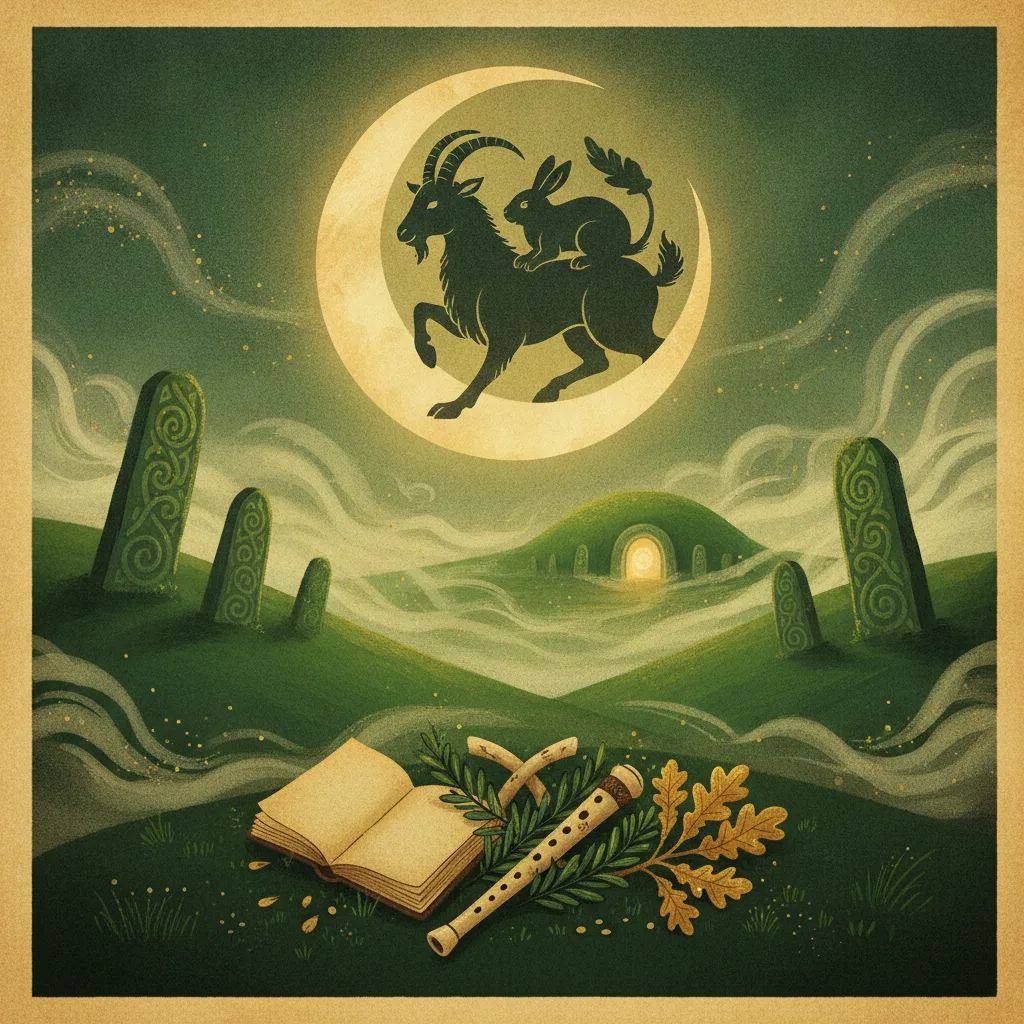
Púca is pronounced 'POO-kuh' - two syllables, stress on the first, the ú a long 'oo,' with a soft unstressed ending. The Púca is a shapeshifting spirit of Irish and Gaelic folklore, appearing as a black horse, goat, hare or dog, by turns helpful and mischievous. The name is cognate with the English 'puck.'
- Púca is said 'POO-kuh,' stress on the first syllable, a long 'oo' sound.
- Avoid 'PUCK-ah' with a short 'u' or 'pyoo-ka.'
- The Púca is a shapeshifting Irish spirit - black horse, goat, hare or dog - helpful or mischievous.
- Crops left after Samhain are 'the Púca's share,' spoiled and no longer fit to pick.
- The word is cognate with English 'puck' and Shakespeare's Puck; Welsh pwca, Cornish bucca.
Short and friendly once you know it: Púca is said “POO-kuh” — two syllables, stress on the first, the ú a long “oo” (the accent, or fada, marks that length). The ending is a soft, unstressed “uh.”
The Púca is one of the most characterful spirits of Irish and wider Gaelic folklore: a shapeshifter who appears as a black horse, a goat, a hare, a dog, or even a small dark man, by turns helpful and mischievous. It might ruin the crops left in the field after Samhain, or reward a respectful farmer with good fortune — a creature you were wise to stay on the right side of.
You will meet many spellings — púca, pooka, phouka, Welsh pwca, Cornish bucca — but the core sound stays “POO-kuh.” English speakers most often go wrong by saying “PUCK-ah” with a short “u,” or “pyoo-ka.” Keep it a long, round “poo.”
Mispronunciations to avoid: “PUCK-uh,” “PYOO-kuh,” “poo-KAH” with the stress at the back.
Where it comes from: Irish púca; it is cognate with the English word puck and with Shakespeare’s Puck, part of a shared web of North-West European words for a household or nature spirit.
A memory trick: “POO” like the long “oo” in “moon,” then a soft “kuh.” Never a short, clipped “puck.”
The Púca is one of folklore’s great ambiguous figures — neither simply good nor simply wicked, but a spirit whose favour you courted and whose temper you feared. Tradition gave it a special claim on the turning of the year: berries and crops left unharvested after Samhain were said to be “the Púca’s share,” spoiled or spat upon and no longer fit to pick. In other tales it offers a wild midnight ride on its back, thrilling or terrifying depending on how you treated it.
The word travels remarkably far. Beside Irish púca sit Welsh pwca, Cornish bucca, and the English puck — the very name Shakespeare gave the mischievous sprite of A Midsummer Night’s Dream. Some even hear its echo in the “Pooka” of 20th-century film and fiction. Saying it right places you at the head of a long, shared North-West European family of household and nature spirits.
