Scottish folklore and myth: books worth reading
The Scottish folklore shelf worth owning — from J. F. Campbell's tales to Henderson and Cowan's history — and why Carmina Gadelica must be read with real care.
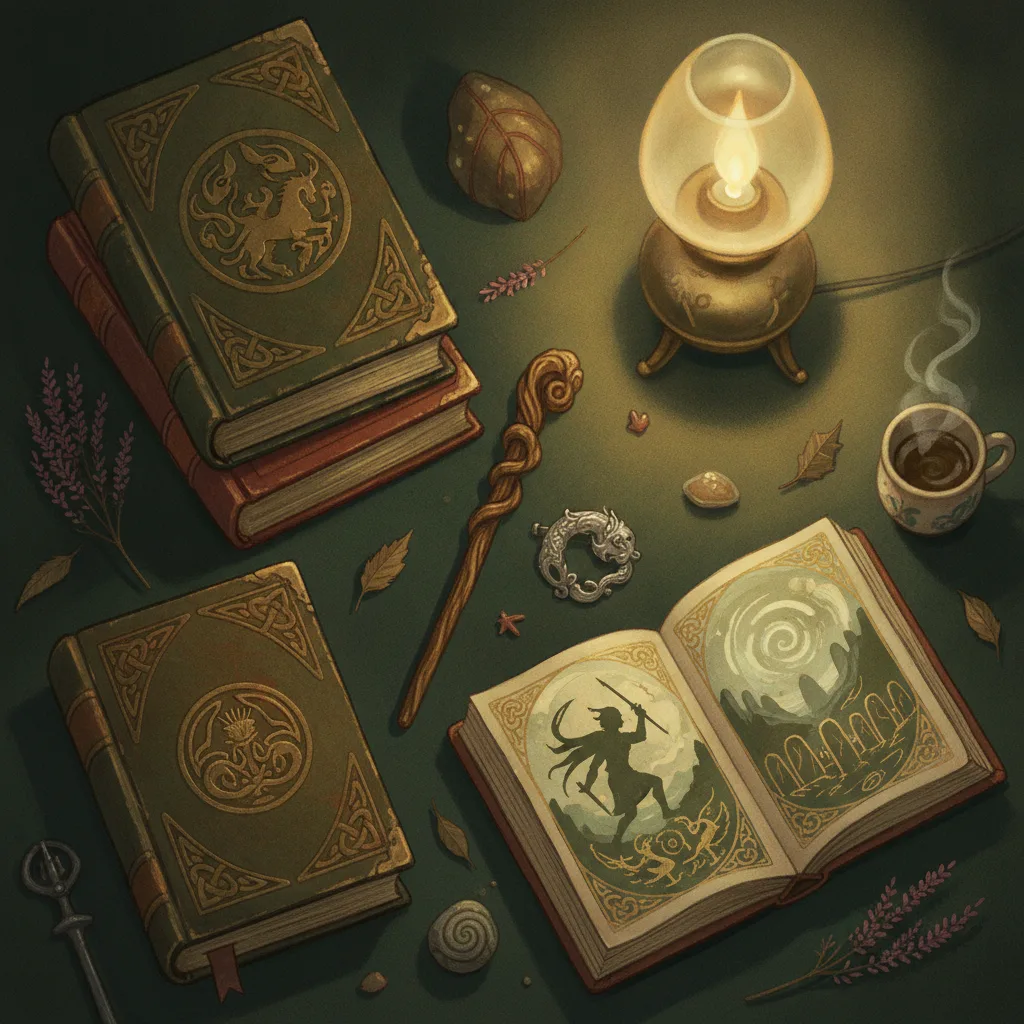
Start with J. F. Campbell's Popular Tales of the West Highlands for stories and John Gregorson Campbell's The Gaelic Otherworld for belief. Add Henderson and Cowan's Scottish Fairy Belief for history. Open Carmichael's Carmina Gadelica last, enjoying its beauty while knowing it was heavily edited.
- J. F. Campbell recorded named tellers in Gaelic, with real transparency.
- John Gregorson Campbell's Gaelic Otherworld documents Highland belief and custom.
- Henderson and Cowan set fairy belief in its social history.
- Carmina Gadelica is beautiful but was freely edited; read it critically.
- Keep ‘Celtic’, Scottish, Gaelic and Scots traditions distinct.
Scotland’s folklore is not a single thing. It runs from the Gaelic-speaking Highlands and Islands, with their seal-folk and water-horses, to the ballad country of the Borders and the Norse-tinged traditions of Orkney and Shetland. The good news is that some of the finest folklore collecting ever done was done in Scotland. The catch is that a few of the most beloved books are also the least reliable, and telling the difference is most of the skill. Here is a shelf worth owning, with the caveats stated plainly.
The gold standard: J. F. Campbell, Popular Tales of the West Highlands
If you read one nineteenth-century collection, make it John Francis Campbell’s Popular Tales of the West Highlands, collected orally in the early 1860s and kept in print by Birlinn (the paperback is ISBN 978-1-874744-15-3). Campbell of Islay was decades ahead of his time: he and his collectors took stories down from named tellers in Gaelic, recorded who told them and where, and printed the Gaelic alongside the English. That is exactly the transparency a modern reader wants — you can see the seams, the variants, the human beings behind the tales. It is a big, browsable, generous book, and it remains the foundation stone of Scottish Gaelic folklore.
The Otherworld, annotated: John Gregorson Campbell
For belief rather than narrative — what people actually thought about fairies, the second sight, witches and the dead — turn to John Gregorson Campbell. His two posthumous volumes, Superstitions of the Highlands and Islands of Scotland (1900) and Witchcraft and Second Sight in the Highlands and Islands (1902), have been reunited by the scholar Ronald Black as The Gaelic Otherworld (Birlinn; ISBN 978-1-912476-83-1). Campbell was a minister and a careful, sympathetic observer, and Black’s introduction and copious notes turn a Victorian miscellany into a usable modern reference. This is the book I reach for when I want to know the texture of Highland belief — the taboos, the calendar customs, the etiquette of dealing with the sìth — rather than a polished story.
The beautiful, difficult one: Carmichael’s Carmina Gadelica
No book casts a longer shadow over Gaelic spirituality than Alexander Carmichael’s Carmina Gadelica, a multi-volume gathering of hymns, blessings, charms and incantations collected in the Hebrides from the 1850s onward. It is genuinely lovely, and it preserves a vast amount of Gaelic vocabulary and rhythm that might otherwise have been lost. But it comes with a serious health warning, and this is where folklore accuracy really bites.
Carmichael was not a trained folklorist, and he edited freely. Since Hamish Robertson’s 1976 article in Scottish Gaelic Studies, scholars have shown that he shortened and lengthened lines, combined fragments, added material, and sometimes could not be matched against the manuscripts he claimed to be drawing from. The folklorist Hamish Henderson went as far as calling parts of it large-scale fabrication. That does not make the Carmina worthless — far from it — but it means you cannot treat any given charm as a verbatim record of what a specific person said. Read it for its beauty, its language and its atmosphere; do not cite it as hard evidence for a “genuine ancient ritual”. The honest way to use Carmichael is to enjoy him with one eyebrow raised.
The modern history: Henderson and Cowan, Scottish Fairy Belief
To make sense of all this older material, you want a modern scholarly guide, and the best single one is Lizanne Henderson and Edward J. Cowan’s Scottish Fairy Belief: A History (John Donald / Birlinn; ISBN 978-1-86232-190-8). It traces fairy belief from the fifteenth to the nineteenth century: how it worked, how the Church demonised it during the witch trials, how it survived in ballads and story, and how antiquarians later tried to rehabilitate it. It is rigorous but readable, and it does the thing the Victorian compendia never could — it puts the beliefs in their real social and historical setting, and tells you how we know what we know.
Where the ballads live
One strand deserves a signpost even if it needs its own shelf: the Scottish supernatural ballads — “Tam Lin”, “Thomas the Rhymer”, “The Wife of Usher’s Well” — are among the richest fairy-lore we have, and they were gathered above all in Francis James Child’s The English and Scottish Popular Ballads. Child’s collection is monumental and long in the public domain, so it is easy to find; just remember that Child was editing printed and manuscript texts, and that a sung tradition is always more fluid than a fixed page. If the water-horse and the seal-wife pull you in, the ballads are where those beliefs turn into art.
A note on “Celtic” versus Scottish, and Gaelic versus Scots
Two distinctions save a lot of confusion. First, “Celtic” is a language family, not a single culture: Scottish Gaelic tradition overlaps with Irish but is not identical to it, and much that is marketed as generic “Celtic myth” quietly blends the two. Second, within Scotland the Gaelic-speaking Highlands and the Scots-speaking Lowlands and Borders have distinct traditions, and Orkney and Shetland add a Norse layer on top. A good book tells you which of these it is drawing on. A weak one flattens them all into a tartan blur.
What to be wary of
The warning signs are the same ones that apply anywhere. Be cautious of any title promising “ancient Celtic Druid wisdom of the Highlands” with no named sources; of charms and “blessings” lifted from Carmichael and presented as unedited tradition; and of the pan-Celtic soup that treats Ireland, Scotland, Wales and Brittany as interchangeable. The reliable books — the two Campbells, Henderson and Cowan — all pass the same test: they tell you who said what, when, and how it reached the page, and they are candid about doubt.
A simple path
Start with J. F. Campbell for the stories and John Gregorson Campbell (via Black) for the beliefs. Add Henderson and Cowan to understand how those beliefs lived and were persecuted. Then, and only then, open the Carmina Gadelica — for pleasure, for the language, and with your critical faculties switched on. That order is not an accident: it lets you enjoy the most seductive book on the shelf without being fooled by it, which is, in the end, what reading folklore honestly is all about.
Frequently asked questions
What is the best Scottish folklore collection to start with?
John Francis Campbell's Popular Tales of the West Highlands (Birlinn), collected orally in the 1860s from named Gaelic tellers with the Gaelic printed alongside the English. It is transparent about its sources, generous and foundational.
Is Carmina Gadelica reliable?
Read it with care. Alexander Carmichael edited his material heavily, shortening, combining and adding lines, so it is unreliable as a verbatim record. It remains invaluable for its beauty and its preserved Gaelic, but should not be cited as unaltered ancient tradition.
What is the best modern book on Scottish fairy belief?
Scottish Fairy Belief: A History by Lizanne Henderson and Edward J. Cowan (John Donald), which traces the belief from the fifteenth to the nineteenth century and sets it in its real social and historical context.
Where can I read about Highland beliefs like the second sight?
John Gregorson Campbell's The Gaelic Otherworld, edited by Ronald Black (Birlinn), reunites his two volumes on superstitions, witchcraft and second sight with extensive, reliable modern notes.
Are Scottish and Irish folklore the same?
No. They overlap because both are Gaelic, but they are distinct traditions, and within Scotland the Gaelic Highlands, the Scots-speaking Lowlands and Norse-influenced Orkney and Shetland each differ. Good books keep them apart.
