The tarot court cards as character and symbol
The sixteen court cards read as an iconographic system: Page, Knight, Queen and King across the four suits, and how Pamela Colman Smiths 1909 imagery encodes them.
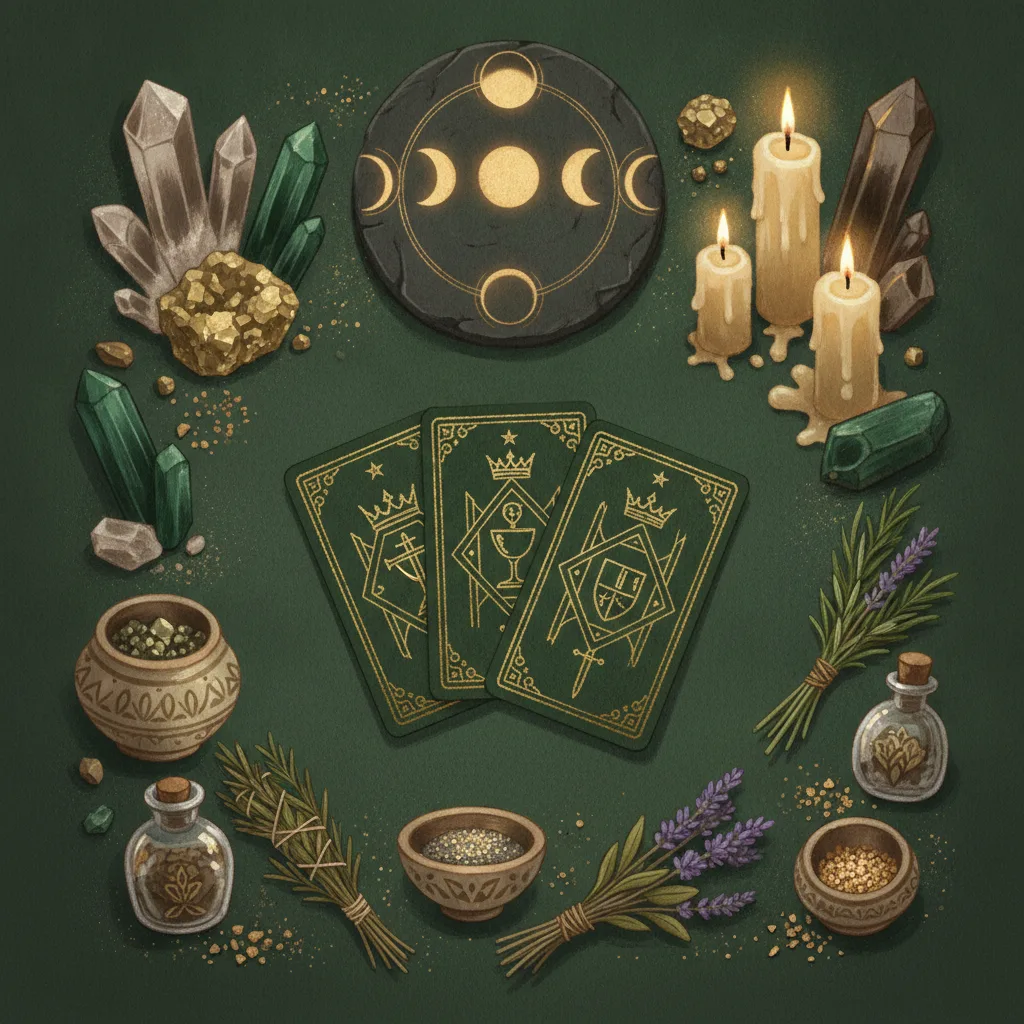
Read purely as iconography. The sixteen court cards — Page, Knight, Queen, King across four suits — descend from playing-card face cards and, in the 1909 Rider–Waite–Smith deck, use a consistent visual grammar of posture, emblem and elemental setting. They are a vocabulary of character types, not a prediction of people or events.
- Court ranks descend from ordinary playing-card face cards.
- Pages, Knights, Queens and Kings mark four stances toward a suit.
- Pamela Colman Smith's 1909 images use consistent posture and elemental settings.
- Golden Dawn and Thoth decks rename and reorder the courts.
- The courts offer character types for reflection, not forecasts.
The sixteen court cards are the part of the tarot people find hardest to read, and no wonder: instead of a clear scene or a countable number, you get a person. Four ranks — Page, Knight, Queen, King — across the four suits of the Minor Arcana. This piece looks at them purely as character and symbol: where the ranks come from, how the Rider–Waite–Smith deck of 1909 draws them, and what the imagery is doing. It treats the cards as an iconographic system, not as fortune-telling fact.
Where the courts come from
The tarot’s four suits — in the modern esoteric decks usually Wands, Cups, Swords and Pentacles (or Coins) — descend from ordinary playing-card suits, and the court is an expanded version of the “face cards” you still find in a modern pack. Early Italian tarot packs typically carried four courts per suit, and the ranks that came down into the occult tradition settle as Page (or Knave), Knight, Queen and King. For the longer story of how tarot moved from a card game into an esoteric system — from the Tarot de Marseille to the Rider–Waite–Smith and Thoth decks — see a short history of tarot.
One useful framing, drawn from the esoteric decks, treats the four ranks as a progression of engagement rather than a social hierarchy: the Page as beginner or messenger, the Knight as the rank in motion, the Queen as inward mastery, the King as outward authority. This is a reading device, not a historical rule, but it makes the sixteen cards easier to hold in the mind.
The four ranks as character
Read as symbols, the ranks describe four relationships to the energy of their suit.
- Pages are the youthful, unfinished figures — students, messengers, apprentices. Iconographically they stand still and examine the suit’s emblem, as if encountering it for the first time. They carry the sense of a beginning, a curiosity, news arriving.
- Knights are the ranks in motion, almost always shown mounted. They are the suit as action and momentum, for good and ill: the Knight can be direction and drive, or haste and imbalance, depending on how the horse and rider are drawn.
- Queens are shown seated and turned inward, holding the suit’s emblem as something possessed and understood. They read as the mature, receptive, interior command of the suit’s quality.
- Kings are also seated but face outward, emblem and often a second regalia in hand. They read as the suit’s authority expressed in the world — its governing, deciding, established form.
Combine rank with suit and you get sixteen distinct characters: the King of Swords as the figure of intellect-as-judgement, the Queen of Cups as feeling held inwardly, the Knight of Wands as drive in headlong motion, the Page of Pentacles as the beginner poring over a single coin. None of this predicts events; it is a vocabulary of human types and stances.
The Rider–Waite–Smith images
The best-known court images are those drawn by Pamela Colman Smith for the deck published by William Rider & Son in 1909, to Arthur Edward Waite’s direction. Smith, an artist connected to the Hermetic Order of the Golden Dawn, illustrated all seventy-eight cards; her great innovation was giving the numbered Minor cards full narrative scenes, and she brought the same command of iconography to the courts, discussed further in our piece on the Minor Arcana as symbolism.
Her court figures are legible because they use a consistent visual grammar. Each holds the suit emblem — a flowering wand, a cup, an upright sword, a pentacle — in a way that signals the rank’s relationship to it. Background and setting echo the suit’s element: Wands courts sit against warm, arid, salamander-marked settings; Cups courts against water; Swords courts under moving sky and cloud; Pentacles courts amid greenery, fields and ripe growth. The animals and costume details continue the code — the Queen of Cups’ elaborate closed cup, the fish and crustacean motifs on watery cards, the bull and ram heads that recur on Pentacles and Wands thrones.
Two familiar cautions belong here. First, the “King” of the Golden Dawn / Thoth systems is not always the same figure as the Rider–Waite–Smith “King”: those decks renamed and reordered the courts (Knight, Queen, Prince, Princess), so a card called “Knight” in one system can correspond to a “King” in another. Second, Smith’s people wear the costume and faces of Edwardian-era illustration; their appearance is an artistic choice of 1909, not a description of any real person.
Reading the courts as symbol, not prophecy
Because the courts show people, readers often ask “who is this in my life?” — and that is exactly the point at which honesty matters. As symbolism, a court card offers a type: a set of qualities, a stance toward the suit’s domain, a way of being that a person (including the reader) might embody. Used reflectively, it is a prompt: which of these figures am I being right now; what would the Queen of Swords’s clarity, or the Page of Cups’ openness, look like here. That is a legitimate imaginative and interpretive exercise.
What the cards do not do is identify a specific individual or foretell what they will do. Treating “the King of Pentacles crossed by the Knight of Swords” as a factual forecast about named people and future events goes well beyond what a picture of symbolic types can support. The value of the courts is as a mirror and a vocabulary for character, not as a prediction engine.
A short way to learn them
A practical, claim-free method: take the sixteen courts out of the deck and sort them first by rank (all four Pages together, then Knights, and so on), noticing the shared posture and gesture within each rank. Then sort the same cards by suit, noticing the shared element, colour and setting. Reading the grid both ways — rank across, suit down — is the fastest route to seeing the courts as a coherent system rather than sixteen unrelated portraits. Do that, and figures that once felt interchangeable resolve into distinct, recognisable characters.
Frequently asked questions
What are the tarot court cards?
They are the sixteen figure cards of the Minor Arcana: four ranks (Page, Knight, Queen, King) across the four suits of Wands, Cups, Swords and Pentacles. They descend from the face cards of ordinary playing-card packs, expanded in early Italian tarot.
How do the four ranks differ as symbols?
Read as character: Pages are beginners and messengers who examine the suit emblem; Knights are the suit in motion, usually mounted; Queens hold the suit inwardly as mature mastery; Kings face outward as the suits authority in the world.
Who drew the best-known court images?
Pamela Colman Smith, for the deck published by William Rider and Son in 1909 under Arthur Edward Waites direction. She illustrated all 78 cards and gave the courts a consistent visual grammar of emblem, posture and elemental setting.
Why do King and Knight sometimes swap between decks?
The Golden Dawn and Thoth systems renamed and reordered the courts as Knight, Queen, Prince and Princess, so a card called Knight in one system can correspond to a King in the Rider-Waite-Smith arrangement. Always check which system a deck uses.
Do court cards identify a specific person or predict events?
No. As symbolism they offer a type: a set of qualities and a stance a person, including the reader, might embody. They work as a mirror and vocabulary for character, not as a way to name individuals or forecast the future.
