Myth & Folklore Scottish Gaelic & Irish · folklore & place-lore
The Cailleach: the divine hag of Gaelic tradition
The divine hag of Scottish Gaelic and Irish tradition: maker of mountains, queen of winter. Honest about a thin medieval record and a large modern reconstruction.
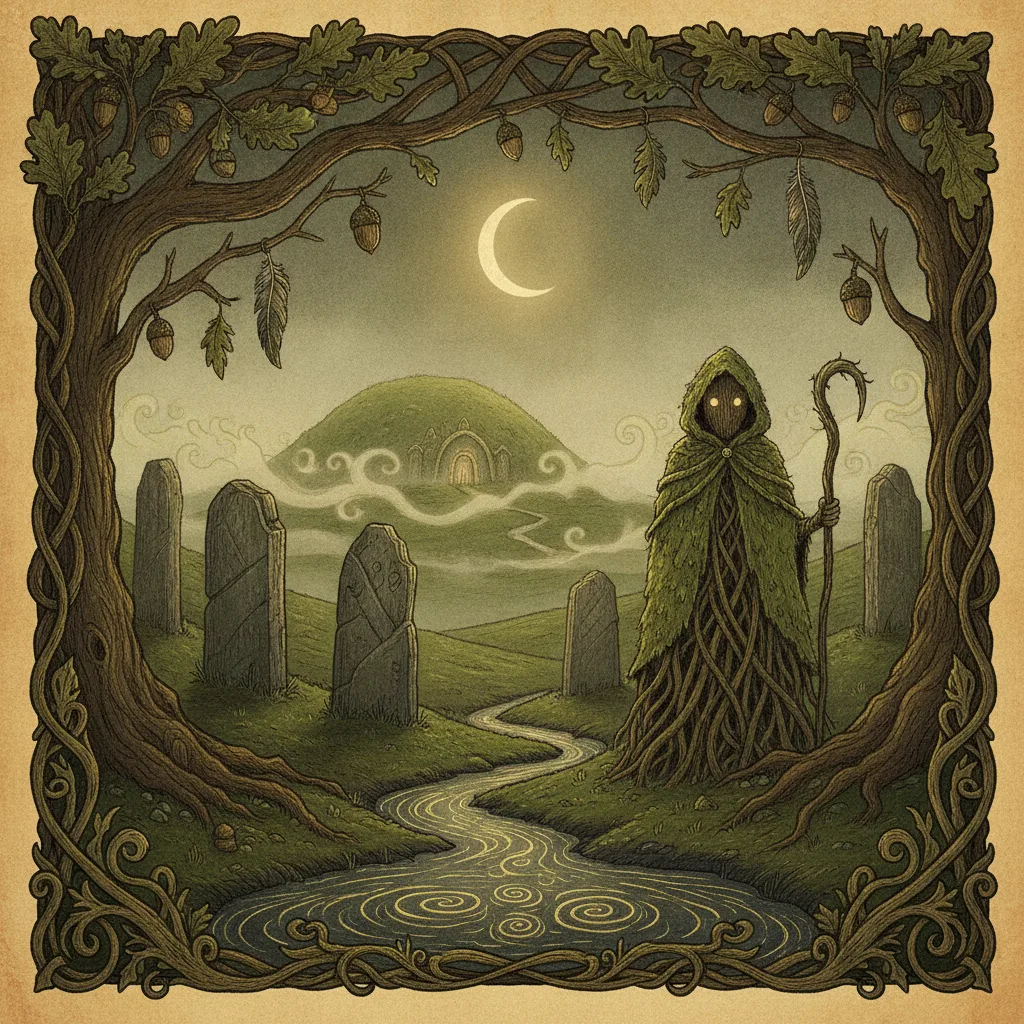
The Cailleach ("old woman" or "the veiled one") is the divine hag of Scottish Gaelic and Irish tradition, associated with winter, wild weather and the making of the landscape. Her deep archive is folklore and place-lore, not the medieval sagas; the "creator goddess" picture and whether she is a survived pre-Christian deity are genuinely contested.
- Cross-Gaelic hag-figure: Ireland's Cailleach Bhéarra and Scotland's blue-faced winter-queen Cailleach Bheur.
- Landscape-maker who drops mountains from her creel and rules the winter until spring.
- Washes her great plaid in the Corryvreckan whirlpool to bring on the snows.
- Oldest text, the c.900 Lament of the Old Woman of Beare, already Christianises her.
- "Beira" and "creator goddess" are largely modern framings (Mackenzie, 1917), not ancient cult.
| Tradition | Scottish Gaelic & Irish (folklore & place-lore) |
| Type | divine hag / winter & landscape figure |
| Earliest attestation | Lament of the Old Woman of Beare (Old Irish, c. 900); otherwise chiefly later folklore |
| Associated places | the Beara Peninsula (Cork); the Scottish Highlands & Islands; Corryvreckan |
| Associated symbols | the creel/apron of stones, the winter hammer or staff, the last harvest sheaf, the blue face |
She strides across the Highlands with a wicker creel on her back, and where a stone slips from it a mountain stands. She washes her great plaid in the whirlpool of Corryvreckan until the sea roars white, and when it is clean it is winter, and the land is hers. She is older than the hills because she made them; she is winter itself, and hunger, and the hard shape of the land — and at the first stirring of spring she is beaten back, or drinks from a secret well and turns young again. She is the Cailleach: the divine hag of Scottish Gaelic and Irish tradition, and one of the figures most loved, and most misdated, in the whole field.
Who she is
The Cailleach (the word means “old woman,” “hag,” or literally “the veiled one,” from caille, “veil”) is a hag- or crone-figure of Gaelic tradition, associated above all with winter, wild weather, and the making of the landscape. In Ireland she is best known as the Cailleach Bhéarra — the Hag of Beara, tied to the Beara Peninsula in County Cork — and is spoken of as a figure of great age and of sovereignty over the land. In Scottish Gaelic tradition she is the Cailleach Bheur, the blue-faced queen of winter who battles the coming of spring. She is a genuinely cross-Gaelic figure — Scottish and Irish, with Manx echoes — and she should be named that way, not filed under a blanket “Celtic.”
The stories the tradition tells
Most of what we know about the Cailleach lives in folklore and place-lore rather than in the grand medieval sagas, and it is wonderfully concrete.
Maker of the land
Across the Scottish Highlands and Islands and in Ireland, countless hills, cairns and islands are explained as things the Cailleach dropped, built or shaped — stones fallen from her creel, mountains piled by her hand. She is, in this body of legend, a landscape-shaper on a giant scale, which is why she is so often called a “creator” figure.
Queen of winter
In Scottish tradition she rules the cold half of the year. She herds deer, wields a hammer or staff that hardens the ground with frost, and holds back the growth of grass. Her reign runs until the turn of the year toward spring — often to Là Fhèill Brìghde, the feast of Brigid at the start of February — when she is defeated, or is transformed, or drinks from the Well of Youth and is renewed. In some tellings the Cailleach and the young spring-goddess are two faces of one turning year.
The washer at the whirlpool
One of the most striking Scottish traditions makes the great tidal whirlpool of Corryvreckan (the Coire Bhreacain, “the cauldron of the speckled/plaid one”), off the isle of Jura, the Cailleach’s wash-tub: for three days she plunges her enormous plaid into the roaring water, and when it comes out white it is the snow-cover of winter laid over the hills. It is a perfect example of how her lore works — a real and dangerous piece of geography given a mythic cause, with the goddess-figure explaining a place rather than the place merely decorating a goddess.
The harvest hag
In agricultural custom the last sheaf of the harvest was in many places called the cailleach, and there were games and small dreads around who would be left to cut it — a living folk-usage that kept her name in the mouths of ordinary people long after any “goddess” was worshipped.
What the sources say vs. what circulates — being honest about the evidence
This is an entry where the responsible thing is to admit how thin the early record is.
- The medieval literary attestation is slim. Unlike the Morrígan or the Tuatha Dé Danann, the Cailleach is not a well-documented character of the great Old and Middle Irish sagas. The single most important early text is a poem — and even that is complicated (see below). The vast, vivid Cailleach we picture is assembled overwhelmingly from later folklore collection and place-name legend, much of it written down only in the nineteenth and twentieth centuries.
- The earliest text half-hides her. The famous Lament of the Old Woman of Beare (Caillech Bérri) is an Old Irish poem of about the ninth or tenth century, in which an aged woman mourns her lost youth and beauty. But its author is Christian, and in the poem she is framed as a penitent, even a nun — the very word caillech can mean “veiled woman / nun.” So our oldest source is already reshaping whatever older figure lay behind her, and reading a pre-Christian “goddess” straight out of it is an interpretation, not a plain fact.
- “Creator goddess” is largely a modern synthesis. The confident modern picture of the Cailleach as an ancient pan-Gaelic creator deity is a twentieth- and twenty-first-century reconstruction, drawing together scattered folklore into a single grand figure. Whether she is a genuine survival of a pre-Christian divinity, or a folklore personification that gathered “goddess-like” traits over time, is contested among scholars. Both can be said honestly; a settled ancient cult cannot.
- “Beira” is a modern coinage. The name Beira, so common now for the Scottish winter-queen, was popularised by the folklorist Donald A. Mackenzie in his Wonder Tales from Scottish Myth and Legend (1917), where he also called her “mother of all the gods and goddesses in Scotland.” That is a 1917 literary framing, not an ancient title.
Where she is written down
The key early text is the Lament of the Old Woman of Beare, an Old Irish poem of c. 900 surviving in several manuscripts (famously translated by Kuno Meyer). Beyond that, the Cailleach’s real archive is folklore: the great manuscript and sound collections of the Irish and Scottish folklore commissions, place-name lore, and the scholarly gathering of it — above all Gearóid Ó Crualaoich‘s The Book of the Cailleach: Stories of the Wise-Woman Healer (2003), which studies her as a figure of oral tradition. For the Scottish winter-queen specifically, the popular shape comes largely from Mackenzie’s 1917 retellings.
The modern revival layer, dated
The Cailleach has become a favourite of the modern Pagan and Goddess-spirituality revival, where she is honoured as crone, wise-woman and earth-mother, often at Samhain as the year darkens. This devotion is sincere and creatively rich — and it is recent, built on the folklore record and on twentieth-century syntheses like Mackenzie’s, rather than on any documented ancient rite. Keeping her properly means enjoying the modern crone and saying plainly that she is a reconstruction.
The Cailleach in modern art, fiction and games
She has a strong contemporary presence: she anchors Ó Crualaoich’s scholarship and a shelf of popular Goddess books; she appears in Scottish and Irish poetry and visual art as the face of winter and the land; and she recurs across fantasy fiction and video games as a hag, winter-witch or ancient earth-power drawing on Gaelic myth. A hill-shape or a spring thaw, in much of Ireland and Scotland, still quietly belongs to her.
Keeping her properly
The Cailleach is the divine hag of Scottish Gaelic and Irish tradition: maker of mountains, queen of winter, the last sheaf in the field, the old woman of Beara. But her deep archive is folklore and place-lore, not the medieval sagas; her oldest text, the ninth-/tenth-century Lament, already Christianises her; “creator goddess” and “Beira” are largely modern framings; and whether she is a survived deity is genuinely contested. Love her, and hold that uncertainty in the same hand. Old stories, kept properly.
| Tradition | Scottish Gaelic & Irish (with Manx echoes); chiefly folklore & place-lore |
| Earliest text | Lament of the Old Woman of Beare (Caillech Bérri), Old Irish, c. 900 — but it frames her as a Christian penitent/nun, so it already reshapes any older figure |
| Also appears | Overwhelmingly in later folklore collection and place-name legend across Ireland and Scotland; the last-sheaf ‘cailleach’ harvest custom |
| Later additions | ‘Creator goddess’ is largely a 20th–21st-c. synthesis and is contested; ‘Beira, Queen of Winter’ was popularised by Donald A. Mackenzie (Wonder Tales from Scottish Myth and Legend, 1917); modern Pagan/Goddess devotion is recent |
| Translation | Kuno Meyer (Lament of the Old Woman of Beare); Gearóid Ó Crualaoich, The Book of the Cailleach (2003) |
| Reviewed | 2026-08 |
Frequently asked questions
What does ‘Cailleach’ mean?
‘Old woman’ or ‘hag’, and literally ‘the veiled one’, from caille, ‘veil’. The same word can also mean ‘nun’, which matters for reading her oldest source.
Is the Cailleach Irish or Scottish?
Both. She is a cross-Gaelic figure: in Ireland the Cailleach Bhéarra (Hag of Beara, Co. Cork), in Scottish Gaelic the Cailleach Bheur, queen of winter, with Manx echoes. Name the specific tradition rather than saying ‘Celtic’.
Is the Cailleach an ancient goddess?
It is contested. Her deep record is folklore and place-lore, not the medieval sagas, and her oldest text (c. 900) already Christianises her. Whether she is a survived pre-Christian deity or a folklore figure that gathered goddess-like traits is genuinely debated.
What is the earliest source for her?
The Old Irish Lament of the Old Woman of Beare, around 900 AD, surviving in several manuscripts — but it presents her as an aged penitent, even a nun, rather than plainly as a goddess.
Where does the name ‘Beira’ come from?
It was popularised by the folklorist Donald A. Mackenzie in Wonder Tales from Scottish Myth and Legend (1917), where he cast her as Queen of Winter and ‘mother of all the gods’. It is a 1917 literary framing, not an ancient title.
How is she connected to winter and to Brigid?
In Scottish tradition she rules the cold half of the year and is defeated or renewed around the start of spring, often at Là Fhèill Brìghde (St Brigid's feast, early February) — in some tellings the old Cailleach and the young spring-goddess are two faces of the turning year.
