Yule and midwinter: greenery, light and the honest history
Decorating for Yule and midwinter honestly: the genuinely ancient evergreens and light, the Roman and Norse layers, the Victorian tree, and modern neopagan Yule.
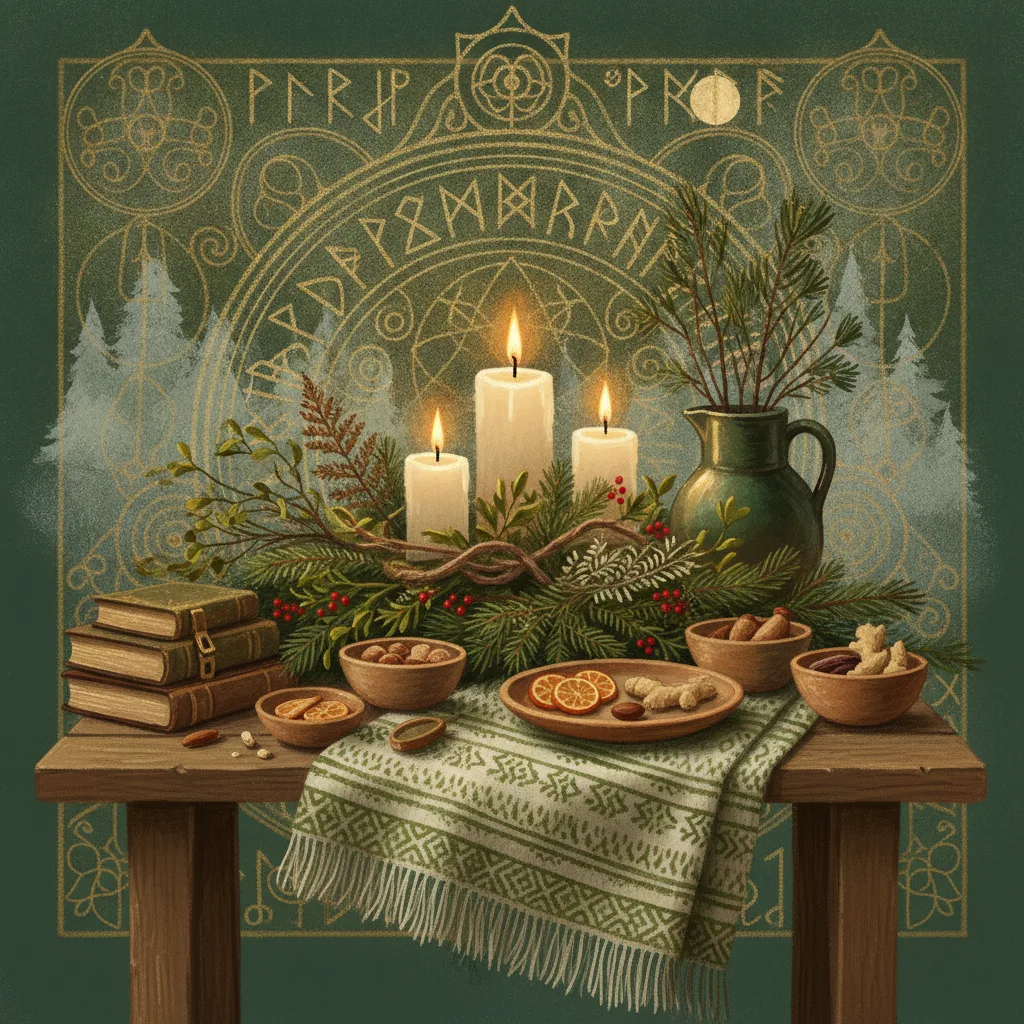
Midwinter decor layers many eras honestly. Bringing evergreens indoors, feasting, light against the dark and gift-giving are genuinely ancient and pre-Christian. The decorated indoor tree is a Victorian import of the 1840s; the eightfold Yule sabbat is mid-twentieth-century. Lead with fresh greenery, beeswax candlelight and natural materials, enjoy the Victorian layer as such, and take greenery down by Twelfth Night.
- Evergreens indoors, feasting and light against dark are genuinely ancient.
- The decorated indoor Christmas tree is a Victorian import of the 1840s.
- Modern Yule sabbat on the eightfold Wheel is mid-twentieth-century.
- Mistletoe-kissing is 18th-century English, later than the plant's reputation.
- Lead with fresh greenery and candlelight; take it down by Twelfth Night.
Midwinter is the season most weighed down with claims about its own antiquity. Nearly every evergreen, candle and garland gets sold with a line about “ancient pagan tradition,” and some of that is true, some is Roman, a good deal is Victorian, and a fair amount is twentieth-century neopagan revival. Decorating the honest way at midwinter means enjoying all of it while knowing which is which. The good news is that the genuinely old customs are also the most beautiful, so accuracy costs you nothing.
What is genuinely old: bringing in the green
The practice of bringing evergreens indoors in the dead of winter is genuinely ancient and widespread. To people watching everything else die back, holly, ivy, mistletoe, pine and fir stayed stubbornly alive, and were brought inside as tokens of life persisting through the cold. The Romans decorated with greenery at Saturnalia, their midwinter festival honouring Saturn, and again at the Kalends of January. Northern European peoples kept their own midwinter feast, Yule (Old Norse jól), a genuinely attested pre-Christian celebration of feasting, drinking and gift-giving, with fires kept burning against the dark.
So the honest headline is this: evergreens indoors at midwinter, feasting, light against darkness and gift-giving are all genuinely old, and they predate Christianity. That is a solid, defensible foundation and it is plenty to decorate from.
What is Christian overlay
Christmas itself, fixed at 25 December, layered onto this existing midwinter season rather than inventing it. The exact degree to which early Christians deliberately “took over” Saturnalia is debated by historians and often overstated online, so the careful phrasing is that Christmas settled into a slot already thick with midwinter custom, and absorbed a great deal of it. Holly and ivy, both pre-Christian midwinter greens, acquired Christian readings but kept their older seasonal role. This layering, old seasonal custom carrying newer devotional meaning, is exactly the pattern we trace at the other end of the year in Samhain and at Brigid’s festival.
What is Victorian invention
Here is where a lot of “traditional Christmas” décor actually comes from, and it is more recent than people think. The decorated indoor Christmas tree was a German custom, largely unknown in Britain until the mid-nineteenth century. It was popularised in England by Prince Albert, Queen Victoria’s German husband, after their marriage, when an illustration of the royal family around a tree made it fashionable. So while bringing evergreens indoors is ancient, the specific tree-in-the-parlour hung with ornaments is a Victorian import of the 1840s, not a druidic rite.
A great deal of the rest of the “traditional” package, the card, the cracker, the elaborate hung ornament, the sentimental family scene itself, is also Victorian. None of that makes it less lovely. It just means that when you dress a tree you are keeping a roughly 180-year-old fashion built on top of a genuinely ancient impulse, and both facts are worth holding at once.
What is modern neopagan Yule
Finally, there is “Yule” as it appears in contemporary pagan practice: a winter-solstice sabbat, one of eight spokes on the Wheel of the Year, with associated correspondences, colours and rituals. The word and the underlying midwinter feast are genuinely old, but the eightfold wheel that gives modern Yule its shape is a mid-twentieth-century construction, assembled from older festivals into a single tidy calendar. There is nothing wrong with celebrating it, but it is living modern tradition, not an unbroken ancient one, and saying so is both more honest and more interesting. We lay the whole thing out in The Wheel of the Year, honestly dated.
One point of genuine astronomy worth keeping straight: the winter solstice, the shortest day, is a real celestial event, usually 21 or 22 December in the northern hemisphere. That is old and factual. The naming of it as a “sabbat” is the recent part.
It is also worth being honest about the mistletoe and the Yule log, two of the most confidently mythologised objects of the season. Mistletoe has genuine ancient associations, a first-century Roman account famously describes druids cutting it with a golden sickle, but the specific custom of kissing beneath it is an English tradition documented only from around the eighteenth century, far more recent than the plant’s reputation suggests. The Yule log is a real northern-European midwinter fire custom, but much of its elaborate “correspondence” lore is modern embroidery. As with the tree, the honest move is to enjoy each object while placing it in the right century.
Decorating from the honest version
All of this gives you a clear, rooted scheme. Lead with the ancient layer and let the later ones sit lightly on top.
- Real greenery, cut fresh. Holly, ivy, pine, fir, bay. This is the genuinely old heart of the season. A swag of mixed evergreen over a mantel or a plain wreath of foraged or florist greenery does more, and more honestly, than anything plastic.
- Light against the dark. Beeswax candles from a small chandler burn slowly and give a warm, near-sunlight glow; a cluster of them on a windowsill or a laid, unlit hearth speaks directly to the oldest meaning of the season. This is the through-line from Yule fires to Christian Advent candles to the modern solstice vigil.
- Natural materials. Undyed or naturally dyed wool and linen, dried orange, clove-studded fruit (a genuinely old scenting trick), pine cones, seed heads. A hand-thrown bowl of these from a small-batch potter is more in keeping than tinsel.
- The tree, kept in perspective. If you have one, enjoy it as the Victorian pleasure it is. Wooden, glass or straw ornaments from independent makers age far better than mass plastic, and straw stars and figures link the tree back to older harvest and midwinter straw-craft.
The one rule
Take the greenery down. Across British and Irish custom there is a persistent belief that indoor Christmas greenery should come down by a set point, most commonly Twelfth Night (5 or 6 January), with real ill-luck attached to leaving it up. Whatever you make of the superstition, it encodes something sound: evergreens brought in for the dark should go back out as the light returns. It gives the whole scheme a beginning and an end, which is what turns decoration into observance.
Dressed this way, greenery cut fresh and taken down on time, candlelight at the heart of it, natural materials from real makers, and the Victorian layer enjoyed for exactly what it is, your midwinter home honours a genuinely ancient season without telling a single tall tale about it. That is the version worth keeping.
Frequently asked questions
Which midwinter customs are genuinely ancient?
Bringing evergreens indoors, feasting, light against the dark and gift-giving are all genuinely old and predate Christianity. The Romans decorated with greenery at Saturnalia and the January Kalends, and northern European peoples kept Yule (Old Norse jol), an attested pre-Christian midwinter feast with fires kept burning against the dark. That is a solid, defensible foundation to decorate from.
When did the Christmas tree tradition actually start?
Bringing evergreens indoors is ancient, but the specific decorated indoor Christmas tree was a German custom largely unknown in Britain until the mid-nineteenth century. It was popularised in England by Prince Albert, Queen Victoria's German husband, in the 1840s, after an illustration of the royal family around a tree made it fashionable. So the tree-in-the-parlour is a Victorian import, not a druidic rite.
Is modern pagan Yule an unbroken ancient tradition?
The word Yule and the underlying midwinter feast are genuinely old, but Yule as a winter-solstice sabbat, one of eight spokes on the Wheel of the Year, takes its shape from a mid-twentieth-century construction. The winter solstice itself is a real astronomical event, usually 21 or 22 December; naming it as a sabbat is the recent part. Celebrating it is fine as living modern tradition, and it is more honest to say so.
What about mistletoe and the Yule log?
Mistletoe has genuine ancient associations, but kissing beneath it is an English custom documented only from around the eighteenth century. The Yule log is a real northern-European midwinter fire custom, though much of its elaborate correspondence lore is modern embroidery. Enjoy both, but place them in the right century rather than backdating them.
When should Christmas greenery come down?
British and Irish custom holds that indoor Christmas greenery should come down by Twelfth Night, 5 or 6 January, with ill-luck attached to leaving it up longer. Whatever you make of the superstition, it encodes something sound: evergreens brought in for the dark should go back out as the light returns, giving the whole scheme a clear beginning and end.
