A witchy wardrobe that isn’t a costume: building a folkloric capsule
Building a folkloric wardrobe that reads as lived-in, not fancy dress: natural fibres, layering, a seasonal palette, rooted jewellery and the appropriation line.
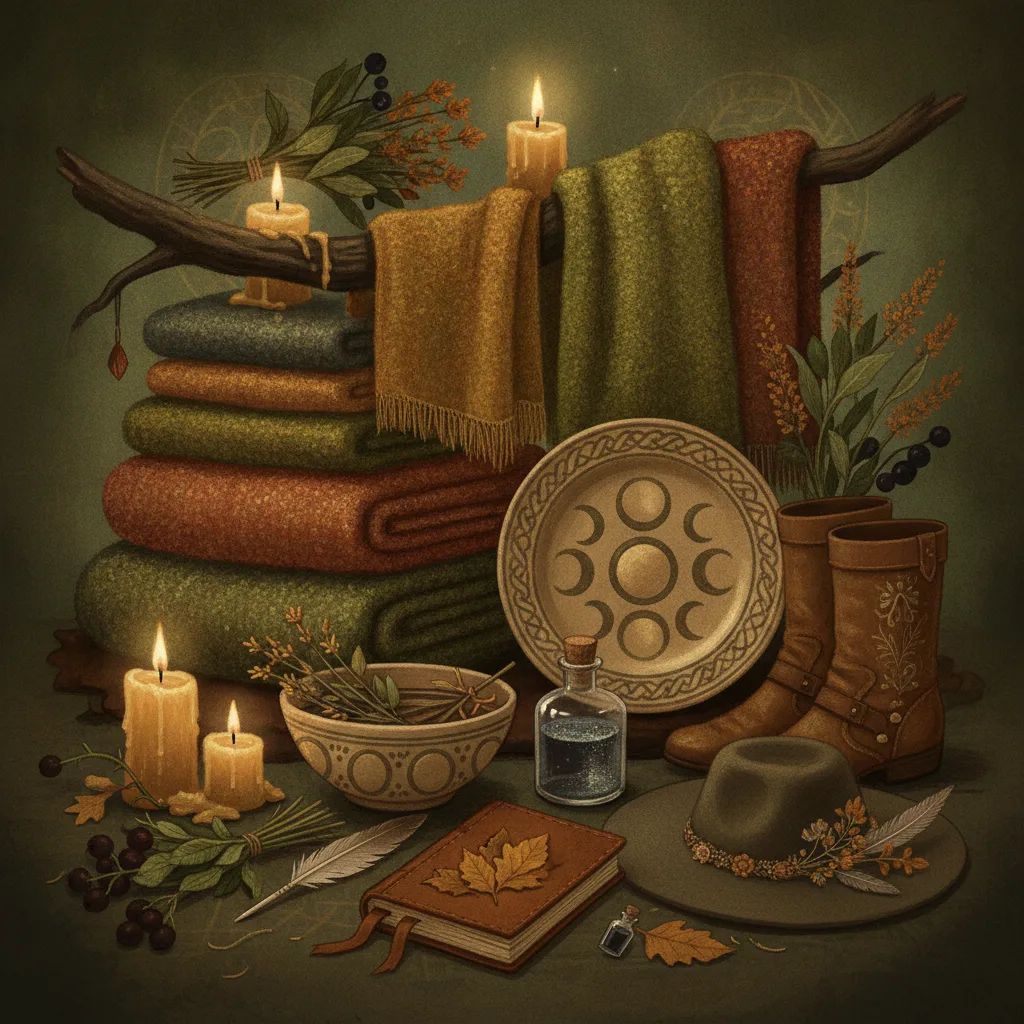
Build a folkloric wardrobe from natural fibres, not aesthetics: wool for cold, linen and hemp for warmth, cotton for everyday. Layer plain pieces in undyed and plant-dyed earth tones so they combine easily and shift with the season. Wear jewellery motifs you understand, and avoid closed or sacred items from living cultures. Buy maker-first and slowly, then mend and keep.
- Start with fibre: wool, linen, hemp and cotton, not aesthetic.
- Layer plain, natural-toned pieces so they combine and last.
- Wear jewellery motifs you can stand over historically.
- Avoid closed or sacred items like war bonnets and smudging.
- Buy maker-first and slowly, then mend and keep wearing.
A folkloric wardrobe is not a costume. A costume is worn once, photographs well and then lives in a bin bag; a wardrobe is worn on a wet Tuesday, gets rained on, and gets better with age. If you are drawn to the witchy end of dressing, the honest version of it is closer to how country people have always dressed for the weather than to anything you will find on a fancy-dress rail. It is built from natural fibres, layered for a changeable climate, tied to the season outside the window, and quietly literate about the symbols it borrows. Here is how to build one that lasts.
Start with the fibre, not the aesthetic
The single biggest difference between a wardrobe that reads as lived-in and one that reads as fancy dress is the cloth. Synthetics photograph as “witchy” and then pill, sweat and smell within a season. Natural fibres do the opposite: they age into something better.
Wool is the backbone of a cold-season capsule. It insulates even when damp, naturally sheds water and holds warmth better than almost anything else you can put on a body. The trade-off is care: wool fibres are covered in tiny scales that lock together permanently under heat, moisture and agitation, which is why a hot machine wash turns a jumper into felt. Wash cool, wash gently, and dry flat.
Linen and hemp carry the warmer months. Both are bast fibres, spun from the long stems of the flax and hemp plants, and both are strong, breathable and mildew-resistant. Hemp in particular gets softer the more you wear it. They crease, and that is the point; a bit of rumple is honest.
Cotton is the breathable everyday layer, cool against the skin and easy to launder. Between them, these four fibres will cover almost any weather these islands can throw at you.
Layering for a changeable climate
Folk dress in a northern climate is not one dramatic garment; it is several plain ones, put on and taken off as the day turns. Think of it in three loose tiers.
- Next to the skin: a linen or cotton shift, smock or plain long-sleeved top. Breathable, washable, unshowy.
- The middle: a wool pinafore, waistcoat, knitted cardigan or overdress. This is where structure and warmth live.
- The outer: a heavy wool coat, cloak or oiled shawl. A large rectangular shawl, pinned at the shoulder, is one of the oldest garments in the book and endlessly practical.
Because every piece is plain and natural-toned, the layers combine without clashing. That interchangeability is the whole trick: a small number of well-made things that all work together beats a wardrobe of one-outfit statement pieces.
A seasonal palette that does the work for you
You do not need to force a “witchy” colour scheme. If you buy natural fibres in undyed and plant-dyed tones, the palette assembles itself and shifts with the year. In the darker half, lean into the colours the land actually turns: russet and oxblood, oak and chestnut brown, sloe and elderberry purple, lichen grey, and the black of bare branch and wet iron. In the light half, let in the greens, the flax-blue of a linen shirt, and the soft cream of undyed wool. Naturally dyed cloth arrives in these tones on its own, which is why plant-dyed pieces tend to sit together so easily. If you want to understand why those particular colours feel right at particular times of year, it helps to know what the old festivals were actually marking; our piece on what Samhain actually was is a good starting point for the turn into the dark.
Jewellery: motifs with roots
Jewellery is where a folkloric wardrobe gets to speak, so it is worth wearing symbols you can stand over. Plenty of the motifs sold as “Celtic” are genuinely old, and a few are Victorian inventions dressed up as ancient. The triple spiral, or triskele, really is ancient: it is carved into the kerbstone and inner chamber at Newgrange, a passage tomb in the Boyne Valley older than Stonehenge and the Egyptian pyramids. Interlaced knotwork, by contrast, is early-medieval manuscript art, not Iron Age Celtic; the Claddagh ring is a specific 17th-century design from a fishing village outside Galway. None of that makes them less worth wearing. It just means you are wearing history accurately rather than a marketing story. We go deep on which is which in our guide to folklore-motif jewellery.
Prefer solid metals that patinate honestly over plated costume pieces, and prefer makers who can tell you where a design comes from. A single good silver brooch, worn for a decade, is more folkloric than a drawer of shiny nothing.
The line you do not cross: appropriation
Here is the part a lot of “witchy fashion” content skips. Building a wardrobe from your own or open cultural traditions is one thing; lifting sacred items out of living cultures that have asked you not to is another. Some symbols and objects are what people call closed practices, and no amount of aesthetic intention makes them fair game.
Concrete examples to keep off your body and out of your styling:
- Feathered war bonnets and Plains-style headdresses. These are earned regalia of specific Native American nations, carrying spiritual and political weight, worn by people formally recognised by their communities. Worn as festival fashion by anyone else, they are straightforward appropriation, and Native representatives have said so repeatedly.
- White sage smudging and palo santo bundles as an accessory. Smudging is a specific ceremonial practice belonging to particular Indigenous communities, and white sage is being over-harvested to feed the wellness market. It is not a prop.
- Dreamcatchers and “spirit animal” language pulled from Indigenous North American cultures and used decoratively.
- The bindi as a hair or festival accessory. It carries religious and cultural meaning in South Asian traditions; worn as a jewel-sticker for a photo, it reads to many as costume.
The test is simple enough: is this an open piece of craft or dress I can wear respectfully, or a sacred or earned item from a culture that is not mine and has asked outsiders to leave it alone? When in doubt, choose the fibre, the plant dye, the honest metal and the well-sourced motif instead. There is more than enough genuine, open folk tradition to build a lifetime’s wardrobe from.
Building it slowly
Do not buy a capsule in a weekend. The whole ethos here is maker-first and slow: a linen shift from a small dressmaker, a wool cardigan from a hand-knitter, a plant-dyed shawl from a natural dyer, a single brooch from a silversmith who can name the motif. Ask where the wool was spun and where the flax was grown. Wear the pieces until they need mending, then mend them. A wardrobe built this way will never look like a costume, because it will carry the one thing a costume never can: the marks of having actually been lived in.
Frequently asked questions
What makes a wardrobe folkloric rather than a costume?
Natural fibres worn until they need mending, a small interchangeable set of plain layers, a palette drawn from the season, and symbols you can stand over. A costume is worn once; a folkloric wardrobe gets better with age and use.
Which natural fibres should a folkloric capsule be built from?
Wool for cold-season warmth (it insulates even when damp), linen and hemp for breathable warmer-weather layers, and cotton as an everyday next-to-skin layer. All four age well and combine easily in natural and plant-dyed tones.
How do I avoid cultural appropriation in witchy fashion?
Do not wear sacred or earned items from living cultures that have asked outsiders to leave them alone: feathered war bonnets and Plains-style headdresses, white sage smudging and palo santo as props, dreamcatchers, and bindis as accessories. Choose open craft, plant dyes and well-sourced motifs instead.
Which folklore jewellery motifs are genuinely old?
The triple spiral (triskele) is genuinely ancient, carved at Newgrange over 5,000 years ago, though pre-Celtic. Interlaced knotwork is early-medieval manuscript art, and the Claddagh ring is a 17th-century Galway design. All are worth wearing when you know their real history.
How do I start a folkloric capsule wardrobe?
Slowly and maker-first: a linen shift from a dressmaker, a hand-knitted wool cardigan, a plant-dyed shawl from a natural dyer, and one good silver brooch whose motif the maker can explain. Ask where the wool was spun and the flax grown, then wear and mend the pieces for years.
