Reading the four cycles of Irish myth: a path through the primary sources
The Mythological, Ulster, Fenian and Kings cycles, explained: which translations actually read well, and the order to tackle the primary sources without stalling.
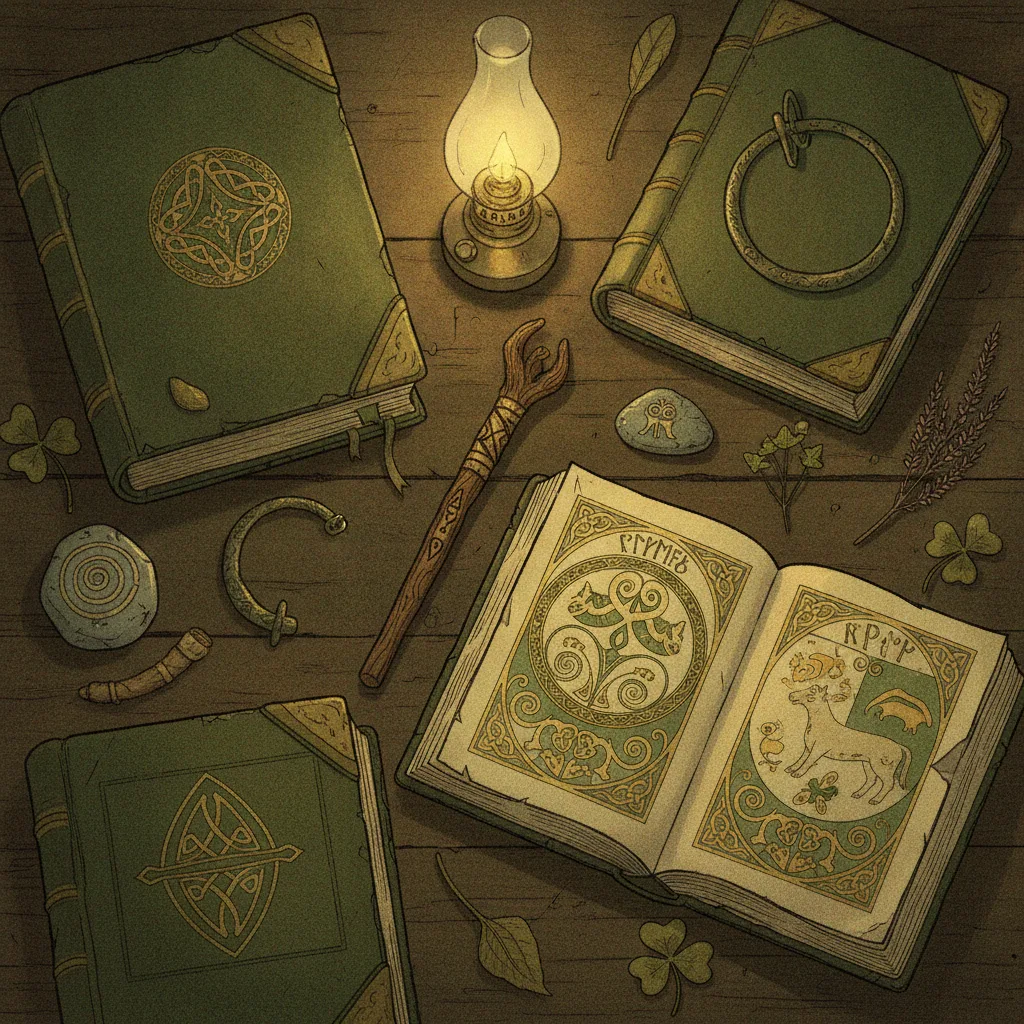
The ‘four cycles’ are a modern map, not a medieval category. Read a retelling (Marie Heaney) first, then the Táin (Kinsella or Carson), Gantz's Early Irish Myths and Sagas for the Mythological cycle, Dooley and Roe for the Fenian world, and Heaney's Sweeney Astray for the Kings.
- The fourfold cycle scheme is a modern convenience, not medieval.
- Start with a retelling, then Kinsella's or Carson's Táin.
- Gantz covers the Mythological cycle and Ulster fore-tales.
- Dooley and Roe's Tales of the Elders opens the Fenian world.
- You read translations; note each one's manuscript and century.
Sooner or later, a reader of Irish myth wants to move past retellings and reach the primary sources — the medieval tales themselves. The usual signpost is “the four cycles”: the Mythological, the Ulster, the Fenian and the Kings. It is worth saying at the outset that this fourfold scheme is a modern scholarly convenience, not a medieval Irish category. The people who wrote these texts did not file them this way. Still, the cycles are a useful map, and each has a translation or two genuinely worth reading. Here is what lives in each, which editions actually read well, and an order that will not stall you.
The Mythological Cycle: the gods
This is the world of the Tuatha Dé Danann — the divine race, their arrival, and their battles. Its keystone text is Cath Maige Tuired (The Second Battle of Moytura), alongside tales such as The Wooing of Étaín. For readable access, start with Jeffrey Gantz’s Early Irish Myths and Sagas (Penguin Classics, ISBN 978-0-14-044397-4), which includes “The Wooing of Étaín” and “The Dream of Óengus” in plain, well-annotated English. For the scholarly text of the battle itself, Elizabeth A. Gray’s edition of Cath Maige Tuired (Irish Texts Society, 1982) is the standard. The great pseudo-history Lebor Gabála Érenn (the “Book of Invasions,” edited by R. A. S. Macalister) underlies much of this cycle, but be warned: it is a genealogical slog, better consulted than read cover to cover. The famous tale of the Children of Lir, which many readers expect to find here, is a later composition usually grouped with the “Three Sorrows of Storytelling” rather than one of the early Mythological texts — a small illustration of how the tidy cycle labels can mislead about dates.
The Ulster Cycle: Cú Chulainn and the Táin
The most famous cycle, centred on the hero Cú Chulainn and the war over the Brown Bull of Cooley. Its centrepiece is the epic Táin Bó Cúailnge. Two modern translations stand out. Thomas Kinsella’s The Táin (Oxford University Press, ISBN 978-0-19-280373-3) is the long-admired standard, built from the partial texts in two medieval manuscripts, illustrated with Louis le Brocquy’s brush drawings, and — importantly — including the remscéla, the fore-tales that set up the action. Ciaran Carson’s The Táin (Penguin Classics, 2007), the first fresh translation in roughly forty years, is punchier and more conversational; many readers now start there. For the surrounding Ulster tales, including the tragedy of Deirdre (“The Exile of the Sons of Uisliu”) and the role of the Morrígan, return to Gantz. It is worth knowing that the Táin does not stand alone: the fore-tales explain how the war began, how Cú Chulainn got his name and his weapons, and why the men of Ulster lie helpless under a curse when the invasion comes. Reading the epic without them is like arriving at the second act of a play. This is exactly why Kinsella’s decision to include the remscéla matters, and why it is often the edition newcomers are steered toward once they want the whole picture.
The Fenian (Ossianic) Cycle: Finn and the Fianna
Here we leave the heroic court for the woods and the roving warrior-bands of Finn mac Cumaill. The great primary source is Acallam na Senórach (“The Colloquy of the Ancients”), the largest surviving literary text from twelfth-century Ireland, in which the last of the Fianna recount their world to Saint Patrick. The complete, readable translation is Ann Dooley and Harry Roe’s Tales of the Elders of Ireland (Oxford World’s Classics, ISBN 978-0-19-954985-6). For a smoothed, story-first version of the same material, Lady Gregory’s Gods and Fighting Men (1904) still works — provided you read it, as ever, as an Edwardian retelling rather than a source. The Fenian tales have a different flavour from the Ulster Cycle: less courtly, more wandering and elegiac, full of hunts, the wild places of Ireland, and the long twilight of a warrior band outliving its age. If the Táin’s chariot-fury leaves you cold, the Acallam may be the cycle that wins you over.
The Cycle of the Kings: the semi-historical kings
The most scattered and least translated of the four, gathering tales around legendary and semi-historical kings of Ireland. Because the material is so dispersed, there is no single volume to hand you. The best way in is one extraordinary text: Buile Suibhne (The Frenzy of Sweeney), in Seamus Heaney’s verse version Sweeney Astray (1983). It tells of an Ulster king cursed to live as a bird after clashing with a cleric, and the nature poetry it contains is among the finest in the whole tradition. For the wider survey, Myles Dillon’s The Cycles of the Kings (1946) remains the classic study, though it is now dated and academic in tone.
An order that works
If you try to storm the primary sources cold, you will bog down. A path that keeps momentum:
- A retelling first — Marie Heaney’s Over Nine Waves — to fix the shape of the whole in your mind.
- The Táin (Kinsella or Carson), because it is the most gripping single work and the best entry to reading a real medieval narrative.
- Gantz’s Early Irish Myths and Sagas, which fills in the Mythological Cycle and the Ulster fore-tales.
- Dooley and Roe’s Tales of the Elders of Ireland for the Fenian world.
- Heaney’s Sweeney Astray as your window on the Kings.
A note on reading “the originals”
One honest caveat. Unless you read Old and Middle Irish, you are reading translations, and every translator makes choices. The cycles overlap; a character can wander between them; and the date a tale was composed is often centuries removed from the date of the manuscript that preserves it. The mature move is not to chase a mythical “pure” original but to read good translations attentively, and to notice which manuscript and which century each one rests on. Do that, and the four cycles stop being a tidy diagram and start being what they always were: a living, argued-over literature.
Two final practical tips. First, keep a retelling or a reference within reach as you read — when a minor king or a place-name surfaces, a quick check saves you from losing the thread. Second, do not feel you must finish a cycle before moving on. These tales cross-reference one another constantly; the Morrígan who haunts the Táin also moves through the Mythological Cycle, and Finn’s world shades into the Kings. Reading a little from each, guided by what grips you, is far truer to how the material actually behaves than marching through it in a straight line.
Frequently asked questions
Are the 'four cycles' a medieval Irish classification?
No. The division into Mythological, Ulster, Fenian and Kings cycles is a modern scholarly convenience. The medieval writers who preserved these tales did not file them this way, though the scheme is still a useful map for readers.
Kinsella or Carson for the Táin?
Both are excellent. Thomas Kinsella's The Táin (Oxford) is the long-standing standard and includes the fore-tales and le Brocquy's drawings. Ciaran Carson's 2007 Penguin translation is punchier and more conversational. Many readers now begin with Carson and keep Kinsella for depth.
Do I need to read Old or Middle Irish?
No. Unless you are a specialist, you read translations, and the good ones are more than enough. The mature approach is to read careful translations and simply note which manuscript and century each one rests on.
What is the best way into the Cycle of the Kings?
It is the most scattered cycle, so start with one great text: Buile Suibhne, in Seamus Heaney's verse version Sweeney Astray. Its nature poetry is among the finest in the tradition and makes an accessible entry point.
In what order should I read the cycles?
Start with a retelling (Marie Heaney), then the Táin, then Gantz's Early Irish Myths and Sagas for the Mythological Cycle, then Dooley and Roe's Tales of the Elders of Ireland for the Fenian world, and finally Sweeney Astray for the Kings.
