Celtic Legends Irish · Mythological & Ulster Cycles
The Morrígan
The Irish goddess of sovereignty, war and prophecy — as she appears in Cath Maige Tuired and the Táin — kept distinct from the modern ‘maiden-mother-crone’ triad imposed on her later.
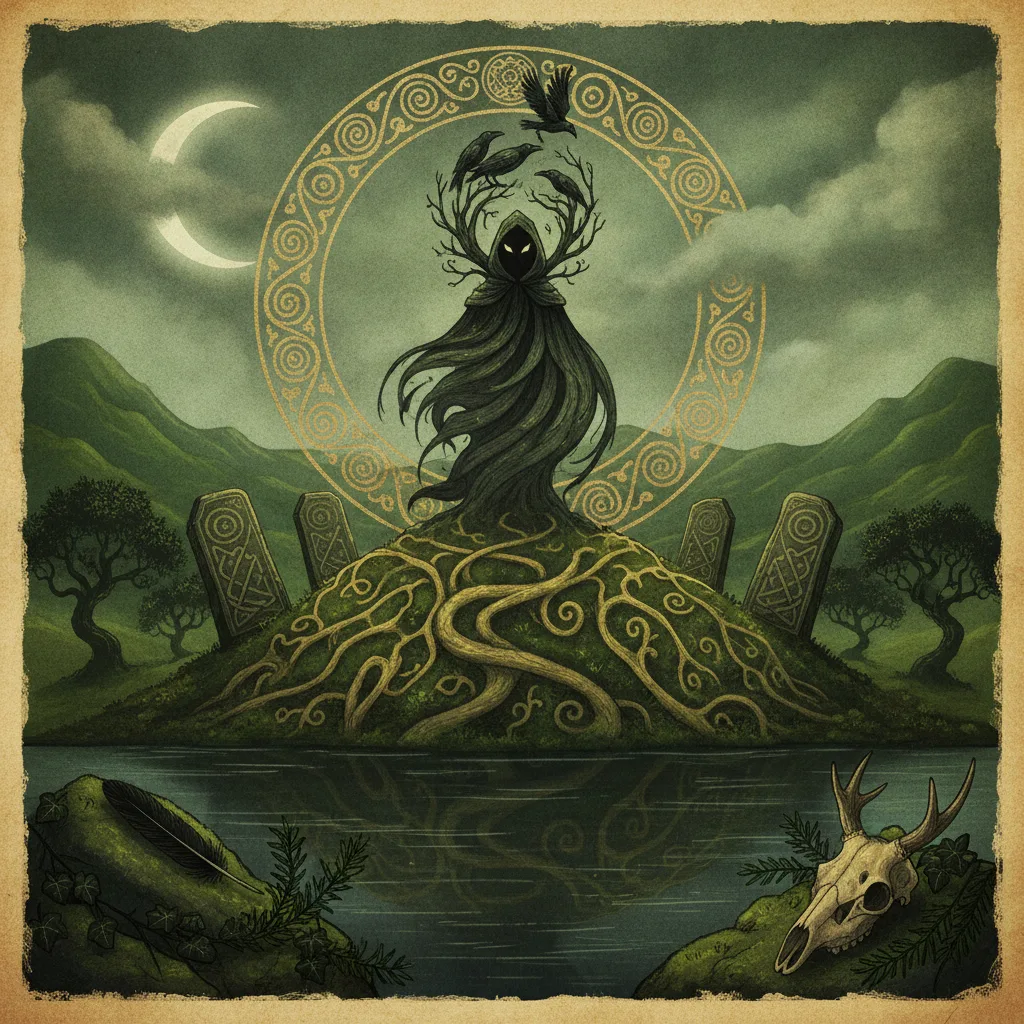
The Morrígan is the Irish goddess of war, sovereignty and prophecy, best seen in Cath Maige Tuired and the Táin Bó Cúailnge, who decides battles through magic, prophecy and shapeshifting rather than fighting herself. Her name means 'phantom queen' or 'great queen' - genuinely contested - and her 'triple' nature is real in the sources but fluid, not the modern maiden-mother-crone triad.
- The Morrígan is the Irish goddess of war, sovereignty and prophecy among the Tuatha Dé Danann.
- In Cath Maige Tuired she unites with the Dagda and helps destroy the Fomorians.
- She works through magic, prophecy and shapeshifting, rarely fighting directly.
- Her name is contested: 'phantom queen' or 'great queen'; she groups fluidly with Badb, Macha and Nemain.
- The fixed maiden-mother-crone triad is modern Neopaganism (Graves, 1948), not the medieval texts.
| Tradition | Irish (Mythological & Ulster Cycles) |
| Type | goddess (sovereignty / war / prophecy) |
| Earliest attestation | Cath Maige Tuired and Táin Bó Cúailnge; MSS Lebor na hUidre c.1100 and Book of Leinster c.1160 |
| Associated places | river fords; battlefields; Ireland’s sovereignty |
| Associated symbols | the crow/raven, shapeshifting, prophecy, cattle |
She comes to the hero at a ford, sometimes as a beautiful woman offering herself, sometimes as an old woman driving cattle, sometimes as a crow on his shoulder at the moment of his death. The Morrígan is the great and troubling figure of Irish myth: a goddess bound up with war, sovereignty, prophecy and death, who almost never fights herself but decides who wins. To keep her properly you have to hold two things at once — the vivid figure the medieval texts actually describe, and the very different “triple war goddess” that later readers assembled from her.
The story the texts tell
The Morrígan belongs to the Tuatha Dé Danann, the divine race of Irish myth, and appears across both the Mythological Cycle and the Ulster Cycle. Her most important scene is in Cath Maige Tuired (“The Second Battle of Mag Tuired”), the story of the Tuatha Dé’s war against the Fomorians. There she meets the Dagda at Samhain, straddling a river with a foot on each bank, and they lie together. In return she promises her aid against the Fomorian host — and she delivers it, using magic and prophecy to help destroy the enemy.
What is easy to miss is how the battle ends. After the victory the Morrígan does not gloat over corpses; she proclaims the triumph to the hills of Ireland and then chants two poems. The first is a vision of peace and plenty — “peace to sky, sky to earth” runs the famous opening — and the second is a dark prophecy of the world’s decline, a foretelling of the moral collapse that will come at the end of the age. This is the sovereignty-goddess pattern in its clearest form: the land, embodied as a woman, grants victory and kingship through union, and then speaks the fate of the whole country.
In the Táin Bó Cúailnge (“The Cattle Raid of Cooley”), the central epic of the Ulster Cycle, she turns her attention to Cú Chulainn. She appears to him as a young woman and offers her love; he refuses her, not recognising who she is, and she warns him she will hinder him in battle. She then attacks him in animal shapes — as an eel that trips him in the ford, a she-wolf that stampedes cattle, a red heifer — and he wounds her each time. Later she appears as an old woman milking a cow, and he unknowingly heals her with three blessings in exchange for three drinks of milk. At the end of his story, tradition places her (or her sister Badb) as the crow that settles on his shoulder once he is dead, the sign that the untouchable hero has finally fallen.
The washer at the ford
One of the most haunting images attached to her circle appears in the death-tale of Cú Chulainn: as the hero rides to his last battle he passes a young woman washing bloodstained clothing and armour in a ford, weeping — and the armour is his own. The washer-at-the-ford, keening over the belongings of a man about to die, is one of the most enduring motifs of Irish and later Scottish Gaelic tradition, and it belongs to this same family of battle-and-fate goddesses.
One goddess or three?
Here is where care matters. The medieval sources do not present a single, tidy “triple goddess.” The name is spelled Morrígan or Morrígu, and its meaning is genuinely contested: it may be “phantom queen” (from mor-, a spectral being) or, with a long vowel, “great queen” (mór). Both readings have serious scholarly backing; we cannot say for certain which is right.
She is also frequently grouped with other war-goddesses, and each has her own character. Badb (“crow” or “scald-crow”) is the battlefield in its most vivid, screaming form, the crow over the slaughter. Macha is more earthbound — tied to horses, to sovereignty, and to the founding of Emain Macha, the great fort of Ulster, whose name she gives. Nemain (“frenzy,” “panic”) is the terror that scatters an army. Some texts speak of “the three Morrígna” and make her one of them; others use the name for the whole group; still others keep her distinct. The genealogical tradition makes her a daughter of Ernmas. The point to hold onto is that the “trinity” is a real feature of the medieval material, but it is fluid and inconsistent — not the fixed maiden-mother-crone triad that later writers imposed.
Where she is written down
The manuscripts matter. The Ulster Cycle survives principally in two great codices: Lebor na hUidre (“The Book of the Dun Cow”), compiled at the monastery of Clonmacnoise around 1100 and now the oldest surviving manuscript written largely in Irish; and the Book of Leinster, from around 1160. The Táin exists in more than one recension across these and the fourteenth-century Yellow Book of Lecan. Cath Maige Tuired, her key Mythological-Cycle appearance, survives in a later manuscript (British Library Harley 5280) but preserves much older material; its standard modern edition and translation is Elizabeth A. Gray’s for the Irish Texts Society (1982), building on Whitley Stokes’s earlier edition in Revue Celtique (1891). She also appears in the place-lore of the Metrical Dindshenchas.
What the sources say vs. what circulates
Much of what is said about the Morrígan online is not medieval:
- The fixed “maiden, mother, crone” triad is a modern framework, popularised through twentieth-century Wicca and Neopaganism (drawing on Robert Graves’s 1948 The White Goddess). It is not how the medieval Irish texts describe her shifting groupings.
- “The Morrígan = a single all-purpose death goddess” flattens her. In the texts she is as much about sovereignty and prophecy as about death, and she works through influence and shapeshifting more than through direct killing.
- Elaborate ritual “correspondences” (specific crystals, incenses, tarot cards) attached to her are contemporary devotional practice, not attested lore. That is a legitimate modern relationship with her — but it should be named as modern.
There is also a real revival layer worth dating. The Celtic-Twilight writers of the late nineteenth and early twentieth centuries — figures around W. B. Yeats and Lady Gregory — brought the Irish gods back into literary view, and their romantic framing shaped how the Morrígan is imagined today. That reception is valuable, but it is Victorian and Edwardian, not medieval, and the two should not be confused.
The Morrígan in modern art, fiction and games
She has become one of the most recognisable Irish deities in popular culture. She is a playable Celtic-pantheon god in the online game SMITE, where her shapeshifting is a core mechanic; she recurs across modern fantasy fiction, urban-fantasy series and comics; and she is a favourite of contemporary Irish and Celtic artists drawn to the crow-and-battlefield imagery. Modern Neopaganism, especially traditions centred on Irish deities, has also made her a major object of devotion. All of this is real and interesting — and all of it sits on top of the medieval figure, not inside it.
Keeping her properly
The honest summary is this: the Morrígan is a genuinely ancient and central Irish goddess, best seen in Cath Maige Tuired and the Táin, associated with sovereignty, prophecy, shapeshifting and the fate of warriors. Her “triple” nature is real in the sources but unstable and inconsistent. The neat modern triad, the crystal correspondences, and the single-note “death goddess” are later overlays — some medieval-adjacent, most twentieth-century — and worth every reader’s attention precisely because they are so easy to mistake for the original.
| Tradition | Irish (Mythological & Ulster Cycles) |
| Earliest text | Cath Maige Tuired (older material; MS Harley 5280) and Táin Bó Cúailnge (Lebor na hUidre, c.1100) |
| Also appears | Book of Leinster (c.1160); Metrical Dindshenchas; genealogical tracts (daughter of Ernmas); grouped with Badb, Macha, Nemain |
| Later additions | Fixed ‘maiden-mother-crone’ triad from 20th-c. Neopaganism/Graves (1948); Celtic-Twilight revival (Yeats/Gregory, late 19th–early 20th c.) |
| Translation | Gray, Cath Maige Tuired (Irish Texts Society, 1982); Kinsella, The Táin (1969); O’Rahilly’s scholarly editions of the Táin |
| Reviewed | 2026-08 |
Frequently asked questions
What does the name Morrígan mean?
It is contested. It may mean ‘phantom queen’ (from a word for a spectral being) or, with a long vowel, ‘great queen’. Both readings have serious scholarly support and we cannot be certain which is correct.
Is she a triple goddess?
The medieval texts do group her with Badb, Macha and Nemain and speak of ‘the three Morrígna’, but the groupings are fluid and inconsistent. The fixed ‘maiden-mother-crone’ triad is a modern (20th-century) framework, not the medieval one.
Where does her main story appear?
In Cath Maige Tuired, where she unites with the Dagda and aids the Tuatha Dé against the Fomorians, and in the Táin Bó Cúailnge, where she confronts and later heals Cú Chulainn.
Did the Morrígan kill Cú Chulainn?
Not directly. In the tradition she opposes and hinders him, and appears as the crow that settles on his shoulder once he is dead — the sign that the hero has finally fallen — rather than as his killer.
What are the earliest manuscripts?
The Ulster Cycle survives chiefly in Lebor na hUidre (c.1100) and the Book of Leinster (c.1160); Cath Maige Tuired survives in the later Harley 5280 but preserves much older material.
Are crystals and tarot correspondences for the Morrígan ancient?
No. Specific crystal, incense and tarot ‘correspondences’ are contemporary devotional practice. They can be a genuine modern relationship with her, but they are not found in the medieval sources.
