Celtic Legends Irish · Mythological Cycle
The Tuatha Dé Danann
The old gods of Ireland — the pantheon of Lebor Gabála Érenn and Cath Maige Tuired — who won Ireland in two battles and, beaten by the Gaels, went into the mounds to become the sídhe.
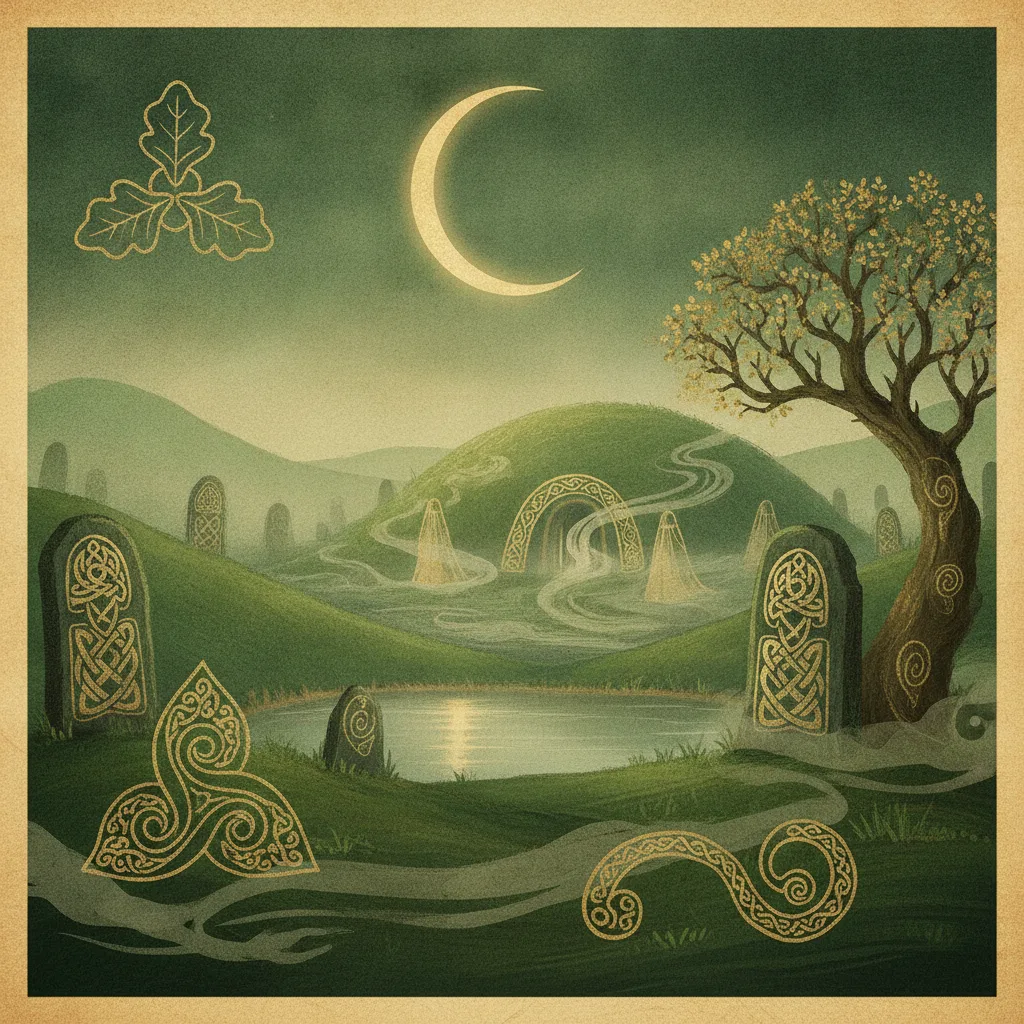
The Tuatha Dé Danann are the old gods of Ireland - a pantheon of craft, war and sovereignty chronicled in the eleventh-century Lebor Gabála Érenn and Cath Maige Tuired. Defeated by the incoming Gaels, they withdraw into the fairy mounds to become the aos sí. Their name's goddess 'Danu' is barely attested and largely reconstructed.
- The Tuatha Dé Danann are the old gods of Ireland, specifically Irish, not generically 'Celtic.'
- Their chief sources are Lebor Gabála Érenn (11th c.) and Cath Maige Tuired.
- They win Ireland in two battles at Mag Tuired, then lose it to the Gaels (Milesians).
- Defeated, they retreat into the sídhe mounds and become the aos sí, the fairy folk.
- The goddess 'Danu' in their name is barely attested and largely reconstructed.
| Tradition | Irish (Mythological Cycle) |
| Type | pantheon / divine race |
| Earliest attestation | Lebor Gabála Érenn (compiled 11th c.) and Cath Maige Tuired |
| Associated places | Mag Tuired; Tara; the sídhe / Brú na Bóinne |
| Associated symbols | the Four Treasures — Lia Fáil, sword of Nuada, spear of Lugh, cauldron of the Dagda |
They arrive in dark clouds over the mountains of the west, and when they land they burn their own ships so that there can be no retreat. They are the most gifted people ever to reach Ireland — masters of druidry, craft, poetry and war — and for a while the island is theirs. Then a newer people comes, and the gifted ones are beaten, and rather than leave they go down under the hills, into the mounds, and become the fairy folk of Ireland. That, in outline, is the story of the Tuatha Dé Danann: the old gods of Ireland, and the bridge by which gods became the sídhe.
Who they are
The name is usually translated “the peoples of the goddess Danu” — but this is one of those places where honesty matters at the very first word. The medieval texts more often call them simply Tuath Dé, “the tribe of gods.” The mother-figure “Danu” is barely attested in her own right; the form is largely reconstructed from the genitive Danann, and some scholars connect it instead with a goddess Anu or Ana. So the familiar gloss is reasonable, but the goddess it names is far shadowier than the confident phrase suggests. It is not a settled fact that there was ever a goddess called Danu.
The Tuatha Dé are less a single character than a pantheon. Among them are figures with their own entries in the folklore of Ireland: the Dagda, the good god and father-chieftain; Lugh, master of all arts; the Morrígan, goddess of war and sovereignty; Brigid, of poetry, healing and the forge; Nuada of the Silver Arm, their king; Dian Cécht, the physician; Goibniu, the smith; Ogma, the champion and father of writing; Manannán mac Lir, the sea-god; Aengus, god of youth and love; and the three sovereignty goddesses Ériu, Banba and Fódla, one of whom, Ériu, gives Ireland its very name.
The story the sources tell
Their history is told chiefly in Lebor Gabála Érenn (“The Book of the Taking of Ireland,” often “The Book of Invasions”), which frames the settlement of Ireland as a sequence of peoples: Cessair, Partholón, Nemed, the Fir Bolg, the Tuatha Dé Danann, and finally the Milesians — the Gaels, the ancestors of the historical Irish. The Tuatha Dé are the fifth of these, and the last of the supernatural ones.
They come from four northern cities — Falias, Gorias, Findias and Murias — where they learned their arts, and from each they bring a treasure: the Lia Fáil (the Stone of Destiny, which cries out under the rightful king) from Falias; the sword of Nuada from Gorias; the spear of Lugh from Findias; and the cauldron of the Dagda from Murias. These are the celebrated Four Treasures of the Tuatha Dé Danann.
Two great battles define them, both fought at Mag Tuired. In the First Battle they defeat the Fir Bolg for control of Ireland, but their king Nuada loses his arm and, because a king must be physically perfect, must give up the throne — he later receives a working silver arm and becomes Nuada Airgetlám, “Silver-Arm.” In the Second Battle — the subject of Cath Maige Tuired — they throw off the oppressive rule of the half-Fomorian Bres and, led by Lugh, crush the Fomorians, Lugh killing his own grandfather Balor.
How gods became fairies
The Tuatha Dé’s own defeat is the hinge of the whole mythology. The Milesians, the incoming Gaels, defeat them — and in the settlement that follows, the two peoples divide Ireland: the Milesians take the surface, and the Tuatha Dé take everything below. They withdraw into the sídhe — the ancient burial mounds and hollow hills, above all the Brú na Bóinne — and the sea-god Manannán is said to have shrouded them in the féth fíada, a magic mist that hides them from mortal sight. From that moment the gods of Ireland become the aos sí (the “people of the mounds”), the fairy folk of later Irish belief. This is the crucial mythological engine that explains why, in living Irish folklore, the fairies were never twee little creatures but a proud, dangerous, older race — the dispossessed gods, still under the fields.
The coming of the Gaels
The people who displace them, the Milesians or sons of Míl Espáine, are given their own memorable arrival. As they approach, the three sovereignty goddesses Ériu, Banba and Fódla each meet them in turn and ask that Ireland be named for her; the poet-judge Amergin promises Ériu that it will, which is why the island is Éire to this day (Banba and Fódla survive as poetic names for Ireland). Amergin himself is remembered for a great invocation he is said to have spoken on first setting foot on the shore — “I am the wind on the sea, I am the wave of the ocean” — a poem endlessly quoted in the modern Celtic revival. Here again the honest note applies: the verses as we have them are medieval and much reworked, and the ringing translations that circulate today are modern renderings, not a transcript of anything spoken at the dawn of Ireland.
What the sources say vs. what circulates
- They are not “Celtic gods” in general — they are Irish. The Tuatha Dé Danann belong to the Irish tradition specifically. Lumping them with Welsh, Gaulish or “Celtic” deities as one interchangeable pantheon erases real differences between separate literatures.
- The texts euhemerise them. The Christian monks who wrote Lebor Gabála generally did not present the Tuatha Dé as gods to be worshipped. They recast them as an ancient, gifted human people skilled in magic — a technique called euhemerism — sometimes even explaining them as fallen angels or exiled tribes. So the “pantheon” we reconstruct is partly a scholarly recovery of gods the sources were busy demoting.
- The four cities and treasures vary. Which treasure came from which city, and even which weapon belonged to whom, differs between texts. The famous fixed list is a tidy modern version of a messier tradition.
There is also a strong revival layer to date. The Celtic Revival of the late nineteenth and early twentieth centuries — Yeats, Lady Gregory, AE (George Russell), and the artist-visionaries around them — brought the Tuatha Dé Danann back into art and literature and shaped the romantic image most people now hold. That reception is real and influential, but it is modern, and it should not be mistaken for the medieval material it draws on.
Where they are written down
The essential sources are Lebor Gabála Érenn, compiled in the eleventh century and surviving in several recensions across many manuscripts (including the Book of Leinster, c.1160), edited and translated by R. A. S. Macalister in five volumes for the Irish Texts Society (1938–1956); and Cath Maige Tuired, in Elizabeth A. Gray’s edition for the Irish Texts Society (1982). Individual members appear across the Mythological Cycle, the Dindshenchas place-lore, and — for the fairy afterlife — a vast body of later folklore.
The Tuatha Dé Danann in modern art, fiction and games
Few mythologies have been so generative for modern creators. The Tuatha Dé Danann are central to fantasy fiction such as Kevin Hearne’s Iron Druid Chronicles, appear across video games and comics that draw on Irish myth, and have inspired some of the most celebrated modern Celtic visual art — notably the illustrations of Jim Fitzpatrick, whose vivid renderings of Lugh, the Dagda and their kin shaped a generation’s image of the Irish gods. And in the quietest, most enduring form of all, they live on as the fairy folk of Irish tradition — the good people under the hill.
Keeping them properly
The Tuatha Dé Danann are the old gods of Ireland, chronicled in Lebor Gabála Érenn and Cath Maige Tuired: a pantheon of craft, war and sovereignty who won Ireland in two great battles and then, defeated by the Gaels, went down into the mounds to become the sídhe. Their name’s “Danu,” the fixed treasure-lists, and the romantic Revival image are all worth knowing — and worth holding a little apart from the euhemerised, uncertain, genuinely ancient tradition the manuscripts preserve. Old stories, kept properly.
| Tradition | Irish (Mythological Cycle) |
| Earliest text | Lebor Gabála Érenn (compiled 11th c., several recensions) and Cath Maige Tuired |
| Also appears | Book of Leinster (c.1160); Dindshenchas; individual members across the Mythological Cycle; the aos sí of later folklore |
| Later additions | Medieval scribes euhemerise them as human magicians, even fallen angels; the goddess ‘Danu’ is largely reconstructed; fixed four-treasures lists smooth over textual variation; Celtic Revival reception (Yeats, Gregory, AE, late 19th–early 20th c.) |
| Translation | Macalister, Lebor Gabála Érenn (Irish Texts Society, 1938–1956); Gray, Cath Maige Tuired (Irish Texts Society, 1982) |
| Reviewed | 2026-08 |
Frequently asked questions
What does ‘Tuatha Dé Danann’ mean?
Usually ‘the peoples of the goddess Danu’ — but the goddess Danu is barely attested and largely reconstructed from the genitive Danann. The medieval texts often just say Tuath Dé, ‘tribe of gods’. The familiar gloss is reasonable but not a settled fact.
Are the Tuatha Dé Danann gods or people?
Originally the old gods of Ireland, but the Christian scribes of Lebor Gabála Érenn generally recast them as an ancient, magically gifted human people (euhemerism), sometimes even as fallen angels. The ‘pantheon’ we describe is partly a modern recovery of gods the sources were demoting.
What are the Four Treasures?
The Lia Fáil (Stone of Destiny) from Falias, the sword of Nuada from Gorias, the spear of Lugh from Findias, and the cauldron of the Dagda from Murias — though which treasure and weapon came from which city varies between texts.
How did the Tuatha Dé Danann become fairies?
After being defeated by the Milesians (the Gaels), they divided Ireland: the Gaels took the surface and the Tuatha Dé took below it. They withdrew into the sídhe (the mounds and hollow hills) and became the aos sí — the fairy folk of Irish tradition.
Who belongs to the Tuatha Dé Danann?
Among many: the Dagda, Lugh, the Morrígan, Brigid, Nuada of the Silver Arm, Dian Cécht, Goibniu, Ogma, Manannán mac Lir, Aengus, and the sovereignty goddesses Ériu, Banba and Fódla — Ériu gives Ireland its name.
What are the main sources?
Chiefly Lebor Gabála Érenn (compiled in the 11th century; R. A. S. Macalister’s 1938–1956 edition) and Cath Maige Tuired (Elizabeth Gray’s 1982 edition), with individual members appearing across the Mythological Cycle and the Dindshenchas.
