Drawing the Morrígan: A Folklore-Accurate Reference Guide for Artists
What the Irish sources actually describe about the Morrígan — the washer at the ford, the red charioteer, the shapeshifter — versus the modern crow-goddess cliché.
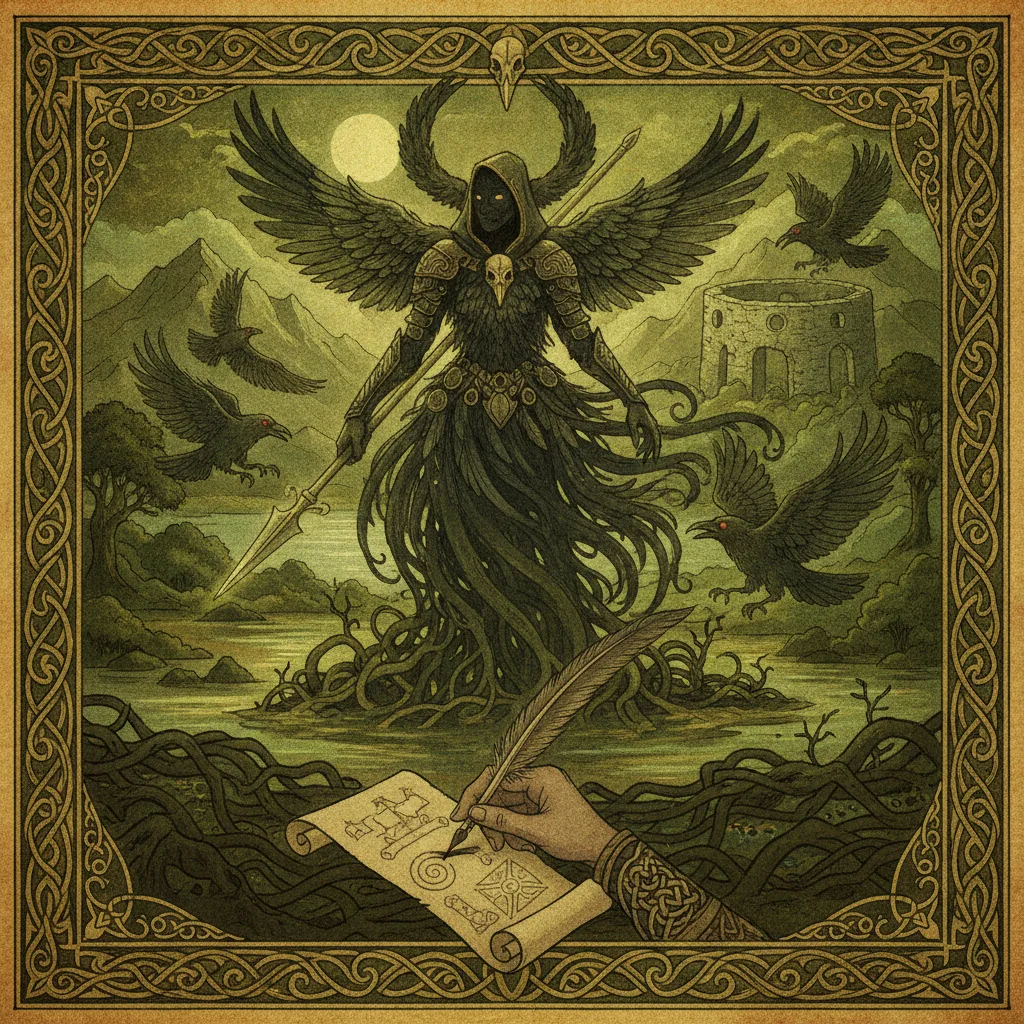
Draw the Morrigan from the medieval texts, not the modern crow-crowned cliche. She is defined by what she does, prophesy, incite, shapeshift, wash the doomed, often as a trio with Badb and Macha. Use grounded scenes: the washer astride the Unius, the red woman with a one-legged horse, and her eel-wolf-heifer shapeshifting. Name any raven-winged invention as invention.
- Draw from the medieval texts, not the crow-crowned cliche.
- She is defined by what she does, not fixed costume.
- The crow is one form and omen, not her portrait.
- Use scenes: the washer at the ford, the red woman.
- Red is her sourced colour; name raven-winged additions as invention.
Search “the Morrígan” today and you will meet the same figure over and over: a woman crowned in crow feathers, standing in silhouette against a red sky, ravens streaming from her hands. It is a striking image, and it has become a visual shorthand for the Irish war goddess. It is also, for the most part, a modern invention. The medieval Irish texts that actually name her describe something stranger, more specific, and far more useful to an artist who wants to draw her with grounding rather than repeating a stock pose. This guide walks through what the surviving sources say, where the crow cliché comes from, and which symbols you can use with a clear conscience.
Who the sources say she is
The Morrígan — Mór-Ríoghan, often glossed as “phantom queen” or “great queen” — appears across the Ulster Cycle and the Mythological Cycle. She is rarely a solitary figure. Early texts group her with Badb and Macha (and sometimes Nemain) as a plurality, the Morrígna, which is why so much writing about her slips between the singular and the plural. If you want the story material behind the symbols, she runs all through our folklore entry on the Morrígan, and she shapes the fate of the hero at the centre of the Cú Chulainn cycle.
The point to hold onto before you sketch anything: she is defined in the texts by what she does — prophesy, incite, shapeshift, wash the doomed — far more than by any fixed costume. That is a gift, not a limitation. It means her iconography is behavioural, and behaviour is easier to draw with authority than a guessed-at wardrobe.
The crow: real, but not the whole picture
The bird association is genuine. The word badb itself means a scald-crow or hooded crow, and the name is used for the war-fury who shrieks over battlefields. In the tale of Cú Chulainn’s death, a crow settles on the hero’s shoulder as he stands dying, lashed to a standing stone — the sign that his enemies can finally approach. So a crow is not wrong. What is misleading is treating the crow as her portrait rather than as one of several forms she takes and one of the omen-birds under her command. Draw the crow as a messenger, a witness, or a transformation caught mid-change, and you are on firm ground. Draw a woman who is essentially a crow in human clothes, and you are illustrating a twentieth-century mood board.
Three source scenes an artist can actually use
The washer astride the river (Cath Maige Tuired)
In the Second Battle of Mag Tuired, the Dagda keeps a tryst with her at Samhain. He finds her washing at the river Unius, standing with one foot on each bank — one to the south, one to the north — with, in the text’s memorable detail, nine loose tresses on her head. After they lie together she pledges to break the Fomorian king Indech, promising to take from him “the blood of his heart and the kidneys of his valour.” Here she is monumental and sexual and prophetic all at once, and there is not a feather in sight. The straddled river, the loosened hair, the moving water: specific, drawable, and almost never used.
The red woman on the chariot (Táin Bó Regamna)
In this short prelude to the great cattle raid, Cú Chulainn meets her on the road as a red-haired woman in a red cloak, driving a chariot pulled by a one-legged horse, a cow being led alongside. The relentless redness — hair, brows, mantle — is the source’s chosen palette, and the lopsided, wrong-footed chariot signals that she belongs to the Otherworld. If you want colour symbolism with a citation behind it, this is it: red for her, not the black-and-crimson gothic scheme that has drifted in from elsewhere.
The shapeshifter at the ford (Táin Bó Cúailnge)
During the raid she comes to Cú Chulainn as a beautiful young woman and offers him her love. He refuses, and she warns she will hinder him. She attacks in three animal forms across his combats — as an eel that coils around his legs in the water, as a grey she-wolf that drives cattle at him, and as a red hornless heifer leading the herd. He wounds each. Later she appears as an old woman milking a cow, and he heals her wounds with three blessings before he realises who she is. The eel, the wolf, the heifer, the milking hag: a whole sequence of grounded images, each tied to a wound and a reconciliation.
A working symbol set
If you want a vocabulary a folklorist would nod at rather than wince at, build from these:
- Water and washing — the ford, the riverbank, bloodstained cloth or armour. This is her single most consistent setting.
- The number three — her triple nature with Badb and Macha. A trio of figures, birds, or reflections reads truer than a lone silhouette.
- Red as her colour — cloak, hair, brows, drawn straight from Táin Bó Regamna.
- Shapeshifting mid-transformation — eel, wolf, heifer, crow, hag, young woman. Catch her between two forms rather than settling on one.
- The scald-crow as omen, not costume — a bird that lands, watches, or lifts, rather than a feathered headdress.
- Prophecy and inversion — the one-legged horse, the wrong-way-round chariot, hair worn loose. Small signs that the ordinary world has tilted.
What to leave out (or use knowingly)
None of the early texts give her a raven-winged gown, a crown of skulls, or a court of ravens obeying a raised hand. Those are contemporary fantasy furniture, and there is nothing wrong with fantasy — but if you are aiming for a folklore-accurate reference, name your invention as invention. The most respectful and, frankly, the most original path is to reach past the search-engine version and pull directly from the scenes above. Almost no one is drawing the woman astride the Unius with nine loosened braids. That image is waiting for you, and it comes with a citation.
Read before you draw
Translations of Cath Maige Tuired, the Táin, and Táin Bó Regamna are widely available in print and through public archives such as the University College Cork CELT text corpus, and reading even one in full will hand you more usable detail than a hundred reference boards. Start with the primary scenes, sketch from the text rather than from other people’s art, and let the strangeness of the sources do the work. The Morrígan has survived a thousand years precisely because she refuses to sit still — the least an artist can do is draw her moving.
Frequently asked questions
Is the Morrígan a crow goddess?
She is genuinely linked to the scald-crow (badb), and a crow settles on Cú Chulainn at his death. But the medieval sources describe her far more often as a shapeshifting woman, a washer at the ford and a red-cloaked charioteer. The all-crow portrait is largely a modern invention.
What colour is the Morrígan in the sources?
In Táin Bó Regamna she appears as a red-haired woman in a red cloak with red brows, driving a chariot drawn by a one-legged horse. Red is her attested colour, not the black-and-crimson gothic scheme that circulates today.
What animals does the Morrígan turn into?
In the Táin she attacks Cú Chulainn as an eel that coils round his legs, a grey she-wolf that drives cattle at him, and a red hornless heifer leading the herd. Elsewhere she takes crow and old-woman forms.
Which texts actually describe the Morrígan?
Chiefly Cath Maige Tuired (the washing scene with the Dagda at Samhain), Táin Bó Cúailnge and its prelude Táin Bó Regamna, plus the tale of Cú Chulainn's death.
Is she one goddess or three?
Early texts often group her with Badb and Macha, and sometimes Nemain, as the Morrígna, which is why the sources slip between singular and plural. A trio of figures is truer to the material than a lone silhouette.
