How to mark Samhain: a seasonal guide
Samhain, kept honestly: what the medieval Irish sources actually say, how Halloween braided in, what modern paganism added — and how to mark the season.
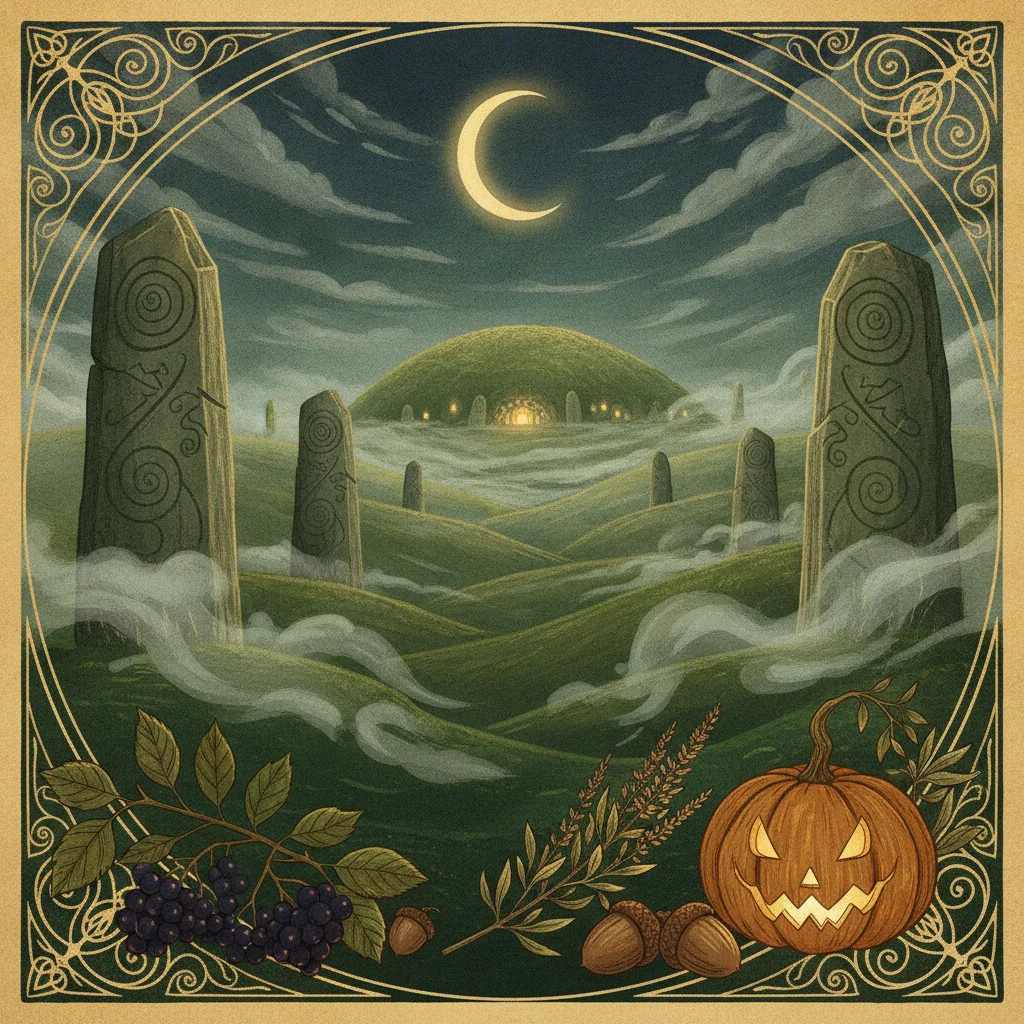
Samhain is the Gaelic quarter-day marking the start of winter and the year's dark half, first securely attested in the medieval tale Tochmarc Emire around the tenth century. This guide separates its three layers - the medieval festival, the folk-Christian Halloween, and the 1950s neopagan Wheel of the Year - then suggests honest ways to mark the season.
- Samhain is the Gaelic quarter-day marking winter's start and the year's dark half.
- It is first securely attested in the medieval tale Tochmarc Emire, around the tenth century.
- Halloween braids the Gaelic quarter-day with the Christian feasts of All Saints and All Souls.
- The eight-sabbat Wheel of the Year is a 1950s creation, not ancient druid practice.
- Honest observance: keep the harvest core, remember the dead, light a flame, read the old tales.
Samhain is the hinge of the Celtic year — the moment the light half tips into the dark, the harvest closes, and, in the old belief, the boundary between this world and the Otherworld thins. It is also the most misremembered date on the calendar, buried under a century of costume plastic and a further century of well-meaning invention. This guide separates what Samhain was from what it has become, then offers a way to mark the season that respects both. History first, practice second, and the seam between them kept visible throughout.
What Samhain actually was
The honest starting point is that we know less than the confident websites suggest, and what we do know comes from medieval Christian scribes writing centuries after any pagan observance. The earliest secure literary reference sits in Tochmarc Emire (“The Wooing of Emer”), an Ulster Cycle tale whose relevant material is usually dated to around the tenth century. There, Samhain is named as the first of the four quarter-days that divide the year, followed by Imbolc, Beltane and Lughnasadh — the same four fire-festivals whose names we still use. Samhain is glossed there in the spirit of “summer’s end,” the point at which the warm half of the year goes to its rest.
From the medieval sources we can say a few things with reasonable confidence. Samhain marked the start of winter and, functionally, a new year: the harvest was in, herds were brought down from summer pasture, and animals were culled for the cold months. It was a time of assembly and feasting — the great tales set major gatherings and Otherworld encounters at Samhain, which tells us the date carried heavy symbolic weight for the storytellers. And it was liminal: in the literature, this is when síd-mounds open and the barrier between the living and the dead, humans and the aos sí, is at its most porous.
Much beyond that is inference. The famous image of Samhain as a solemn “festival of the dead” is real in outline but was sharpened considerably by nineteenth-century folklorists, who did the work of drawing a continuous line from ancient Ireland to the Halloween of their own day. Some of that line is sound; some of it is romantic reconstruction. For the fuller account of what the medieval texts genuinely support — and what they don’t — see Samhain: what it actually was. And to hear the word said properly, our short Say It Right: Samhain covers it.
The Halloween lineage
Halloween is not simply “Samhain with a costume on.” It is a genuine braid of two strands. One strand is the Gaelic quarter-day above, with its bonfires, its concern for the dead, and its customs of disguise and mischief recorded in Ireland and Scotland. The other is Christian: the feast of All Saints (All Hallows) on 1 November, with All Souls’ Day following on the 2nd, giving us All Hallows’ Eve — Hallowe’en — on 31 October. The timing of the Christian feast and the older quarter-day coincided, and over centuries the two fed each other rather than one simply replacing the other.
The customs we think of as ancient are mostly late and mostly documented, not guessed. Guising and souling, turnip lanterns carved in Ireland and Scotland, apple divination, the pumpkin adopted after emigration to North America — these are attested folk practices with paper trails, not pagan survivals handed down unbroken. That is not a demotion. A custom recorded in the eighteenth or nineteenth century is still a real tradition; it simply belongs to the layer it belongs to, and honesty about the dating is part of respecting it.
What the twentieth century added
The third layer is modern, and it is the one most often mistaken for the oldest. When people describe Samhain today as one of eight evenly-spaced “sabbats” on a great Wheel of the Year, they are describing a scheme assembled in 1950s Britain, largely through the collaboration of Gerald Gardner and Ross Nichols, which fused the four Gaelic fire-festivals with the solstices and equinoxes into a single eightfold cycle. The four fire-festival names are medieval; the tidy eight-spoked wheel is not. We set out the whole chronology in The Wheel of the Year, honestly dated, and it is worth reading before you accept any “ancient eight sabbats” claim at face value.
None of this means modern Samhain observance is fake. Twentieth- and twenty-first-century neopagan practice — ancestor altars, dumb suppers, seasonal correspondences — is a living tradition with real meaning for the people who keep it. The only error worth avoiding is back-dating it: presenting a devotional practice designed in living memory as something the Iron Age Celts did. Mark the season however moves you; just don’t sell the new as the ancient.
Marking the season: observance
With the layers straight, here is how to keep the season in a way that stays honest about where each element comes from.
- Keep the agricultural core. Samhain’s oldest meaning is the close of harvest and the turn into winter. A meal built from the last of the season’s produce, a clearing-out of the garden, a marking of the first hard frost — these connect you to the layer we can actually date, no supernatural claim required.
- Remember the dead, plainly. The association of this date with the dead is genuinely old in outline. An ancestor shelf, a candle for someone gone, a re-told family story — this needs no invented ritual to carry weight. If you like the neopagan “dumb supper” (a silent meal with a place set for the departed), keep it, and simply know it as a modern devotional form.
- Light something. Fire is the one element that runs through every layer — the medieval bonfires, the carved lanterns, the modern candle. A single lit flame at dusk on the 31st is the most historically defensible ritual gesture there is.
- Mind the threshold. If you enjoy the folklore of the thinning veil, lean into the tales rather than into invented correspondences. The season’s best material is narrative: the Otherworld journeys, the fairy processions, the riders of the Wild Hunt abroad in the dark half of the year.
Reading for the dark half
Samhain is a reading season as much as a ritual one, and the primary literature is where the date’s real power lives. Start with the figures who own this time of year. The Morrígan — goddess of sovereignty, war and prophecy — presides over the battlefield and the fords, and her appearances cluster around the great confrontations of the tales. The Otherworld itself is best entered through the aos sí and the fairy mounds, the síde whose doors, in the stories, stand open at Samhain.
If you want to read from the sources outward rather than from modern paraphrase inward, our guide to reading the four cycles of Irish myth lays out a path through the primary texts, and there is a companion piece on the best Irish mythology non-fiction for those who want a guided way in. Read even a little of the actual medieval material and the difference between the tradition and the tourist version becomes obvious very quickly. The tales set at this time of year — Otherworld visits, the opening of the mounds, the return of the dead — are not decorative; they are the reason the date carried such weight for the people who first wrote it down, and they remain the most rewarding way to spend the long evenings the season hands you.
Décor for the season
You do not need a single item of moulded orange plastic to mark Samhain, and the season looks far better without it. The move is toward the natural and the seasonal: bare branches, the last leaves, rosehips and haws, beeswax candles, wool, dark linen, iron and stone. Carved gourds and turnips belong here on their own merits, as does anything that reads as harvest’s-end rather than horror-aisle. For a full treatment — what to use, what to skip, and how to build something that looks intentional rather than shop-bought — see Samhain décor that isn’t Halloween-store plastic, and, if you keep a seasonal shelf year-round, our guide to building an altar or seasonal shelf.
The through-line, in décor as in everything else here, is that you can be reverent and accurate at once. Mark the harvest’s close. Light a flame. Remember your dead. Read the old stories on the night the old stories say the doors stand open. Keep the medieval, the folk-Christian and the modern-pagan layers distinct in your own mind, and the season becomes richer for it — not a costume, but a genuine turn of the year kept with open eyes.
Frequently asked questions
Is Samhain the same as Halloween?
Not quite. Halloween braids together the medieval Gaelic quarter-day of Samhain with the Christian feasts of All Saints (1 Nov) and All Souls (2 Nov), giving All Hallows' Eve on 31 October. The two strands fed each other over centuries rather than one simply replacing the other.
How old is Samhain, really?
The name and the quarter-day are medieval: the earliest secure literary reference is in Tochmarc Emire, dated to around the tenth century, which lists Samhain as the first of the four quarter-days. Much of the associated custom was recorded far later, by 18th- and 19th-century folklorists.
What did Samhain mean in medieval Ireland?
It marked summer's end and the start of winter — harvest in, herds down from pasture, a new year beginning — and it was a liminal time when, in the tales, the síd-mounds opened and the boundary between the living and the dead thinned.
Is the eightfold 'Wheel of the Year' ancient?
No. The four fire-festival names are medieval, but the tidy eight-spoked wheel that adds the solstices and equinoxes as equal 'sabbats' was assembled in 1950s Britain, chiefly through Gerald Gardner and Ross Nichols.
How can I mark Samhain honestly?
Keep the agricultural core (a harvest's-end meal, clearing the garden), remember the dead plainly (a candle, a story, an ancestor shelf), light a flame at dusk, and read the old tales set at this time of year — labelling any modern devotional forms as modern.
When is Samhain?
It is traditionally reckoned from sunset on 31 October through 1 November, aligning with the modern Halloween/All Hallows' period.
