12 writing prompts rooted in actual Irish legend
Twelve writing prompts, each tied to a real figure from Irish legend, from the Morrigan to the Children of Lir, with the source to read first.
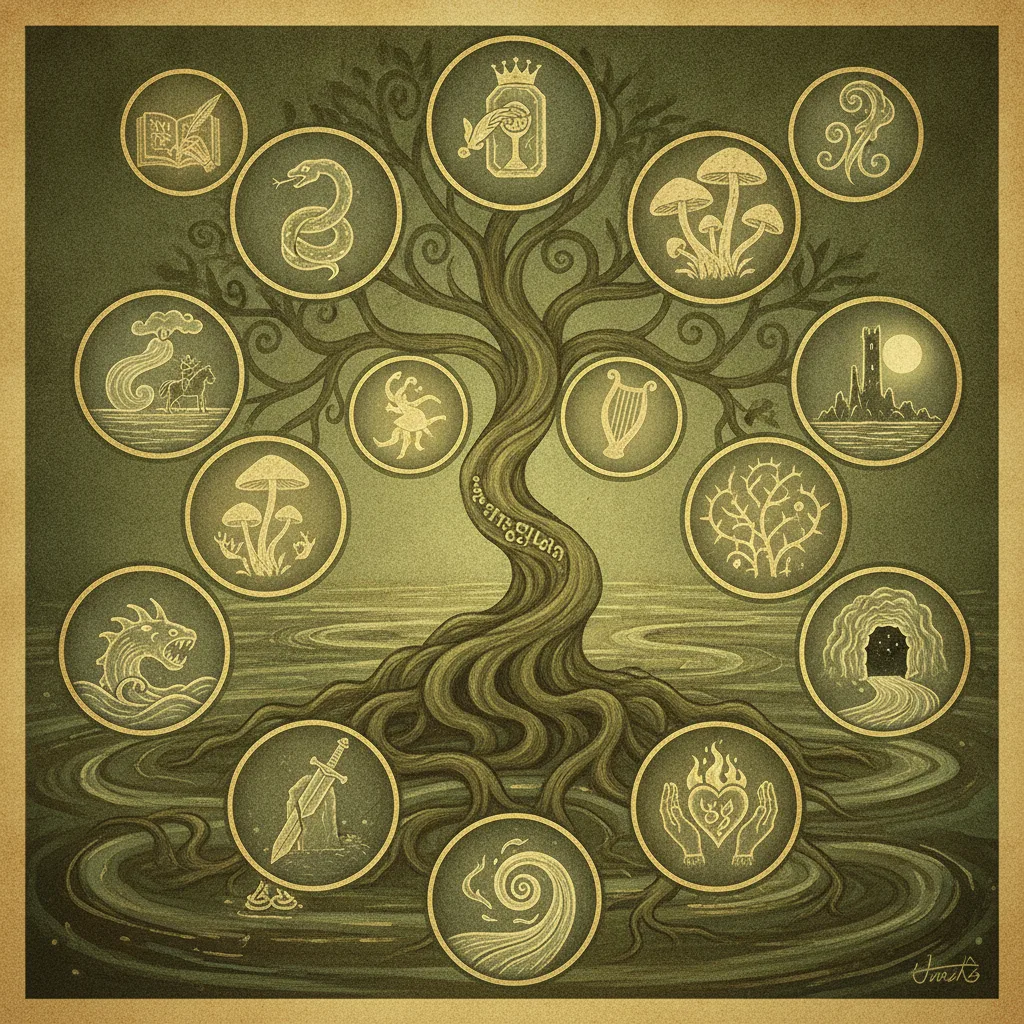
Twelve writing prompts rooted in named figures from Irish legend, each with its source so you read further first. They span the Ulster Cycle (the Morrigan, Cu Chulainn, Macha, Deirdre), the Mythological Cycle (the Children of Lir, Etain, Balor), the Fenian Cycle (Fionn, Oisin) and the wider tradition (the Cailleach, Manannan). Read a retelling first, and resist tidying the strangeness.
- Twelve prompts, each rooted in a named Irish legend.
- Ulster Cycle: the Morrigan, Cu Chulainn, Macha and Deirdre.
- Mythological Cycle: the Children of Lir, Etain and Balor.
- Fenian Cycle and wider tradition: Fionn, Oisin, the Cailleach.
- Read a retelling first; keep the condition, resist tidying.
The trouble with “Celtic-inspired” writing prompts is that most of them aren’t. They ask for a generic druid or a nameless fae court and call it done. The Irish tradition is far stranger and far more specific than that, and its actual figures — with their names, their taboos and their peculiar logic — make much better fuel. Below are twelve prompts, each tied to a real figure or story from Irish legend, with a note on the source so you can read further before you write. Spellings and details follow the medieval material; where a name has variants, the common form is given.
From the Ulster Cycle
1. The Mórrígan at the ford
The Mórrígan is a goddess of war, fate and sovereignty who often appears as a crow and who both desires and dooms the hero Cú Chulainn in the Táin Bó Cúailnge. Prompt: write the scene from her point of view — a being who can see how the battle ends offering help to a man who refuses her, and choosing what to do with his refusal.
2. The boy who named himself Cú Chulainn
The child Sétanta kills the smith Culann’s fearsome guard-hound in self-defence and, in recompense, offers to take the hound’s place until a replacement is reared — earning the name Cú Chulainn, “the Hound of Culann.” Prompt: write about a debt paid by becoming the very thing you destroyed. What does it cost to guard a door you once broke down?
3. Macha’s curse
In the tale behind the Ulstermen’s recurring weakness, the otherworldly woman Macha, heavily pregnant, is forced by a boastful king to race his horses. She wins, gives birth at the finish line, and curses the men of Ulster to suffer a woman’s labour-pains in their hour of greatest need. Prompt: write about a promise of privacy broken in public, and a curse that is really a demand to be believed.
4. Deirdre, who was warned about
In Longes mac nUislenn, it is prophesied at Deirdre’s birth that her beauty will bring ruin; she is raised in isolation to be the king’s, escapes with the man she loves, and is betrayed back. Prompt: write from inside a life lived under someone else’s prophecy — a person told what she is before she is allowed to be anything.
From the Mythological Cycle
5. The Children of Lir
Jealous of her stepchildren, Aoife transforms the four children of Lir into swans for nine hundred years, leaving them their human voices and song. Prompt: write about keeping your voice while losing your shape — a family that stays a family across centuries of exile, waiting for a bell they don’t yet understand.
6. Étaín, remembered in pieces
In Tochmarc Étaíne, Étaín is turned into a pool, then a worm, then a jewel-bright fly, blown about for centuries before being reborn — with no memory of who she was. Prompt: write a love story in which one lover has forgotten they ever lived before, and the other has spent a thousand years finding them again.
7. Aengus and the dream he could not name
In Aislinge Óengusa, the young god Aengus falls sick with love for a woman he has only seen in a dream, and searches until he finds her among a flock of maidens who become swans each Samhain. Prompt: write about recognising, in waking life, a face you have only met while asleep — and the strange bargain required to keep it.
8. Balor of the Baleful Eye
In Cath Maige Tuired, the Second Battle of Moytura, the Fomorian giant Balor has a single terrible eye that destroys what it looks upon; it is prophesied he will be killed by his own grandson, Lugh, and he is. Prompt: write about a tyrant undone by the very descendant he tried to prevent from existing — and tell it from the side of the family locked away to stop the prophecy.
From the Fenian Cycle
9. The Salmon of Knowledge
The young Fionn mac Cumhaill is set to cook a salmon that will grant all knowledge to whoever first tastes it; burning his thumb on the fish, he sucks it, and the wisdom passes to him instead of his master. Prompt: write about a gift that arrives by accident, to the wrong person, through a small carelessness — and what the person who spent years waiting for it does next.
10. Oisín in Tír na nÓg
The poet-warrior Oisín goes with Niamh to the Land of the Young; when he returns after what feels like three years, three hundred have passed, and the moment his foot touches Irish soil, age falls on him all at once. Prompt: write the homecoming — a person returning to find everyone they loved is centuries dead, and the single instant in which their borrowed time runs out.
From the wider tradition
11. The Cailleach shapes the land
The Cailleach is the divine hag of Irish and Scottish tradition, a maker and un-maker of the landscape and a personification of winter, said to drop stones from her apron to form hills and mountains. Prompt: write about an ancient woman who built the shape of the world you live in and is still, quietly, rearranging it — and what happens when someone notices a hill has moved.
12. Manannán’s mists
Manannán mac Lir is the sea god associated with the Isle of Man, keeper of a crane-bag of treasures, who can raise concealing mists between this world and the Otherworld. Prompt: write about a ferryman between worlds who decides, once, to let the wrong passenger through — and what the sea asks in return.
How to use these
Two suggestions. First, read at least a short retelling of the source before you write; the specifics — Macha’s exact grievance, the mechanics of Étaín’s rebirths — are where the real strangeness lives, and they will give you far more than a vague “Celtic” mood. Marie Heaney’s Over Nine Waves and a good translation of the Táin are excellent starting points. Second, resist the urge to tidy. These stories keep their loose ends, their cruelties and their odd, dream-logic causation. Honour that, and even a short piece will carry the weight of the tradition it grew from.
Frequently asked questions
Who is the Mórrígan in Irish legend?
The Mórrígan is a goddess of war, fate and sovereignty, often appearing as a crow. She figures prominently in the Táin Bó Cúailnge, where she both offers help to and dooms the hero Cú Chulainn.
What is the story of the Children of Lir?
Jealous of her stepchildren, Aoife transforms the four children of Lir into swans for nine hundred years, leaving them their human voices and song. It is one of the great tragic tales of the Mythological Cycle.
Where can I read the original Irish legends?
Marie Heaney's Over Nine Waves gathers the major cycles in clear prose, and a good translation of the Táin Bó Cúailnge covers the Ulster Cycle. Read the source before writing from it.
How was Fionn mac Cumhaill given wisdom?
As a boy he was set to cook the Salmon of Knowledge; burning his thumb on the fish, he sucked it and the wisdom passed to him instead of his master, Finnegas.
What happened to Oisín in Tír na nÓg?
Oisín went with Niamh to the Land of the Young; returning after what felt like three years, he found three hundred had passed, and age fell on him the instant his foot touched Irish soil.
