Seasonal table settings through the turning year
Setting the table to the real year: a festival-by-festival guide from Imbolc to midwinter, built from seasonal material on constant handmade ceramics, dated honestly.
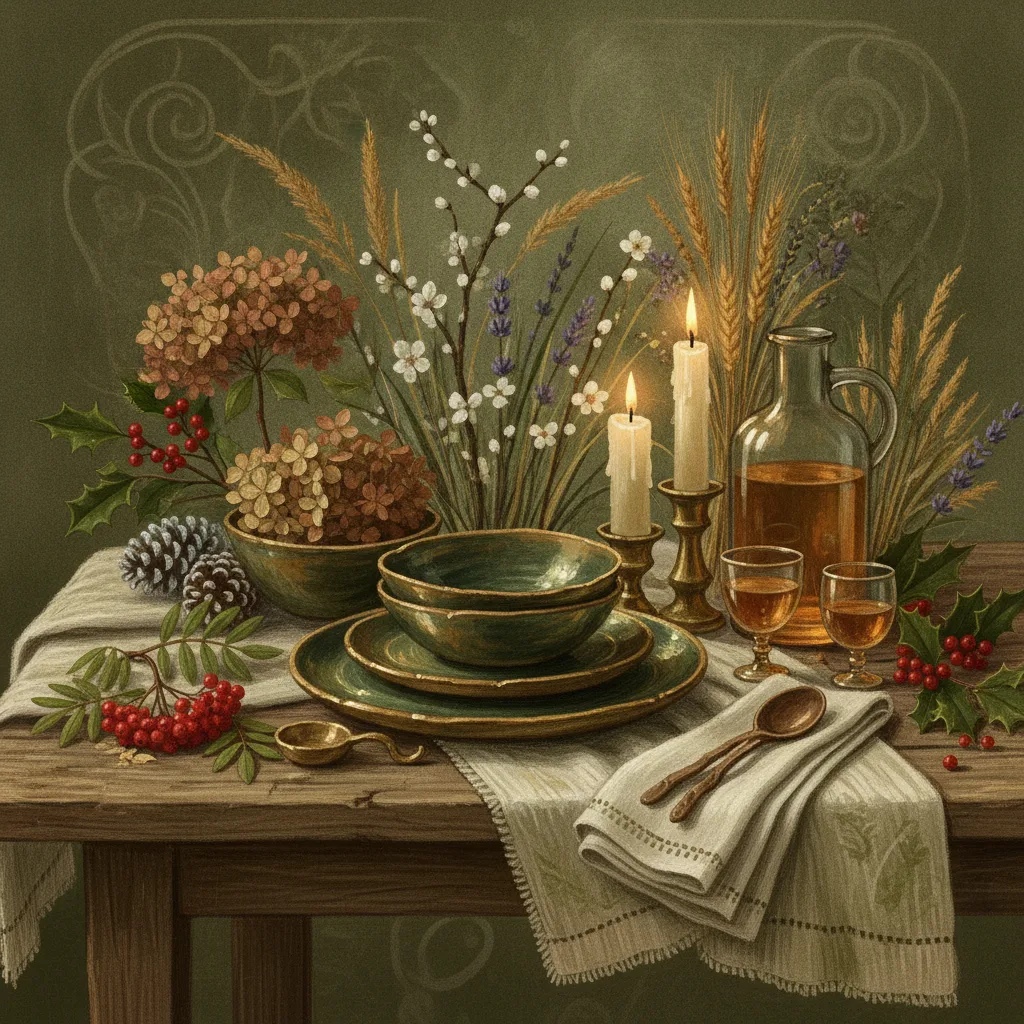
Set a seasonal table by foraging the palette and keeping a constant set of well-made ceramics, linen and beeswax candles to re-dress through the year. Match each festival honestly: Imbolc snowdrops and a rush cross (17th-century custom), Beltane yellow flowers, Lughnasadh grain, Samhain deep harvest colours, midwinter evergreens. The fire-festivals are old; the eightfold Wheel is modern.
- Forage the seasonal palette; keep constant, well-made ceramics and linen.
- Real flame belongs on the folkloric table in every season.
- Imbolc's rush cross is a documented 17th-century custom, not ancient.
- Beltane favours yellow flowers; keep hawthorn blossom outdoors.
- Fire-festivals are genuinely old; the eightfold Wheel is a modern synthesis.
A table set to the season is one of the oldest forms of decoration there is, older than the dining room and older than the tablecloth: the food itself changed with the year, and the way it was laid marked the turning points. For anyone drawn to folklore, the table is a chance to observe the real calendar rather than the shop calendar, if you build each setting from what the season actually offers and date your customs honestly. Here is a run through the turning year, festival by festival, kept accurate.
The principle: forage the palette, buy the pieces made
Two things carry a seasonal table. The first is the natural material you bring to it, cut greenery, flowers, grain, fruit, foliage, which costs nothing and is always exactly in season by definition. The second is a small set of well-made base pieces you keep year-round and re-dress: hand-thrown plates and bowls from a small-batch potter, plant-dyed or undyed linen from a hand-weaver, wooden boards and beeswax candles from a small chandler. Change the natural material and the cloth colour with the season; keep the good ceramics constant. That is how you get variety without accumulating clutter, and our guide to building a seasonal shelf uses the same logic.
One more base layer is worth keeping constant: light. Real flame, a couple of beeswax candles or a simple lantern, belongs on a folkloric table in every season, because the fire and light customs run right through the year, from Imbolc’s hearth to the midwinter candles against the dark. Buy good candles once from a small chandler and they become the thread that ties every seasonal setting together, whatever else changes on the cloth.
Imbolc and early spring (1 February)
The first stirring of the year is tentative, and the table should be too. Undyed or white linen, the first snowdrops, bare or just-budding branches, and pale green. A real rush cross laid at the centre is the single most on-theme object, and it is a genuinely old custom, documented from the seventeenth century on, rather than an ancient one. We set out the whole festival, and the honest dating of the cross, in our guide to decorating for Imbolc and Brigid’s Day. Beeswax candlelight suits Imbolc especially, since it is a fire festival tied to Brigid and the hearth.
Beltane and early summer (1 May)
Now the table can open up into colour. Yellow flowers are the genuinely traditional Beltane choice, echoing the summer sun, primroses, marigolds, buttercups, gorse, along with fresh green and real ribbon dressing a small bough. Rowan is the safe cut branch for the table; keep hawthorn blossom outdoors, in line with the widespread and consistent folk belief that bringing May blossom inside is unlucky. The fuller picture is in our piece on Beltane and the May customs.
Midsummer (around 21 June)
The summer solstice is a real astronomical event and a genuine occasion for a table full of high-summer abundance: meadow flowers, soft fruit, herbs at their peak. Worth a clean note of honesty here, the solstice is old as an event, but its role as a named neopagan “sabbat” is a twentieth-century framing, so celebrate the long light for what it is. Everything gathered now is at its best, so let the food and flowers, rather than any theme, carry the table.
Lughnasadh and the first harvest (1 August)
The first harvest calls for grain above all: a few cut stalks of wheat, barley or oats laid along the table, a home-baked loaf on a board, and a bowl of the first dark berries, bilberries or blackberries. The palette is green-gold, not the russet of full autumn, because this is late summer with the harvest only just begun. A corn dolly, a genuinely old last-sheaf custom revived in the mid-twentieth century, makes a fine centrepiece. The full styling is in Lughnasadh and harvest home.
Samhain and the turn to winter (1 November)
This is the great hinge of the old Gaelic year, the beginning of winter, and its table can be the richest of all: now the deep colours are right. Late apples, nuts, root vegetables, the last of the squash, dark foliage, and candlelight for the dead. Setting an extra place, or leaving a little food out for those who have gone, is a genuine strand of the tradition; it is a far older and more moving gesture than any plastic Halloween prop. We separate the real festival from the shop version in Samhain: what it actually was and in our guide to Samhain décor that isn’t Halloween-store plastic.
Midwinter (around 21 December)
The darkest point of the year is where evergreens come into their own, and bringing them indoors is the genuinely ancient part of the season. Holly, ivy, pine and bay along the table, a cluster of beeswax candles for light against the dark, dried orange and clove-studded fruit for scent, and natural materials throughout. Enjoy the Victorian layer, crackers, ornaments, the decorated tree in the room beyond, for exactly what it is: a roughly 180-year-old fashion on top of a very old impulse. The full untangling is in Yule and midwinter. And take the greenery down by Twelfth Night, as custom asks.
The through-line: material honesty
Set out across the year, the pattern is obvious. Each table is built from what the season genuinely provides, dressed on a constant set of well-made ceramics and natural-fibre linen, and lit by real flame. Nothing is out of season, nothing is plastic, and every custom is placed accurately, the four fire-festivals genuinely old, the solstices real events, the eightfold “Wheel” and the sabbat names a modern synthesis we date honestly in The Wheel of the Year, honestly dated.
That is the quiet reward of setting the table to the real year rather than the retail one: the decoration keeps time with something true. Buy a good set of hand-thrown plates and a few lengths of natural linen once, learn what each season actually offers, and you will never need a themed table kit again. The turning year does the styling for you.
Frequently asked questions
How do I set a seasonal table without accumulating clutter?
Keep a small set of well-made base pieces year-round, hand-thrown plates and bowls, plant-dyed or undyed linen, wooden boards and beeswax candles, and re-dress them each season with natural material that is always in season by definition: cut greenery, flowers, grain, fruit and foliage. Change the material and cloth colour; keep the good ceramics constant. That gives variety without accumulation.
What should a Beltane or early-summer table look like?
Yellow flowers are the genuinely traditional Beltane choice, echoing the summer sun, primroses, marigolds, buttercups, gorse, with fresh green and real ribbon. Use rowan as the safe cut branch for the table and keep hawthorn blossom outdoors, in line with the widespread folk belief that bringing May blossom inside is unlucky.
How is a Lughnasadh table different from an autumn one?
Lughnasadh, on 1 August, is the first harvest and should read green-gold, not russet: cut grain along the table, a home-baked loaf, and the first dark berries. The deep russets, apples, nuts and squash belong to Samhain around 1 November, the great hinge into winter, when the richest table of the year is appropriate.
Are the solstices and the eightfold calendar equally old?
No. The four fire-festivals, Imbolc, Beltane, Lughnasadh and Samhain, are genuinely ancient, and the solstices and equinoxes are real astronomical events. But the eight-part Wheel of the Year that binds them together, and the sabbat names, are a twentieth-century synthesis. The festivals are old; the wheel is modern.
What ties every seasonal table together?
Real flame. A couple of beeswax candles or a simple lantern belong on a folkloric table in every season, because the fire and light customs run right through the year, from Imbolc's hearth to the midwinter candles against the dark. Buy good candles once and they become the constant thread across all your settings.
